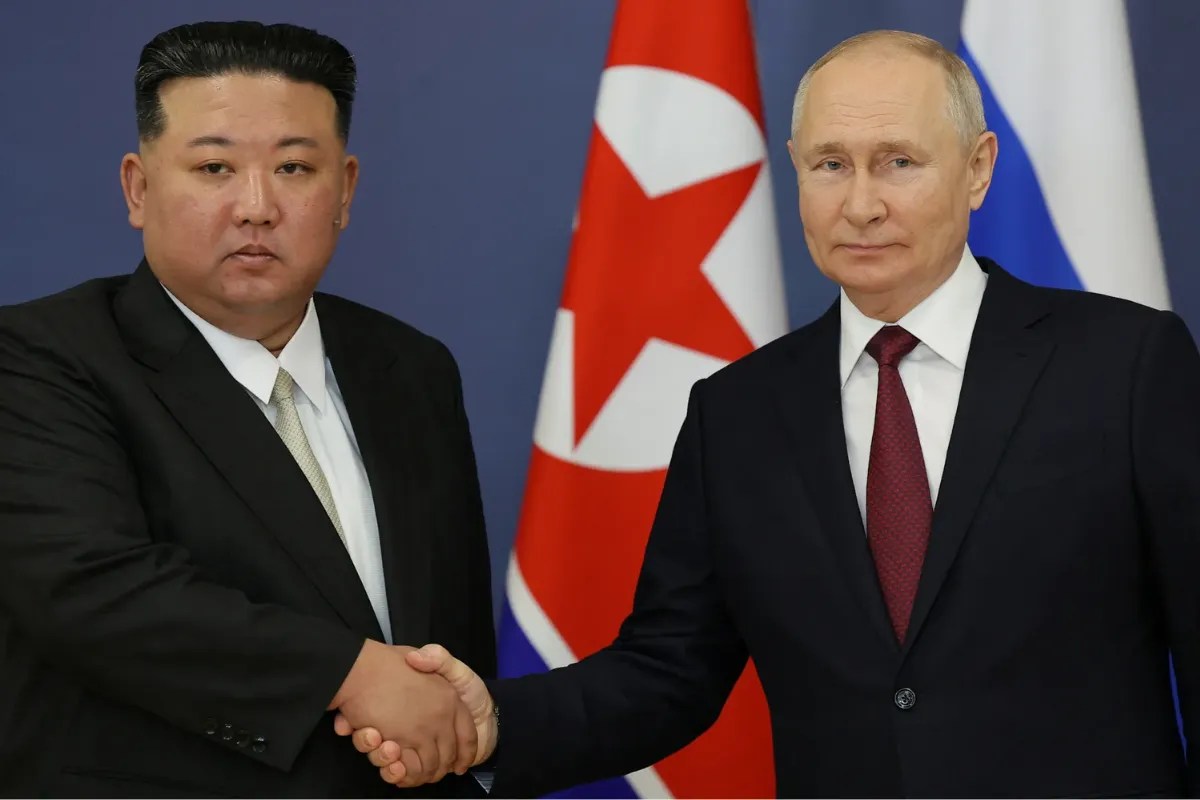
The transactional marriage between Vladimir Putin and Kim Jong-un has moved past the stage of symbolic handshakes into a cold, hard exchange of military hardware for high-end survival tech. This is not a friendship built on shared values; it is a logistical lifeline for a Russian military depleted by years of high-intensity attrition and a North Korean regime desperate for a technological leap. While Western observers focus on the spectacle of armored trains and gala dinners, the real story lies in the shipping containers moving across the Tumangang-Khasan border and the specific blueprints traveling back in the opposite direction.
Russia is burning through shells at a rate that would bankrupt most industrial economies. North Korea, effectively a massive munitions factory disguised as a nation-state, has the stockpile to keep the Russian guns firing. But Kim Jong-un is a shrewd negotiator who knows that his aging artillery shells are currently the most valuable currency in the world. He isn't trading them for cash or food alone. He wants the keys to the kingdom: satellite guidance, submarine propulsion, and the sophisticated telemetry required to make his nuclear deterrent credible.
The Logistics of Desperation
Russia entered its current conflict expecting a short campaign. Instead, it found itself in a meat-grinder that demands millions of rounds of 152mm and 122mm artillery ammunition. Domestic Russian production has ramped up, but it cannot match the sheer consumption on the front lines. Enter Pyongyang.
Satellite imagery has identified a steady flow of rail traffic and cargo vessels moving between North Korea’s port of Najin and Russia’s Dunay. These aren't empty crates. Intelligence estimates suggest that over five million shells have already changed hands. While Western analysts often mock North Korean tech as "vintage," a shell from the 1970s kills just as effectively as one made last week if it hits its target. For Putin, quantity has a quality all its own.
The problem for the Kremlin is that this dependency grants Kim significant leverage. For decades, Russia played the role of the responsible global power, occasionally chiding North Korea at the UN Security Council to maintain a veneer of international cooperation. That mask has slipped. By vetoing the renewal of the UN panel monitoring sanctions on North Korea, Moscow effectively dismantled the guardrails that kept Kim’s nuclear ambitions in check. This was the first major down payment on the artillery deal.
What Kim Wants in the Toolbox
Kim Jong-un has three primary gaps in his military capability: reliable satellite reconnaissance, quiet submarine technology, and advanced fighter aircraft. Russia possesses all three in abundance.
The failure of several North Korean satellite launches in recent years was a public embarrassment for the regime. However, the sudden success of the Malligyong-1 spy satellite followed closely on the heels of Kim’s visit to the Vostochny Cosmodrome. The timing was more than a coincidence. Russian engineers are likely providing the fine-tuning for the staging and separation mechanisms that previously plagued the North Korean space program.
The Underwater Threat
Perhaps more concerning is the transfer of naval technology. North Korea has long sought to develop a "second-strike" capability via Submarine Launched Ballistic Missiles (SLBMs). Their current fleet is noisy, diesel-powered, and easily tracked by US and South Korean sonar. If Russia shares even a fraction of its expertise in hull design or propulsion silencing, the tactical balance in the Pacific shifts overnight. A silent North Korean submarine lurking off the coast of Guam or Hawaii changes the math for the Pentagon.
The Fighter Gap
The North Korean Air Force is a flying museum. Their pilots train on airframes that belong in history books, making them easy prey for modern F-35s or F-15Ks. While Russia is hesitant to hand over its top-tier Su-57s, the transfer of Su-35s or even older Su-30 variants would provide a massive boost to Pyongyang’s ability to defend its airspace. This isn't just about dogfighting; it’s about the radars and electronic warfare suites that come with these jets.
The Failure of Traditional Sanctions
The international community is currently watching the total collapse of the sanctions regime. For thirty years, the strategy was to isolate North Korea until the cost of its weapons program became unbearable. That strategy relied on the consensus of the "Big Five" at the UN. With Russia now actively violating the very sanctions it once helped draft, the pressure cooker has a massive hole in the side.
Economic insulation is the new reality for both Moscow and Pyongyang. They are building a parallel economy that bypasses the US dollar and the SWIFT banking system. This "axis of the sanctioned" uses barter, cryptocurrency, and gold to settle accounts. When Russia pays for shells with oil, grain, and aerospace parts, there is no digital trail for the US Treasury to freeze. This makes the traditional toolkit of Western diplomacy—seizing assets and blocking bank transfers—almost entirely toothless.
Regional Shockwaves and the China Factor
While the world watches the Russia-North Korea axis, Beijing is watching with a mixture of interest and irritation. China views North Korea as its private backyard. Seeing Moscow move in as the primary benefactor disrupts Beijing’s influence over Kim. However, a stronger North Korea that distracts US military assets away from the Taiwan Strait serves China’s long-term interests.
South Korea, meanwhile, is facing a nightmare scenario. For years, Seoul maintained a delicate balance, refusing to send lethal aid to Ukraine to avoid upsetting its relationship with Russia. That restraint has yielded nothing. Now, Seoul is openly discussing the possibility of sending its own high-quality tanks and artillery to Kyiv as a direct response to Russian-North Korean cooperation. We are seeing a localized conflict in Eastern Europe trigger a massive rearmament cycle in East Asia.
The technological transfer isn't a one-way street, either. North Korea’s willingness to test its missiles in a real-world combat environment—against Western air defense systems like the Patriot—provides Russia with invaluable data. They are learning how North Korean KN-23 missiles perform against NATO-standard interceptions. This data is fed back into the design loop, making the next generation of missiles harder to stop.
The Shell Game’s End Point
The world is currently witnessing a fundamental shift in the global security architecture. The era where Russia worked with the West to contain "rogue" states is over. In its place is a transactional realism where survival outweighs international law.
This deal is not without risks for Putin. Relying on North Korea signals a profound weakness in the Russian industrial base. It tells the world that the "Second Strongest Army" cannot sustain itself without the help of a pariah state. For Kim, the risk is simpler: he is betting his entire future on a Russian victory. If Russia falters, Kim loses his only significant patron and faces an even more emboldened and angry West.
The containers continue to roll across the border. Every trainload of shells buys Russia another week of offensive operations, and every Russian technician arriving in Pyongyang brings Kim one step closer to a nuclear force that cannot be ignored or dismantled. The price of these shells will be paid in the destabilization of the Pacific for the next twenty years.
The true danger isn't just the weapons being used today, but the knowledge being handed over for tomorrow. When a nuclear-armed state with nothing to lose gains access to the sophisticated military secrets of a desperate superpower, the old rules of deterrence no longer apply. The board has been flipped, and the pieces are being set for a much longer, much more dangerous game.
The West’s habit of dismissing North Korean technology as "crude" is a luxury that military planners can no longer afford. Every shipment of oil that enters the port of Nampo is a deposit into a bank of future aggression. Every blueprint for a miniaturized warhead or a solid-fuel rocket motor that leaves Moscow is a permanent scar on the global non-proliferation effort. This is the reality of the new geopolitical marketplace: everything is for sale if you have enough artillery to pay for it.