The air inside a high-stakes Washington ballroom possesses a specific, pressurized weight. It is a mix of expensive cologne, the metallic tang of overheating stage lights, and the hushed, frantic energy of people who believe they are at the center of the universe. When you are the former president of the United States, that pressure is your natural habitat. You don't just breathe it; you command it.
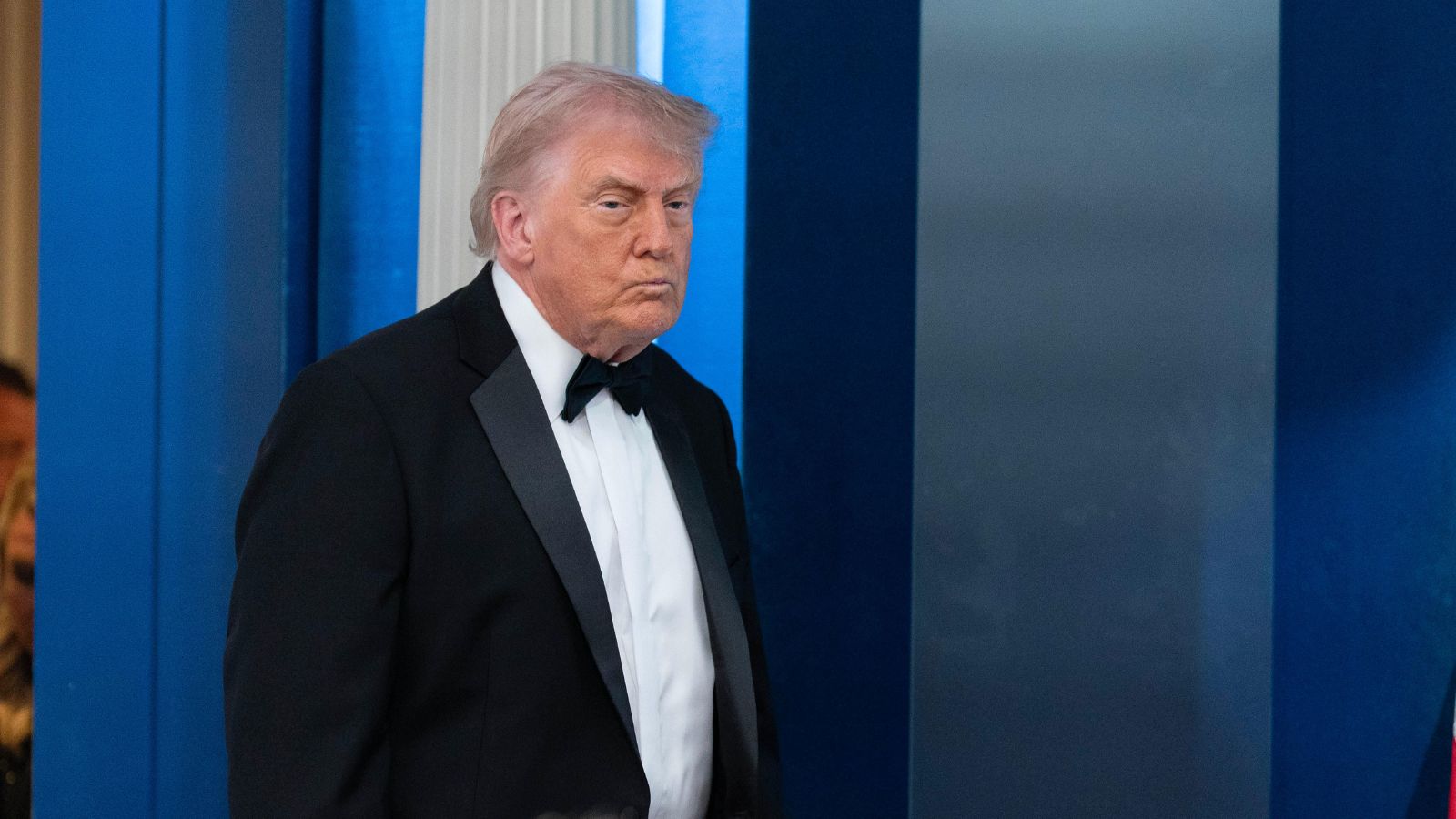
Donald Trump stood at the podium during the Alfalfa Club dinner, a venue defined by its elite guest list and its tradition of lighthearted roasting. It was meant to be an evening of sharp wit and softened edges. Then, the rhythm broke. A disturbance in the back of the room—a sudden, sharp movement, the frantic shouting of security details, and the visceral realization that the perimeter had been breached.
Security protocol dictates a very specific set of movements in these moments. The Secret Service becomes a single, multi-limbed organism designed to cover, move, and evacuate. But as the agents surged forward, the man at the center of the fray didn't flinch. He didn't duck. He watched.
There is a psychological phenomenon often described by those who spend their lives in the crosshairs. It’s not bravery in the classical sense, nor is it a lack of fear. It is a profound, almost eerie detachment. When the world starts spinning into chaos, some people accelerate to match the speed of the crisis.
The Anatomy of Indifference
Most of us spend our lives building shells of safety. We check the locks twice. We avoid dark alleys. We calculate risk in every grocery store line and morning commute. To the average person, the idea of a security scare in a room full of the world’s most powerful people is the stuff of nightmares. It represents the ultimate breakdown of order.
Trump’s reaction to the incident—a shrug of the shoulders and a comment about living in a "crazy world"—reveals a chillingly logical worldview. If you accept that the world is inherently broken, you stop being surprised when the shards start flying. You don't panic when the glass breaks because you never expected the window to hold in the first place.
Consider the mental load of that perspective. To walk into every room knowing that a percentage of the population views your existence as an obstacle to be removed requires a specific kind of internal hardening. It is the scar tissue of a decade spent in the most aggressive political arena in modern history. The man wasn't worried because worry is a tax paid by those who still believe in the predictability of the status quo.
The Invisible Shield of Public Life
The facts of the evening are straightforward. An individual attempted to disrupt the event. The Secret Service neutralized the threat within seconds. No shots were fired. No one was physically harmed. On paper, it was a minor blip in a long career of high-tension events.
But the human element tells a different story. It tells the story of a culture that has become so desensitized to political violence that a potential assassination attempt or a violent disruption is treated as a conversational footnote. We have moved past the era of shocked silence. Now, we just check the headlines and move on to the next outrage.
Imagine a hypothetical staffer working that night. Let's call her Sarah. Sarah is twenty-four, ambitious, and currently hiding under a table covered in white linen. To her, the "crazy world" isn't a philosophical observation; it’s a physical threat. Her heart is hammering against her ribs like a trapped bird. She sees the boots of the security detail rushing past. She hears the muffled grunts of a struggle. For Sarah, the world has just ended.
Ten minutes later, the dinner resumed. The steaks were served. The wine was poured. The gap between Sarah’s terror and the candidate’s nonchalance is where the real story lives. It is the chasm between the governed and those who seek to govern. One side feels the fragility of life; the other has integrated that fragility into their brand.
A Masterclass in Narrative Control
There is a power in refusing to be a victim. In the immediate aftermath, Trump didn't lean into the trauma of the event. He didn't call for a national day of mourning or retreat behind even thicker walls of glass. Instead, he folded the chaos into his existing narrative. By labeling the world "crazy," he positioned himself as the only sane observer left standing.
It is a brilliant, if instinctive, bit of psychological theater. If the world is crazy, then the traditional rules of engagement no longer apply. If the world is crazy, then the aggression directed toward you is merely proof of your importance. It turns a security failure into a badge of honor.
We often mistake this for ego, but it’s actually a survival mechanism. In the high-altitude atmosphere of global politics, admitting to fear is like admitting to a leak in your oxygen tank. You don't do it. You just keep climbing and hope the person next to you doesn't notice the blue tint of your fingernails.
The Cost of Constant Vigilance
The human brain wasn't designed to live in a state of permanent "Code Red." Biologically, the stress response is meant to be a temporary spike—a burst of cortisol to help you outrun a predator, followed by a long period of rest. When you live in the spotlight of the American presidency or a high-profile campaign, that spike never resets. It becomes the baseline.
This constant state of hyper-vigilance changes a person. It narrows the focus. It makes the world smaller, weirder, and more tribal. You stop seeing people and start seeing "assets" or "threats." The "crazy world" becomes a self-fulfilling prophecy because when you treat every interaction as a potential ambush, you eventually provoke the very hostility you're guarding against.
The Alfalfa Club dinner incident wasn't just a failure of security; it was a symptom of a fever that hasn't broken. We are living in an era where the proximity to violence is considered a standard job requirement for public service. We’ve traded the "smoke-filled rooms" of old-school politics for rooms filled with tactical gear and earpieces.
The Spectacle of the Unmoved
Watching the footage of the event, or reading the transcripts of the aftermath, one is struck by the stillness. In a room of frantic movement, the center remained motionless. There is something hypnotic about a person who refuses to react the way they are supposed to. It breaks the social contract. We expect our leaders to be human, to show a flicker of vulnerability, to acknowledge the gravity of a threat.
When they don't, it creates a vacuum. We fill that vacuum with our own projections. To his supporters, that lack of worry is proof of strength—a stoicism that borders on the superhuman. To his detractors, it is proof of a fundamental disconnect from reality, a lack of empathy for the danger others might be in.
The truth is likely much simpler and much more exhausting. He wasn't worried because he had already priced the danger into the cost of doing business.
The "crazy world" comment isn't an excuse. It’s an epitaph for a version of America that no longer exists—a place where political disagreements ended at the water's edge or the ballroom door. That America has been replaced by a landscape where the perimeter is always being tested, where the "scare" is just another Tuesday, and where the man at the podium knows that the only way to stay standing is to never, ever look down.
The lights in the ballroom eventually dimmed. The guests went home to their secure compounds and gated communities. The man at the center of the storm boarded a plane to do it all again the next day. The steak was cold, the joke was told, and the world kept on being exactly as crazy as he said it was.
Beneath the bravado and the tactical vests, there is a lingering question that no one in that room wanted to answer. What happens to a society when its most public figures stop being worried about the violence directed at them? When the "crazy" becomes the "ordinary," the walls aren't just there to keep people out. They're there to keep the reality of our own volatility from sinking in.
The most dangerous part of the Washington dinner wasn't the person who tried to break in. It was the ease with which everyone—the target, the guests, the media—brushed the dust off their tuxedos and kept on eating.