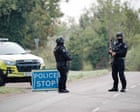
When three suspicious vans rolled toward the perimeter of RAF Fairford in Gloucestershire, they didn't just trigger local bomb disposals and an evacuation of 85 nearby households. They blew open a much larger, darker narrative about foreign-state proxy operations unfolding quietly on British soil. For weeks, official statements danced around the elephant in the room. British authorities urged calm, local police kept cards close to their chests, and speculation ran wild.
Then, federal prosecutors in New York unsealed a sweeping terrorism indictment that connected the dots. Suddenly, a localized Gloucestershire security scare wasn't just an isolated incident. It looked like a single, terrifying node in a broader, Iran-backed campaign targeting Western military assets and Jewish communities.
How the Plot Unfolded in Gloucestershire
Let's look at what actually happened on the ground. In late September, surveillance and intelligence pointed toward a coordinated movement. Three vans fitted with sham commercial branding—disguised as a fuel delivery service and a pool supply company—set off toward the sprawling military installation used heavily by the United States Air Force. Inside, operatives allegedly packed fuel drums, chemical accelerants, and metal items meant to act as shrapnel.
British security forces intercepted the vehicles at roadblocks. Army bomb disposal specialists moved in, controlled detonations echoed near Whelford, and multiple men were initially arrested. While those suspects were initially bailed, the gravity of the threat became clear fast. Two men were later formally charged under the strict parameters of the National Security Act for assisting a foreign intelligence service.
The immediate fallout was severe. The United States military didn't wait around to see if lightning would strike twice. Washington promptly withdrew its long-range strategic bombers—the B-1 Lancers stationed at Fairford—flying them back across the Atlantic. When a foreign plot forces the Pentagon to reposition strategic nuclear-capable assets, you know the threat assessment behind closed doors was grim.
The New York Indictment Connects the Global Dots
The real breakthrough in understanding the motivation didn't come from London. It came from a federal courtroom in Manhattan. US prosecutors laid out a sprawling conspiracy involving a network of operatives orchestrated on behalf of Iran-backed groups.
According to the indictment, a key figure named Mohammed Ali Al-Hassani operated as a central handler. While communicating from abroad, Al-Hassani allegedly began paying local associates in Britain to scout the perimeter of RAF Fairford. But the Fairford operation wasn't an anomaly. The same network was allegedly tied to a wave of nearly 20 violent acts and attempted attacks spanning multiple European countries and the United States, including arson targeting Jewish community centers and synagogues.
Perhaps most bizarrely, the indictment revealed that another co-conspirator, detained in a Brooklyn jail following an arrest earlier in the year, managed to keep managing the enterprise. Using coded messages and phone calls to family members back home, he checked on the status of what he called "work" and directed funds to be funneled to operatives like Al-Hassani for the Gloucestershire operation.
Tehran's Denials Versus Western Intelligence
Predictably, the Iranian embassy in London dismissed the allegations as malicious and unfounded speculations. Tehran has routinely denied orchestrating proxy attacks on Western soil, framing such claims as western propaganda designed to escalate geopolitical tensions.
Yet, Western intelligence agencies aren't buying the denials. Prime Minister Andy Burnham publicly noted strong indications that Iran played a role in the weekend breach at Fairford, while senior US officials openly pointed to the unmistakable hand of a hostile foreign actor.
The reality is that the United Kingdom has increasingly become a psychological and operational theatre for simmering conflicts in the Middle East. When Britain allows allied nations to utilize its sovereign airbases for strategic power projection, it inherits the digital and physical blowback of those alliances. Proxy warfare no longer stays neatly contained within regional borders. It trickles down into suburban rental vans, local logistics disguises, and encrypted real-time directives beamed into the hands of local operatives.
The legal proceedings in New York and the ongoing national security prosecutions in London will eventually unearth every last detail of how a foreign state managed to recruit locally for a strike on a British-American military installation. Until then, the incident serves as a harsh reminder that the frontline of international conflict is no longer thousands of miles away—it's parked right down your street.