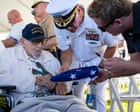
The media loves a tear-jerker about closure. It sells. It feels noble. It suggests that with enough silicon and sequencing, we can mend the holes in history. The recent fixation on disinterring unidentified Pearl Harbor victims because of "DNA milestones" isn't a triumph of science—it’s a failure of prioritization. We are witnessing the bureaucratic equivalent of an expensive vanity project, fueled by a fundamental misunderstanding of what forensic DNA can actually achieve for seventy-year-old remains.
The consensus says we owe it to the families. The reality is that we are trading the dignity of the dead for a high-tech lottery ticket that most families never asked for.
The Myth of the Universal ID
The public has been fed a CSI-style fantasy where a technician drops a bone fragment into a centrifuge and a name pops out on a screen. Forensic reality is messier. When we talk about the unidentified remains at the National Memorial Cemetery of the Pacific, we aren't talking about pristine samples. We are talking about commingled remains subjected to extreme thermal trauma and decades of environmental degradation.
The "milestone" isn't a magic wand. It is an incremental improvement in Single Nucleotide Polymorphism (SNP) analysis and mitochondrial DNA sequencing. But $DNA$ isn't a database of every human who ever lived. It requires a viable reference sample. In many cases, the direct maternal or paternal lines required for older testing methods have thinned out or vanished. Even with modern autosomal DNA, you are looking at distant cousins whose genetic overlap with the fallen is so slight it produces more "maybe" than "definitely."
We are digging up graves to find maybes.
The Opportunity Cost of Nostalgia
Let’s talk about the money. Forensic identification is an astronomical expense. A single complex case involving commingled remains can cost tens of thousands of dollars in lab time, anthropological analysis, and administrative overhead. Multiply that by hundreds of sets of remains, and you are looking at a budget that could fund actual, living veteran services for a decade.
I’ve seen forensic budgets balloon while active duty housing crumbles. If you have $50 million to spend, do you spend it on identifying a sailor who died in 1941, or do you spend it on preventing the suicide of a soldier who returned in 2024? This isn't a cold-hearted calculation; it's a moral one. We have a finite amount of specialized talent and high-throughput sequencing capacity. Redirecting those resources toward cold cases from nearly a century ago is a luxury we can't afford while modern forensic backlogs for violent crimes—where perpetrators are still walking the streets—remain in the hundreds of thousands.
The Dignity of the Unknown
There is an arrogance in the modern belief that everything must be categorized and indexed. The "Unknown Soldier" wasn't a placeholder for a future tech solution; it was a profound acknowledgement of the collective sacrifice. By insisting on individual identification, we are stripping away the symbolic power of the communal tomb.
When we disinter these men, we break the "permanent" rest we promised them. For what? So a great-great-grandniece who never knew them can have a name on a headstone? Most families have already found their own version of closure. They have the stories, the faded photos, and the empty chairs at Thanksgiving that have been empty for three generations. Forcing a physical homecoming eighty years later is often more disruptive than it is healing.
Technical Realities the Press Ignores
Standard forensic labs aren't equipped for this. This work requires specialized ancient DNA (aDNA) protocols—the kind used for Neanderthals or Bronze Age bog bodies. These labs are rare. The process involves:
- Destructive Testing: You have to grind the bone to powder. To identify the person, you must destroy part of what remains of them.
- The Bioinformatic Nightmare: Dealing with "low-copy number" DNA means the risk of contamination is through the roof. One stray skin cell from a lab tech in 1995 can lead to a false positive that ruins the entire sequence.
- Commingling Chaos: In many Pearl Harbor cases, individual "remains" are actually parts of multiple people. You don't just identify "the sailor." You have to identify "the left humerus" and "the right femur," which might belong to two different men.
If you think this leads to a clean, easy funeral, you haven't seen the paperwork.
The Policy of False Hope
Government agencies like the Defense POW/MIA Accounting Agency (DPAA) are under immense political pressure to "bring them home." This pressure leads to the "disinterment first, ask questions later" approach. They dig, they test, and when the DNA is too degraded to provide a match, those remains sit in a cardboard box in a climate-controlled lab for years.
They were more at peace in the ground.
We need to stop pretending that every technological leap mandates a retroactive search. The "People Also Ask" sections on search engines are full of queries like "How many Pearl Harbor victims are still missing?" or "Can DNA identify all WWII soldiers?" The honest answer is: No. And we shouldn't try. The goal of forensic science should be justice for the living, not a data-entry exercise for the dead.
Stop the disinterments. Let the Pacific keep its secrets. Use that money to fix the VA, clear the rape kit backlog, and support the families of soldiers who are actually missing today.
History is a tragedy, not a puzzle to be solved until the last piece fits.