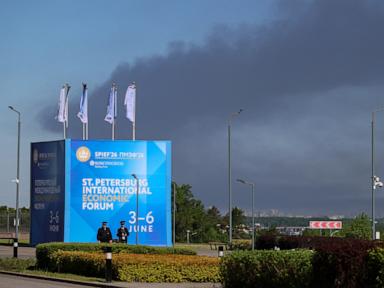
The champagne at the St. Petersburg International Economic Forum is always perfectly chilled. For decades, this event has been designed as a gilded mirror, reflecting back to the world an image of flawless, impenetrable Russian economic might. Under the soaring ceilings, billionaires rub shoulders with state officials, discussing investments and oil futures over plates of caviar. It is an environment meticulously engineered to block out the rest of the world.
But no architectural marvel can block out the sky.
Early in the morning, just as the delegates were waking up in their luxury hotels, a low, persistent buzz hummed over the Gulf of Finland. It was a sound that didn't belong to the sleek infrastructure of Russia’s second city. It was the sound of a cheap, lawnmower-style engine carrying explosives. Moments later, the air defense systems rattled the windows of the suburbs. A Ukrainian long-range drone, having traveled over a thousand kilometers from the border, crashed into an oil refinery on the outskirts of the city.
The illusion shattered.
To understand the real weight of this strike, we have to look past the military briefings. The strategic target wasn't just a collection of steel pipes and fuel tanks. The true target was the psychological armor of the Russian elite. For two years, the war was something that happened somewhere else—a distant, televised event affecting border towns and muddy trenches in the Donbas. St. Petersburg was supposed to be safe. It was supposed to be open for business.
Consider a hypothetical investor sitting in that conference hall. Let’s call him Mikhail. Mikhail spent the last month reviewing spreadsheets, calculating risks, and convincing himself that the domestic market is stable enough for a massive new logistics project. He sits in a velvet chair, listening to a panel discussion about shifting trade routes to Asia. Then, a notification vibrates against his chest. A drone has hit an oil depot just a few miles away. The data on his screen suddenly feels entirely irrelevant. The risk profile of his entire portfolio has just changed in the span of a heartbeat.
This is the new reality of asymmetric warfare.
Ukraine has systematically expanded its reach, turning the sky into a fluid, unpredictable front line. The drones used in these attacks are not multimillion-dollar stealth bombers. They are relatively crude, slow-moving aircraft built in hidden workshops, powered by basic GPS navigation and packed with just enough explosives to cause a catastrophe if they hit the right pressure valve. They are inexpensive to build but astronomically expensive to defend against.
Russia’s air defense grid was built for a different century. It was designed to intercept massive, fast-moving Western missiles and fighter jets. Detecting a composite-material drone that flies low to the tree line and mimics the radar cross-section of a large bird is an entirely different nightmare. To protect a single economic forum, the military must redirect scarce radar units and missile batteries away from the actual combat zones in the south and east. Every battery deployed to guard a billionaire’s hotel is one less battery protecting a supply depot near Avdiivka.
The choice is brutal. Protect the frontline, or protect the narrative.
For the Kremlin, the narrative is an essential currency. The St. Petersburg forum was meant to prove to global allies—and to the Russian public—that Western sanctions have failed, that the economy is growing, and that life carries on with aristocratic normalcy. The state media reports focused heavily on foreign delegations from Africa, Asia, and the Middle East, attempting to showcase a multipolar world that doesn’t need Europe.
But smoke has a way of ruinous honesty. You can censor the newspapers, and you can block the independent news sites, but you cannot hide a column of black oil smoke rising against the morning horizon.
The geography of this strike tells a story of profound vulnerability. St. Petersburg is Vladimir Putin’s hometown. It is his window to the West, the city where he began his political career. Hitting this specific location during his flagship economic event is a deeply personal message. It says, with terrifying clarity, that nothing is untouchable. The war cannot be compartmentalized. It cannot be kept in the provinces.
What happens to an economic ecosystem when the sky becomes an active variable? Insurance premiums for shipping vessels in the Baltic Sea skyrocket. Foreign executives, already skittish about reputational risks, look at the security briefings and quietly cancel their flights. Domestic business owners look at their factories and wonder if they need to invest in private electronic jamming equipment rather than new manufacturing machinery. Capital, by its very nature, craves predictability. It flees from the sound of explosions.
The battlefield is no longer defined by trenches and barbed wire. It is defined by the range of a lithium-ion battery and the precision of a commercial guidance chip. As the delegates in St. Petersburg finished their coffee and walked into the high-security exhibition halls, the air outside smelled faintly of burning petroleum. The speeches went on, the handshakes were photographed, and the state television broadcasts maintained their triumphant tone.
But every person in that room knew that the ceiling above them was no longer solid.