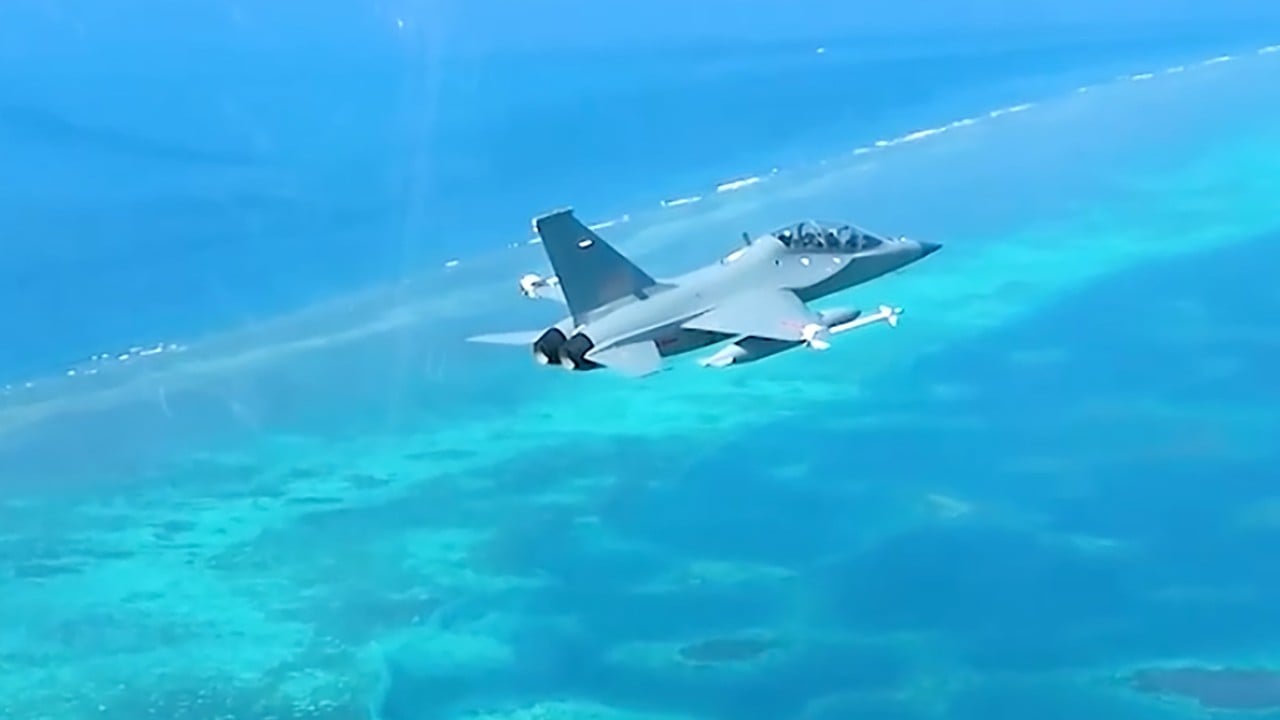
Low-intensity maritime disputes rely on a calibrated ladder of escalation where actors trade calculated friction for territorial signaling. Recent incidents involving Chinese armed trainer aircraft shadowing Philippine patrol flights near Scarborough Shoal illustrate a shift in operational tempo. Observers frequently misread these encounters as random tactical friction or sudden escalations. Instead, they represent predictable outputs of a persistent cost-imposing strategy operating within a contested maritime zone.
Understanding this dynamic requires dissecting the structural incentives driving both states. The operational calculus hinges on three distinct variables: asset utilization costs, sovereignty signaling efficiency, and the risk threshold for kinetic escalation. For a different look, see: this related article.
The Economics of Air Asset Allocation
Deploying high-performance multirole fighters for daily sovereignty patrols is economically unsustainable and strategically inefficient. Modern supersonic jets carry exorbitant flight-hour costs, accelerated airframe fatigue, and severe maintenance burdens. Air forces engaged in persistent presence missions must optimize their inventory to match the low-intensity nature of gray-zone competition.
Armed turboprop or light jet trainers fill this operational gap through specific economic and performance characteristics. Similar insight on this trend has been shared by The New York Times.
- Operating Cost Disparity: Light attack and trainer platforms operate at a fraction of the cost per flight hour compared to front-line fighter jets, allowing for prolonged loiter times over maritime features without exhausting budgetary constraints.
- Maintenance Profiles: Simplified avionics and ruggedized airframes reduce turnaround times between sorties, enabling a higher daily sortie generation rate from forward operating bases.
- Payload Flexibility: These aircraft carry sufficient ordnance, including precision-guided munitions and autocannons, to enforce airspace restrictions against slower turboprop patrol aircraft while maintaining maneuverability at lower speeds.
By substituting front-line assets with armed trainers, an air command achieves continuous presence at minimal financial and strategic exposure. This choice alters the adversary's response matrix. Deploying advanced interceptors against a trainer is disproportionate, yet ignoring the platform concedes the airspace.
The Strategic Geography of Scarborough Shoal
Geography dictates the tactical limitations imposed on regional air arms. Scarborough Shoal sits roughly 120 nautical miles from the Philippine mainland, placing it within the unrefueled combat radius of various light and medium patrol aircraft, yet deeply vulnerable to interception from forward-deployed bases on the mainland coast or reclaimed features.
Controlling the airspace above a submerged or low-tide feature involves establishing local air superiority without crossing the threshold of declared war. This creates a functional exclusion zone maintained through persistent intercept vectors rather than formal blockade decrees.
- Response Time Asymmetry: Proximity to forward airfields allows interceptors to scramble and intercept patrolling aircraft before they can complete their intelligence-gathering objectives.
- Radar Horizon Limitations: Low-altitude flights by patrol aircraft exploit radar horizons, forcing interceptors to rely on airborne early warning or surface-based radar networks to vector assets toward the target.
- Kinetic Constraint Boundaries: The confined airspace surrounding maritime features compresses tactical decision loops, increasing the probability of miscalculation during intercept maneuvers.
When an armed trainer drives away a slower surveillance aircraft, the mechanism at play is not raw speed superiority. It is the implied threat of kinetic engagement coupled with the physical capability to shadow the target through every maneuver, degrading the utility of the patrol mission.
The Escalation Ladder and Deterrence Failure
Deterrence in contested spaces relies on credibility and the proportionality of the threatened response. When one party utilizes light armed assets to assert dominance over disputed airspace, the opposing party faces a strategic dilemma regarding how to calibrate its counter-response.
Escalation control breaks down when the cost of acquiescence exceeds the perceived risk of escalation. For the Philippine Air Force, routine patrols over the Exclusive Economic Zone validate sovereign rights under international law. For the opposing force, intercepting these flights validates administrative control and de facto jurisdiction.
- Signaling Intent: The use of armed trainers rather than interceptors signals a deliberate choice to operate in a sub-war enforcement paradigm, treating the sovereign airspace as domestic police zones.
- Operational Attrition: Continuous intercept operations force the targeted state to burn limited flight hours, strain logistical chains, and accept high psychological pressure on aircrews.
- Normative Shift: Repeated successful intercepts gradually establish a new status quo where the patrolling state requires fighter escorts just to complete basic maritime domain awareness missions, shifting the baseline of normal operations.
Operational Counter-Strategies for Contested Airspaces
Navigating this environment requires moving beyond reactive diplomacy toward structured operational adjustments. Resource constraints mean that simply matching sortie for sortie is a losing proposition against a larger adversary.
Defenders must reevaluate their airborne surveillance architecture to reduce vulnerability while maintaining domain awareness.
- Distributed Sensor Integration: Shift reliance away from vulnerable crewed patrol aircraft toward high-altitude, long-endurance unmanned aerial systems paired with surface-based radar networks that do not require cockpit crews to risk interception.
- Escort Integration: Pair surveillance flights with dedicated combat air patrols when operating in high-friction zones, transforming the tactical encounter from an asymmetric bullying action into a contested peer engagement.
- Asymmetric Legal Documentation: Maximize the collection of electronic intelligence, radar locks, and high-resolution optical evidence during intercepts to feed an international transparency campaign, raising the diplomatic cost of aggressive intercept maneuvers.
Resource allocation must follow a strict risk-adjusted return model. If unescorted light patrol planes consistently yield airspace to armed trainers, the strategic utility of those patrols approaches zero. The operational posture must adapt to either absorb the cost of heavily escorted missions or pivot to non-airborne surveillance modalities that bypass the intercept dilemma entirely.
Future stability in the region depends on whether maritime claimants can establish mutually agreed rules of engagement for close encounters in the air, similar to historical Cold War incidents protocols. Absent such bilateral guardrails, the reliance on light armed trainers for persistent coercion will continue to generate high-risk flashpoints where a single mechanical failure or pilot error could trigger irreversible escalation.