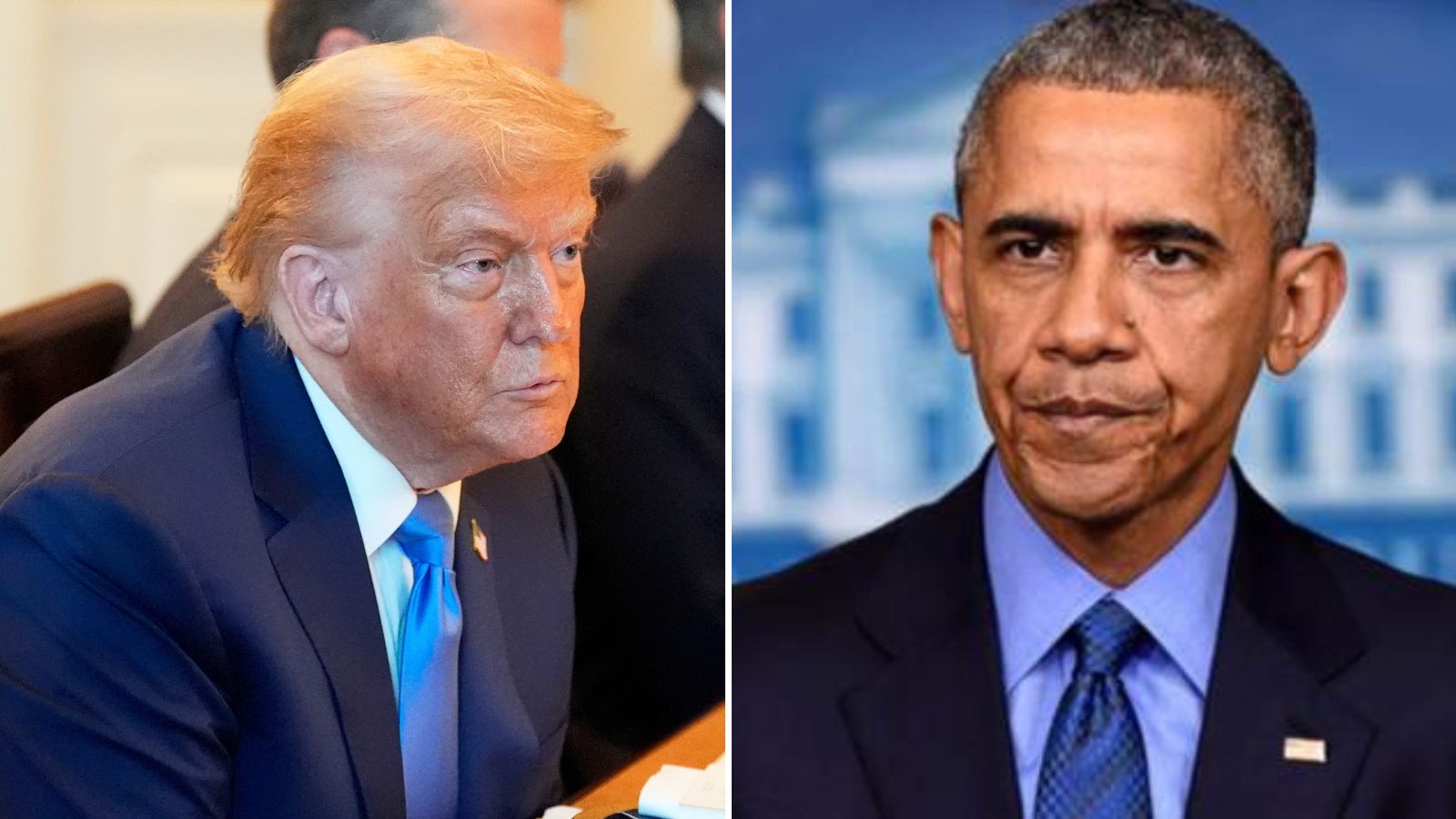
The mainstream political press is addicted to junk food. Every time Donald Trump and Barack Obama trade barbs, cable news anchors and digital editors gorge themselves on the spectacle like teenagers at an all-you-can-eat buffet.
The latest feeding frenzy revolves around a throwaway joke about the Cheesecake Factory. Obama mocked Trump’s obsession with crowd sizes and grievances, comparing his rambling rally speeches to someone complaining about the portion sizes at a chain restaurant. Trump, true to form, fired back, calling Obama "not smart" and a "lousy president."
Legacy outlets immediately ran with the lowest-hanging fruit. They framed it as a clash of titans, a clash of styles, or another chapter in a decade-long personal vendetta. That framing is lazy, profitable, and completely backwards.
If you are clicking on articles to see who "won" the Cheesecake Factory exchange, you are falling for the oldest magic trick in modern politics. While your eyes are glued to the shiny object of presidential insults, the actual machinery of political persuasion is shifting right beneath your feet. This isn't a story about thin skin or sharp wit. It is a masterclass in how two entirely different eras of political communication collide—and why the old rules of decorum are dead for good.
The Myth of the "Presidential" Standard
Political commentators love to clutch their pearls over tone. Whenever Trump calls a predecessor "not smart," the pundit class immediately writes five hundred words lamenting the death of presidential dignity. They treat Obama’s measured, professorial cadence as the gold standard and Trump’s schoolyard insults as an aberration.
This is historical amnesia. American politics has never been a polite parlor game.
In 1800, Thomas Jefferson’s surrogates called John Adams a "hideous hermaphroditical character." In 1828, Andrew Jackson’s opponents accused his wife of bigamy and labeled his mother a prostitute. Abraham Lincoln was routinely depicted in the press as an ape.
The idea that the American presidency was an unbroken chain of dignified statesmen until 2015 is a fabrication invented by people who only started paying attention to politics during the West Wing era. What we are witnessing between Obama and Trump isn't the collapse of norms; it is the restoration of the bare-knuckle brawling that defined the nineteenth century, amplified by twenty-first-century algorithms.
The Trap of the High Road
Obama’s strategy relies on an outdated assumption: that voters reward the adult in the room.
For eight years, Michelle Obama’s motto—"When they go low, we go high"—served as the theological bedrock of the Democratic establishment. Yet, in the Cheesecake Factory moment, Obama went low. He didn't offer a nuanced critique of Trump’s tariff proposals or his judicial appointments. He mocked his rival's masculinity and rambling speech patterns using a suburban chain restaurant as the punchline.
Why? Because the high road is a dead end in an attention economy.
I have spent fifteen years analyzing political media buys and voter sentiment data. I have watched campaigns burn tens of millions of dollars on high-minded, policy-dense television spots that moved the needle by zero percentage points. Meanwhile, a thirty-second clip of a candidate landing a visceral, relatable insult generates millions of earned media impressions for free. Obama knows this. His shift from soaring rhetoric to sharp-elbowed mockery is an admission that Trump’s playbook works. You cannot beat a street fighter with a rulebook.
Decoding the Cheesecake Factory Metaphor
To understand why this specific exchange stuck, you have to look at the cultural subtext. Politics is downstream from culture, and few brands represent the American middle-class psyche quite like the Cheesecake Factory.
It is aspirational yet accessible. It offers a menu the size of a phone book, massive portions, and an illusion of luxury wrapped in faux-Tuscan drywall. It is the exact demographic battleground that decides presidential elections: the suburban swing voter in Pennsylvania, Michigan, and Wisconsin.
When Obama uses that specific setting to mock Trump, he is attempting a delicate surgical strike. He is trying to separate Trump from the working- and middle-class voters who view him as their champion. Obama’s subtext is clear: This billionaire doesn't actually care about you; he’s just a cranky elitist complaining about his dinner.
Why Trump’s Counterpunch Landed
Most political strategists argued that Trump walked right into Obama’s trap by responding. Conventional wisdom says that when a rival gets under your skin, you ignore them to project strength.
Conventional wisdom is wrong.
Trump’s brand is built entirely on asymmetrical retaliation. If you hit him with a feather, he hits you back with a sledgehammer. By calling Obama "not smart" and a "lousy president," Trump instantly flattened the nuance of Obama’s joke.
Think about the cognitive load required to process both statements:
- Obama’s approach: Requires you to follow a multi-sentence setup, appreciate the irony of the setting, and connect the metaphor to Trump’s rally behavior.
- Trump’s approach: Two words. "Not smart."
In a media environment where the average user scrolls past a headline in 1.7 seconds, simplicity wins every single time. Trump doesn't care about winning the debate at the Harvard Kennedy School. He cares about dominating the chyron at the bottom of the television screen while people are eating dinner. By reducing a sophisticated comedic jab to a blunt-force insult, he forced every media outlet in the country to repeat his exact words in their headlines.
What People Are Actually Asking (And Why It’s Wrong)
If you look at search trends surrounding this feud, voters are overwhelmingly asking variations of the same question: "Who won the argument between Trump and Obama?" or "Why does Trump insult Obama so much?"
These questions are fundamentally flawed because they treat politics like a courtroom drama where an impartial jury weighs the evidence and declares a winner.
There is no impartial jury. There are only entrenched tribes looking for ammunition.
If you already despise Trump, Obama’s Cheesecake Factory routine looks like a devastating takedown of a narcissistic strongman. If you already loathe Obama, his joke looks like the smug condescension of a coastal elitist looking down his nose at regular people, and Trump’s response feels like a cathartic punch in the mouth to the establishment.
Asking who "won" misses the entire point of modern political theater. Neither man is trying to persuade the other's base. They are engaged in base mobilization. The goal isn't conversion; it is turnout. Every time these two men trade insults, small-dollar donations spike on both sides of the aisle. Anger is the highest-converting currency in political fundraising, and both men are master bankers.
The Real Casualty of the Insult Economy
Here is the uncomfortable truth that neither side wants to admit: this mutual obsession is a massive distraction from actual governance.
While the press corps dissects every syllable of their personal animosity, critical structural issues rot in the background. We are staring down a $35 trillion national debt, an entitlement crisis that will bankrupt Medicare and Social Security within a decade, and a rapidly destabilizing global security architecture.
Neither a joke about restaurant portions nor a schoolyard taunt about intelligence solves a single supply chain bottleneck or lowers the cost of a grocery run.
The Downside of the Contrarian View
Now, it is easy to sit back and cynically dismiss all political rhetoric as meaningless theater. That is a trap, too. Words do matter, and the degradation of public discourse has real consequences.
When the highest office in the land is treated like a professional wrestling promo, it erodes institutional trust. If voters believe their leaders are just petty, vindictive celebrities, they stop believing in the legitimacy of the system itself. Over time, that cynicism breeds apathy, and apathy is the fertile soil where authoritarianism grows. So while the pearl-clutching of the mainstream media is hypocritical, the underlying anxiety about where this rhetoric leads is entirely valid.
How to Consume Political News Without Losing Your Mind
If you want to understand what is actually happening in Washington without getting played by media algorithms, you need to change how you process political conflict. Stop acting like a spectator and start acting like an analyst.
- Follow the money, not the microphone. Ignore what politicians say at rallies. Look at what they actually sign into law and where their campaign cash comes from. Rhetoric is free; budgets are policy.
- Identify the distraction. Whenever a story about a personal insult dominates the news cycle for more than 24 hours, ask yourself what boring, consequential legislation is being passed quietly in the background while everyone is looking the other way.
- Audit your emotional reaction. If a headline makes you feel an immediate surge of righteous anger or smug superiority, recognize that you are being manipulated. Journalists and strategists A/B test headlines specifically to trigger your amygdala. Do not give them the click.
- Watch the swing states, not the pundits. The commentary class in New York and D.C. lives in a bubble. Look at local news coverage in places like Erie County, Pennsylvania, or Maricopa County, Arizona, to see what actual deciding voters care about. Spoiler: it isn't the Cheesecake Factory.
The feud between Barack Obama and Donald Trump is the defining cultural clash of our era, pitting an institutionalist technocrat against a populist wrecking ball. It makes for incredible television, endless clicks, and effortless content for lazy journalists.
Just remember that while they are trading jokes about chain restaurants, you are the one paying the bill.