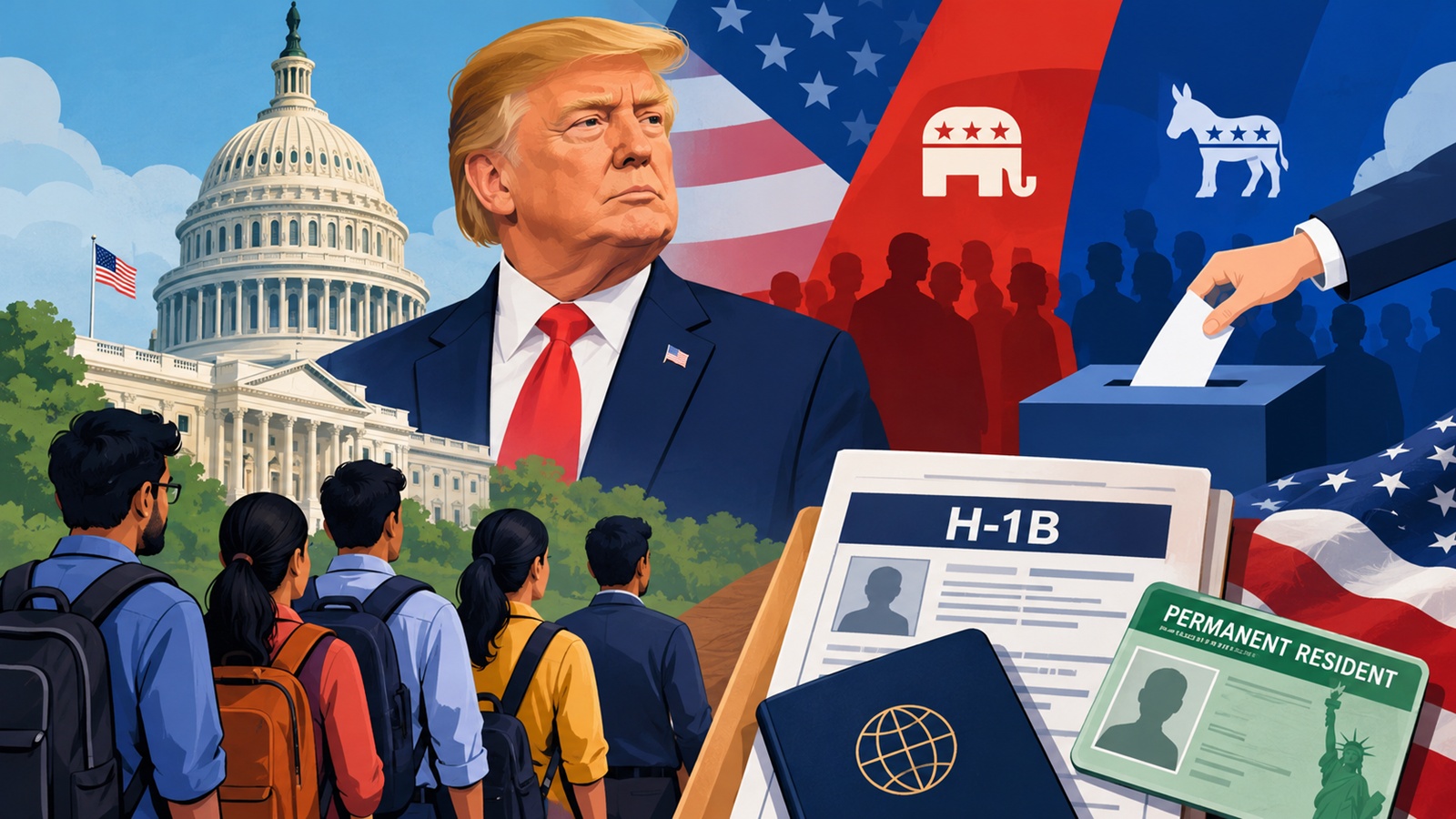
The November 2026 midterm elections handed control of Congress to the Democrats, immediately setting off a wave of hopeful speculation across WhatsApp groups and immigration forums from Bengaluru to San Jose. Here is the cold reality. The election results do not advance a single priority date, waive a single processing fee, or protect a single visa holder from executive enforcement. While a Democratic majority seating in January 2027 will act as a legislative firewall against the most aggressive anti-immigration bills currently sitting in committee, it cannot unilaterally rewrite the Immigration and Nationality Act over a presidential veto. For hundreds of thousands of Indian professionals trapped in decades-long permanent residency queues, the shift on Capitol Hill changes the political theater, not the immediate legal math.
To understand why, you have to separate legislative power from executive authority. The White House controls the Department of Homeland Security, the Department of State, and the Department of Labor. Congress controls the statute books and the purse strings. When those two branches belong to opposing parties, immigration policy enters a state of trench warfare. Discover more on a connected issue: this related article.
The Legislative Firewall Against Restrictive Bills
Before November 3, Indian tech workers and international students faced a barrage of restrictionist legislation introduced during the 119th Congress. With unified Republican control, several of those proposals threatened to upend the entire employment-based visa pipeline.
Consider S. 5097 and H.R. 8443, known as the End H-1B Visa Abuse Act of 2026. Introduced by Senator Tim Sheehy, the measure proposed a three-year moratorium on new H-1B visas alongside severe restrictions on dependent work authorizations and post-graduation employment programs for international students. Simultaneously, companion bills S. 5638 and H.R. 10799 sought to gut the H-1B-dependent employer exemption by replacing the static $60,000 salary threshold with a floating floor set at twice the national average wage index. Under current wage metrics, that adjustment would have pushed minimum compensation requirements well past $130,000 for many IT consultancies and staffing firms. More reporting by The Washington Post highlights similar views on the subject.
A Democratic majority in the House and Senate effectively kills those bills on arrival when the 120th Congress convenes in January 2027. Committee chairs set the legislative calendar. Democratic leadership in the House and Senate Judiciary Committees will simply refuse to grant hearings or floor votes to bills designed to freeze the H-1B program or dismantle Optional Practical Training (OPT). Furthermore, the new majority will block any legislative attempt to codify controversial executive actions, such as the administration's push to impose a massive $100,000 surcharge on certain visa petitions, which has already faced fierce pushback in federal courts.
Yet stopping bad bills is not the same as passing good ones.
Why the Green Card Backlog Will Not Budge
Every election cycle brings fresh promises to fix the employment-based green card queue. Every cycle ends in the same statutory dead end.
Under federal law, the United States caps employment-based permanent residency at 140,000 visas per fiscal year, distributed across five preference categories. Layered on top of that cap is a rigid 7% per-country ceiling. Because demand from Indian nationals vastly outstrips that 7% allocation, the backlog has grown into a generational trap. According to the Department of State's November 2026 Visa Bulletin, final action dates for Indian nationals sit at November 1, 2013 for EB-2 applicants and January 22, 2014 for EB-3 applicants.
Eliminating the per-country cap or recapturing unused visas from previous decades requires passing a bill through both chambers of Congress and securing the president's signature. Even if a Democratic House passes a clean green card relief bill, the Senate remains bound by the 60-vote filibuster threshold for standalone legislation. Assuming an immigration reform bill somehow clears the Senate, it still lands on the desk of a president who campaigned on tightening, not expanding, legal immigration pathways.
The Narrow Exception of Budget Reconciliation and Must-Pass Bills
When standalone bills fail, Washington turns to legislative riders attached to must-pass funding bills. Immigration advocates are already eyeing two specific vehicles for 2027.
- Protecting Documented Dreamers: Over 250,000 children who grew up in the United States as dependents of long-term visa holders face "aging out" of legal status the day they turn 21. Legislation modeled on the American Dream and Promise Act, which explicitly includes provisions for children of H-1B, L-1, E-1, and E-2 workers who entered the country before age 18, commands genuine bipartisan sympathy. Lawmakers could attempt to attach a targeted age-out freeze to an annual appropriations package.
- Healthcare Worker Carve-Outs: Rural hospital lobbies wield immense influence across red and blue states alike. Measures that exempt foreign-born physicians and nurses from green card caps or recapture unused healthcare visas stand a measurable chance of surviving a divided government.
For the average software engineer, financial analyst, or systems architect working in corporate America, however, broad green card relief remains politically dead until at least 2029.
The Executive Branch Still Holds the Hammer
Focusing entirely on Congress misses where the real operational pain originates. The daily friction experienced by Indian professionals stems from regulatory interpretation, agency adjudication standards, and consular processing—all of which sit squarely under White House control.
A Democratic Congress cannot stop U.S. Citizenship and Immigration Services (USCIS) from tightening its definition of a "specialty occupation" through policy memos or formal rulemaking. It cannot prevent the agency from issuing higher rates of Requests for Evidence (RFEs) on routine H-1B extensions, nor can it force the Department of Labor to alter prevailing wage calculations that price entry-level international graduates out of the market.
Even more critically, Congress has virtually no leverage over consular operations abroad. When an H-1B worker travels to Hyderabad, Chennai, or Mumbai for visa stamping, they enter a zone of near-absolute executive discretion. Administrative processing delays, heightened security vetting, and appointment backlogs can strand a worker outside the United States for months, jeopardizing their employment and separating them from their families. No committee subpoena can force a consular officer to approve a stamp.
The Oversight Lever and the $240 Billion War Chest
Where the new congressional majority can inflict political damage is through oversight. Starting in January 2027, House and Senate committees regain subpoena power. Expect aggressive hearings hauling USCIS directors, Department of Labor officials, and State Department bureaucrats before cameras to explain processing delays, worksite enforcement raids, and the economic fallout of talent attrition.
Public scrutiny forces agencies to defend their metrics in court. Documenting arbitrary adjudication shifts on the congressional record provides ammunition for business groups and immigration attorneys filing lawsuits under the Administrative Procedure Act.
What Congress cannot easily do is defund enforcement. Through budget reconciliation bills passed in 2025 and 2026, lawmakers already appropriated roughly $240 billion in multi-year funding for immigration enforcement and border operations. Because that money is already locked into agency accounts, withholding future discretionary funds during FY2027 appropriations fights will have limited immediate impact on worksite audits, I-9 inspections, or ICE operations.
The Bipartisan Blind Spot on Wage Floors
Indian professionals often assume that a Democratic victory automatically translates into uncritical support for the H-1B program. That assumption ignores a deep ideological fault line inside the Democratic caucus.
Progressive lawmakers and labor-aligned senators have long criticized corporate reliance on temporary guest workers. Senator Dick Durbin, a senior Democrat on the Senate Judiciary Committee, has spent years partnering with Republican Senator Chuck Grassley on the H-1B and L-1 Visa Reform Act. Reintroduced as S. 2928, the Durbin-Grassley bill proposes sweeping new wage mandates, strict recruitment rules requiring employers to offer jobs to qualified American workers first, and expanded Department of Labor enforcement authority to audit companies without waiting for a whistleblower complaint.
In a hypothetical scenario where a mid-sized IT services firm relies heavily on H-1B transfers to staff client projects, a Durbin-style reform package would be nearly as disruptive as a Republican restriction bill. While Democrats oppose outright visa bans and xenophobic rhetoric, a powerful faction of the party views the current H-1B system as a mechanism that depresses domestic tech wages. If any bipartisan compromise on skilled immigration emerges over the next two years, it will almost certainly include higher mandatory salary thresholds and stricter curbs on third-party client placements.
How Corporate America Is Already Routing Around Washington
While politicians argue over statutory caps, multinational corporations have stopped waiting for Capitol Hill to fix the system. The prolonged instability of the past decade has permanently altered global workforce planning.
Major technology firms, financial institutions, and consulting giants are aggressively expanding their Global Capability Centers (GCCs) in India. Instead of fighting through a weighted H-1B lottery, absorbing escalating legal fees, and risking visa denials for mid-career engineers, companies are simply building high-end R&D, artificial intelligence, and cybersecurity hubs directly in Bengaluru, Hyderabad, Pune, and Gurugram.
Simultaneously, firms with North American footprints are leaning heavily on nearshore transfers to Canada and Latin America when U.S. visa renewals stall. The election results will not reverse this structural offshoring trend. In fact, two years of legislative gridlock between a Democratic Congress and a Republican White House guarantees that corporate immigration departments will continue treating U.S. visa sponsorship as a high-risk, last-resort option rather than a standard recruitment tool.
What Visa Holders Must Actually Do Before January 2027
Relying on political momentum is a dangerous immigration strategy. Because statutory rules remain unchanged, Indian nationals on temporary visas or trapped in the green card queue need to operate strictly under current law.
- Audit your compliance file immediately. Worksite enforcement and Department of Labor wage audits remain fully funded and active. Confirm that your actual job duties, physical work location—especially if you work remotely or in a hybrid setup—and base salary match the exact terms listed on your certified Labor Condition Application (LCA).
- Treat international travel as a calculated risk. A change in congressional leadership does not clear consular backlogs or alter vetting protocols at U.S. embassies in India. Before booking international flights for visa stamping, verify current appointment wait times and confirm your employer's remote-work policy in case you are hit with an extended administrative processing hold.
- File extensions at the earliest possible window. USCIS allows employers to file H-1B extensions up to six months before your current status expires. Use that full window, and leverage premium processing whenever a pending extension threatens your ability to renew a driver's license or maintain continuous work authorization.
- Lock in your priority date and explore parallel tracks. If your employer has stalled on starting your PERM labor certification, push for an immediate timeline. Once you secure an approved I-140 petition, your priority date is locked, granting you the ability to extend H-1B status beyond the standard six-year limit even if you change employers. If you hold advanced credentials, patents, or critical leadership roles, evaluate whether you qualify for an EB-1A extraordinary ability petition or an EB-2 National Interest Waiver (NIW) to bypass employer dependency altogether.
The 2026 midterms bought the skilled immigration system a two-year reprieve from the worst-case legislative scenarios. Use that breathing room to fortify your legal standing, because Congress is not coming to rescue your green card.