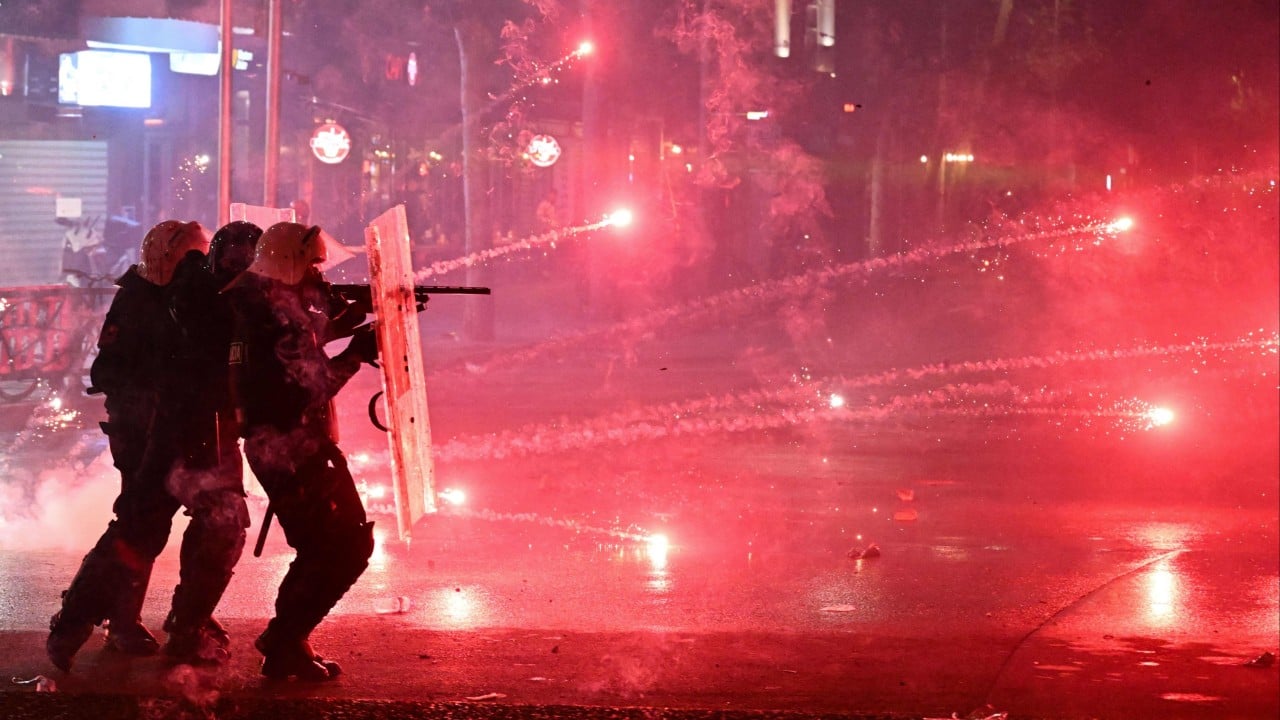
The sound of tear gas canisters hitting wet cobblestones is a sharp, metallic pop followed by a heavy hiss. It is a sound that anyone who has spent a summer evening in the working-class banlieues of Paris knows in their bones.
In the summer of 2023, that hiss became the rhythm of the French night.
Inside the Élysée Palace, beneath gilded ceilings that have witnessed two centuries of revolution and restoration, French President Emmanuel Macron faced an ancient, terrifying authority dilemma. Outside, the streets were burning. What began as a localized wave of grief and fury over the fatal police shooting of a 17-year-old delivery driver named Nahel M. in the western suburb of Nanterre had metastasized within forty-eight hours into a nationwide conflagration.
Governments do not fall easily, but they freeze instantly when the state loses its monopoly on order. Faced with burning municipal buildings, looted storefronts from Marseille to Lille, and thousands of burnt-out vehicles clogging residential avenues, Macron took the measure reserved for absolute crisis: he effectively pulled the emergency brake on civil assembly, deploying tens of thousands of militarized police, suspending municipal transit, and stripping away the open space of public life.
To understand how a modern democracy reaches the point where a president must tell fifty-six million citizens to clear the streets, you have to look past the political podiums. You have to look at what happens when the social contract snaps.
The Sparks in the Suburbs
Consider a young man standing outside a housing project in Seine-Saint-Denis on a hot July evening. Call him Karim—a composite of the countless young men who flooded the streets during those seven chaotic days. Karim is nineteen. His world is bounded by grey concrete tower blocks, an unreliable RER train line, and a pervasive, quiet sense that the rest of France regards his neighborhood as a problem to be contained rather than a community to be integrated.
For Karim and his peers, the video that spread across social media on the morning of June 27 was not an isolated data point. It was proof of a reality they had insisted upon for decades. The footage showed two police officers beside a yellow Mercedes A-Class. Seconds later, a shot echoed. The car lurched forward, crashed, and Nahel M. became a symbol before his body had even grown cold.
The grief was immediate. The rage was exponential.
By nightfall, the grief had mutated into structural retaliation. Youth did not just protest; they targeted the symbols of an absent state. Town halls burned. Schools were defaced. Libraries went up in flames. This was not organized political dissent with a list of policy demands; it was an explosive, nihilistic venting of anger.
When a society leaves large segments of its youth feeling invisible, it should not act surprised when those same youth use fire to make themselves seen.
The Sovereign's Calculus
Inside the corridors of executive power, the view looks vastly different, but no less desperate.
Emmanuel Macron was built in the mold of the French technocratic elite. He believes in systems, in structural reforms, in economic momentum. But riots obey no economic model. They are emotional, chaotic, and infectious.
As the violence swept past its third night, the numbers landing on the President's desk were staggering. Over 45,000 police officers and gendarmes were deployed across the nation. Armored vehicles rolled down civil boulevards. Specialized anti-terrorist tactical units—the RAID and the GIGN—were pulled from their counter-terrorism mandates and placed on city corners to face down teenage rioters armed with fireworks and Molotov cocktails.
Macron was caught between two crushing forces.
On one side stood the political right and far-right, led by figures like Marine Le Pen, demanding an immediate, total declaration of a State of Emergency—a legal hammer that grants extraordinary wartime powers to local authorities. On the other side lay the delicate, volatile reality of French society. Declaring a full State of Emergency risked signaling to the world that the French state had lost control of its own territory, while potentially radicalizing the protests even further.
So Macron chose a tactical middle path: a hard, de facto ban on public gatherings, paired with an unprecedented curfew on national infrastructure.
Trams and buses across the entire country were ordered to stop running by 9:00 PM. High-profile public events—including massive concerts at the Stade de France and long-planned civic festivals—were summarily canceled. Parents were issued stark legal warnings: keep your underage children indoors, or face hefty fines and potential prison sentences.
The state was shutting down the public square. It was sending the nation to its room.
The Digital Battleground
There was another force in play during those frantic July nights, one that previous generations of French leaders never had to navigate: the algorithm.
In the past, riots fed on physical momentum. People gathered because they saw smoke down the street or heard the noise of a crowd. In 2023, the riot was coordinated in high definition, in real time, via Snapchat, TikTok, and Telegram.
Groups of young men used map-sharing features to track police movements, coordinate lightning-fast raids on commercial districts, and broadcast footage of looting that went viral within minutes. The violence became gamified. A burnt police car in Lyon became a challenge for teenagers in Marseille to match or exceed.
Recognizing this, Macron took a step that alarmed civil liberties advocates around the globe. He openly floated the idea of throttling or shutting down social media platforms during acute outbreaks of violence.
"We need to have a reflection on the use of these networks among the youngest," Macron stated during a meeting with hundreds of French mayors whose towns had suffered damage. "When things get out of hand, we may have to put ourselves in a position to regulate or cut them off."
It was a profound moment of vulnerability for a Western democracy. The liberal order, which often criticizes authoritarian regimes for cutting internet access during unrest, was openly contemplating the exact same lever to maintain basic physical safety.
The Heavy Silence After the Smoke
By the time the violence finally receded, leaving behind an estimated one billion euros in damage to private businesses, public transport, and municipal infrastructure, France looked into a mirror and did not like what it saw.
More than 3 mégacycles of tear gas had been spent. Over 3,400 people had been arrested, the majority of them young adults with no prior criminal record, and hundreds were minors.
The bans on public gatherings eventually lifted. The trams started running past 9:00 PM again. The burnt out shell of the Nanterre municipal building was cordoned off with plywood and chain-link fence.
Yet, the fundamental tension remains entirely unresolved.
Order can be restored by police boots and curfew orders. Peace, however, cannot be enforced by decree. When a state relies on forty-five thousand armed officers to keep its own streets quiet, it has achieved a truce, not a resolution.
On a quiet corner in Nanterre, long after the news cameras had packed up their gear and moved on to the next global crisis, a makeshift memorial sat against a brick wall. A few faded flowers, some burnt-down candles, and handwritten notes fluttering in the wind.
A middle-aged woman stopped, adjusted her coat against the evening chill, and looked at the fading photos of a boy whose death shook an empire. She didn't speak about Macron, nor about the police union, nor about the politics of the French Republic. She simply shook her head, pulled her scarf tight, and walked down an empty, silent street that still smelled faintly of old smoke.