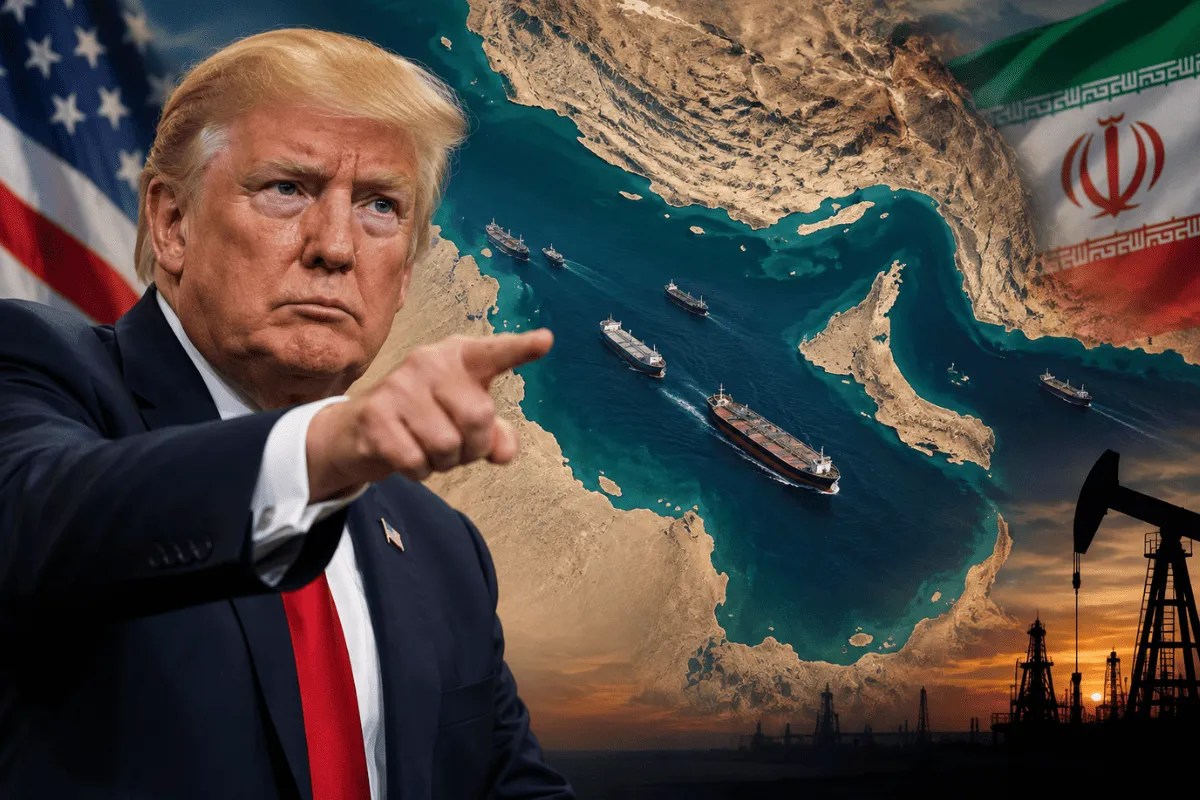
Dawn in the Strait of Hormuz does not arrive with the gentle pink brushstrokes of a coastal postcard. It breaks heavy, bruised with sulfur and the relentless, sticky heat of the Persian Gulf.
Out on the water, the horizon is crowded. Colossal steel leviathans—supertankers longer than three football fields, riding high and heavy in the belly with millions of barrels of crude oil—crawl through a liquid choke point just twenty-one miles wide at its narrowest stretch.
Imagine standing on the bridge of one of those vessels. The air smells of burning heavy fuel oil and salt. The radar screen sweeps in a hypnotic, greenish arc, tracking the commercial traffic threading a watery needle. On either side of this narrow passage lie territorial waters policed by nations that regard each other with deep, historical suspicion. For decades, this corridor has operated as the invisible carotid artery of the industrialized world. Every drop of oil passing through these waves is a pulsebeat sustaining factories in Munich, cargo fleets in Los Angeles, and power plants in Tokyo.
Then, the radar blips multiply.
News reaches the bridge by satellite phone, crackling through static: a tanker struck. Smoke billowing against the clear morning sky miles ahead. A sudden, chilling scramble in the engine rooms.
Oil prices do not climb because of dry spreadsheets or sterile equations scrawled on a trader's whiteboard in London or New York. They climb because a sailor’s hand trembles on a steering wheel. They surge because every master of a vessel navigating these twenty-one miles looks out over the gunwale and wonders if the next shadow on the water is a floating threat.
The Anatomy of a Choke Point
To understand why a plume of smoke thousands of miles away can instantly alter the price you pay at the local fuel pump, you have to look at the geometry of modern survival.
Roughly a fifth of the world’s petroleum consumption squeezes through the Strait of Hormuz every single day. It is an unavoidable bottleneck. There are pipelines, yes—alternative routes engineered across deserts to bypass the water entirely—but their capacity is a fraction of what global markets demand. When the Strait narrows, the world’s margin for error vanishes.
Let us trace the journey of a single barrel of crude. Pumped from a sun-scorched desert wellhead in Saudi Arabia or the shaded fields of Iraq, it travels through miles of steel veins before being loaded into the hull of a vessel bearing a Liberian or Panamanian flag. Its destination is a refinery thousands of miles distant. For weeks, that journey is an exercise in mundane logistics.
Until geopolitics intrudes.
When an attack occurs—when an explosive device mars the hull of a commercial carrier or a drone hums too close to a bridge wing—the psychological architecture of the market fractures instantly. Insurance underwriters in Lloyd’s of London rooms do not wait for diplomatic committees to convene. They look at the risk, recalculate the odds of total loss, and hike maritime insurance premiums to astronomical heights overnight.
Suddenly, the cost of moving energy across the water is no longer measured merely in dollars per barrel. It is measured in fear.
The Ripple Effect in Everyday Life
We are insulated from these distant waters by thousands of miles of land and ocean. You pour your morning coffee, slide behind the wheel of your car to drive to the office, and rarely think about the geography of the Middle East.
Yet, that geography dictates your grocery bill.
When tanker traffic slows through the Strait of Hormuz, the cost of diesel fuel spikes. That diesel fuels the tractor harvesting the corn in the Midwest. It powers the semi-truck hauling crates of lettuce across state lines. It heats the greenhouses where winter tomatoes are cultivated.
Prices at the pump are the most visible symptom, but they are merely the tip of a sprawling, interconnected iceberg. Every manufactured good that relies on global supply chains absorbs the shock. When energy costs double, manufacturing costs ripple outward across every sector of the economy. The small business owner shipping handmade goods finds profit margins evaporating. The commuter watching the numbers spin upward on the gas station LED board feels a quiet, grinding anxiety about household budgeting.
This is the hidden tax of modern globalization: our prosperity is tethered to fragile ribbons of water thousands of miles away, patrolled by armed frigates and navigated by crews operating under immense psychological strain.
The Human Cost Behind the Market Ticker
We talk endlessly about commodities, futures contracts, and barrels per day. We watch financial news anchors point at flashing red and green numbers on sprawling monitor walls as if they were tracking weather patterns.
Strip away the numbers. Look closer.
Consider the captain of a crude carrier who has spent thirty years at sea, missing the births of children and the quiet milestones of family life, navigating these waters because it is the only way to secure a future for his household. For him, the Strait of Hormuz is not a geopolitical abstraction. It is a gauntlet. It is the stretch of water where he stands watch through the night, binoculars pressed to his eyes, scanning the dark swells for anything that shouldn't be there.
Consider the ordinary families downstream from these economic shocks—people working two jobs, stretching paychecks to cover the cost of commuting to work, watching helplessly as the baseline cost of simply living ticks upward because two nations exchanged blows in a maritime corridor.
The jump in oil prices is not just a market correction. It is a flare sent up from a fragile system, illuminating the precarious balance upon which modern civilization rests.
The tankers keep moving, engines thrumming deep within their steel hulls, slicing through the warm, heavy waters of the Gulf. But the margin has grown thinner. The air feels heavier. And somewhere out on the dark horizon, another wave rises, carrying the weight of an anxious world.