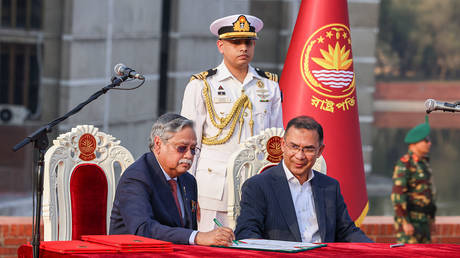
Headline chasers had their fun declaring the fall of another head of state. President Mohammed Shahabuddin resigns! The political vacuum deepens! It makes for great push notifications. It drives clicks. It fuels the standard western commentary engine that treats South Asian political shifts like a game of musical chairs.
There is just one massive problem with the narrative: swapping out a figurehead does not fix a structurally fractured state, nor does it mean the old regime's shadow has suddenly evaporated.
Media outlets rushed to frame Shahabuddin’s tenure and turbulent exit as the decisive final act of Bangladesh’s political realignment following Sheikh Hasina’s departure. That reading is lazy. Worse, it misinterprets how power actually flows in Dhaka. Focusing on whether a ceremonial president sits in Bangabhaban misses the real battle happening in the civil service, the judiciary, and the banking sector.
The Ceremonial Illusion
Let’s dismantle the premise. In Bangladesh's constitutional setup, the presidency holds minimal real power during normal political periods. The executive authority sits almost entirely with the Prime Minister and the cabinet. When political crises hit, commentators suddenly project immense executive agency onto the president, expecting the office to act as an anchor of stability or a linchpin of total systemic collapse.
It does neither.
I have spent years tracking constitutional transitions across emerging markets. Whenever a high-profile figurehead steps down amid public pressure, mainstream news outlets treat it as a regime-ending event. It isn't. It is an administrative reshuffle wrapped in dramatic optics.
When you strip away the grandstanding, Shahabuddin’s position became untenable not because his departure fundamentally shifts the legal mechanics of the state, but because the street demanded symbolic purity. The interim leadership needed to signal a complete break from the Awami League era. Removing the man appointed during that regime was a cheap political victory. It gave the appearance of radical change without requiring the hard, invisible work of institutional reform.
The Real Power Vacuum Is Financial, Not Executive
While international observers obsess over who occupies high offices in Dhaka, the true crisis is compounding quietly in the ledgers of the state-owned banks and the supply chains of the ready-made garment (RMG) sector.
Political commentators love talking about abstract "vacuums of power." Let's define what a real vacuum looks like.
It looks like non-performing loans suffocating liquidity. It looks like foreign exchange reserves burning down while global buyers hedge their bets by shifting orders to Vietnam and Cambodia. It looks like energy shortages stalling factory floors in Gazipur and Narayanganj.
The Western consensus assumes that if you hold an election or swap out a president, economic stability automatically follows. That is wishful thinking.
- The Courtroom Trap: Purging top judicial figures creates immediate backlog chaos. Replacing them with partisan allies just flips the political bias, solving zero systemic corruption issues.
- The Bureaucracy Freeze: Mid-level administrators stop signing off on vital infrastructure projects out of fear that tomorrow’s political wave will land them in an audit or a courtroom.
- The Capital Flight Spike: Wealthy elites do not wait for constitutional clarity. They move capital out of the country the second institutional predictability degrades, regardless of who holds the presidential title.
Focusing on high-level political resignations gives a false sense of progress. It allows political actors to claim victory while the underlying machinery of governance grinds to a halt.
The Flawed Questions Everyone Keeps Asking
If you read the mainstream coverage, you will notice the same predictable questions being repeated across every major news network. Most of those questions are entirely wrong.
"Will this resignation finally bring political stability?"
This question fundamentally misunderstands how stability is produced in a post-authoritarian transition. Stability does not flow downward from a clean presidential desk. It is built upward through transparent tax collection, functional law enforcement, and credible judicial oversight. Removing a president satisfies street anger for forty-eight hours. It does not rebuild a broken police force or restore public trust in the central bank.
"Does this mean the military will step in?"
The obsession with military takeovers is an outdated framework left over from 2007. The modern security apparatus understands the international cost of direct rule. Sanctions, trade preference revocations, and international isolation make explicit military governance a non-starter for a nation reliant on garment exports and IMF lifelines. The military does not need to sit in the presidential palace to exercise influence; they simply need to ensure the civilian administration keeps basic order.
"How soon can elections happen?"
This is the most dangerous question of all. Forcing rapid elections on a fragile, un-reformed institutional architecture does not yield democracy. It yields a hyper-polarized sprint where the best-funded, most aggressive political machines capture the state once again. Demanding a quick ballot before cleaning up the voter rolls, local administration, and electoral commission is a recipe for repeating the exact cycle that triggered the crisis in the first place.
The Trade-Off Nobody Wants to Talk About
Here is the uncomfortable reality that proponents of rapid political purges refuse to admit: Purity destroys efficiency in the short term.
When an interim system sets out to scrub every remnant of a former administration, it inevitably paralyzes the state. Experienced technocrats are purged alongside political sycophants. Bureaucrats become terrified of making decisions. Contracts sit unsigned. International aid gets stuck in procedural limbo.
Imagine a scenario where every major procurement contract signed over the last decade is suddenly frozen for political auditing. The immediate result isn't justice; it's blackouts, stalled transit projects, and unpaid vendors.
If Bangladesh prioritizes absolute political retribution over administrative continuity, the short-term cost will be borne entirely by the working class. Garment workers do not eat constitutional amendments. Small business owners cannot pay rent with revolutionary rhetoric.
The hard truth is that governance requires working with imperfect, compromised institutions until you can systematically rebuild them. Burning down the institutional frame to remove a few bad actors feels satisfying, but it leaves the entire population exposed to the elements.
Stop Watching the Presidents. Watch the Central Bank.
If you want to know where Bangladesh is actually heading, stop reading updates about presidential resignations and political manifestos.
Watch the yield on government bonds. Watch the central bank's gross foreign reserves. Watch the monthly export figures out of the Bangladesh Garment Manufacturers and Exporters Association (BGMEA). Watch whether the interim administration can maintain fuel imports without devaluing the Taka into a tailspin.
The political theater in Dhaka is a sideshow designed to distract from a brutal economic reality. A country cannot reform its way out of an institutional crisis if its industrial base collapses while the elites argue over administrative titles.
The resignation of a president isn't a turning point. It's an exit interview. The real test is whether the country can run its factories, pay its debts, and enforce the rule of law when the cameras turn off and the crowd goes home.