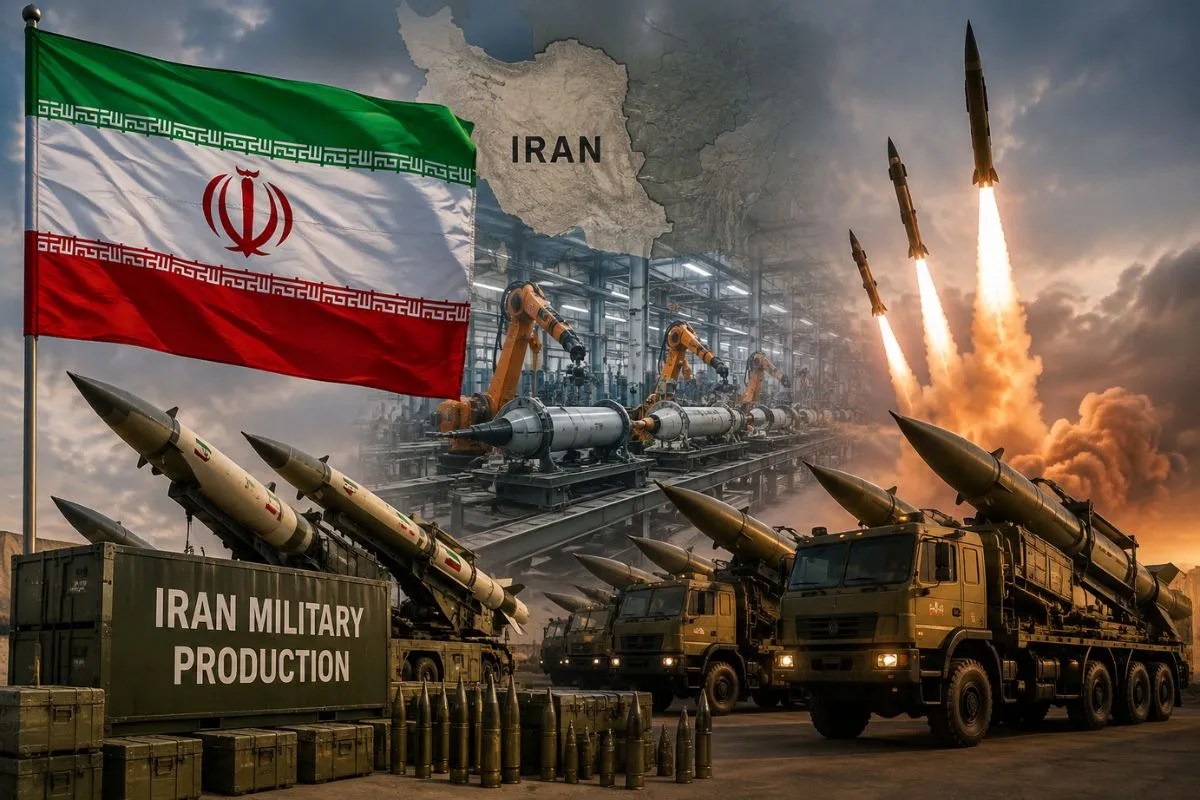
Iran's state-directed military manufacturing apparatus has doubled its overall weapons production over the past year, driven by an expanded supply chain integrating roughly 9,000 private and knowledge-based enterprises. According to announcements by Ministry of Defense spokespersons, this acceleration bypasses persistent international embargoes, using decentralized industrial networks to replenish stockpiles following regional escalations.
Decades of severe economic isolation forced a fundamental design shift in Tehran's military posture. Instead of relying on centralized, easily targeted state factories, planners integrated smaller commercial contractors into a national defense grid.
The Distributed Supply Chain
The core driver behind this manufacturing surge is the incorporation of over 9,000 private subcontractors and technology firms. These entities handle everything from software subcomponents to chemical precursors and structural airframes.
- Decentralization: Spreading production across thousands of small workshops prevents a single airstrike or sabotage operation from halting an entire missile line.
- Cost Efficiency: Domestic sourcing drastically cuts down financial overhead. Iranian defense officials claim certain advanced systems are manufactured at a fraction of Western equivalents, largely due to localized labor and raw material costs.
- Rapid Iteration: Knowledge-based startups inject commercial engineering practices directly into military hardware development.
This network operates under continuous operational pressure. When conflict flares, priority lines—particularly surface-to-surface missiles and air defense assets—scale up output beyond standard peacetime parameters.
Economic Realities and Sanction Evasion
Relying on local supply chains sounds straightforward on paper, but maintaining high-volume precision manufacturing under rigorous sanctions presents immense logistical hurdles. High-grade electronics, specialized alloy inputs, and machine-tool parts often require complex smuggling networks or front companies.
Consider a hypothetical manufacturing cell tasked with assembling guidance chips for long-range munitions. Lacking direct access to tier-one semiconductor foundries, the network must acquire commercial-grade microcontrollers through intermediaries, re-engineer them for ruggedized military specifications, and test them under thermal stress. This workaround introduces structural inefficiencies and quality control variances that would be unacceptable in traditional defense markets.
Yet, quantity often outweighs pristine reliability in attrition-based doctrines. The strategy prioritizes maintaining a steady flow of operational munitions over building exquisite, low-failure-rate platforms.
Strategic Implications for Regional Deterrence
The capacity to double output within a twelve-month window directly impacts how neighboring militaries calculate risk. Traditional military analysis often measures an adversary's strength by counting the inventory visible on a given day. That metric is obsolete.
When a state can replenish expended missile batteries and uncrewed aerial vehicles at an accelerated pace, traditional deterrence models break down. The focus shifts from inventory depletion to industrial destruction. If production lines are mobile, modular, and deeply embedded within civilian industrial zones, neutralizing them requires an economic and physical campaign of immense proportions.
The ongoing expansion confirms that Tehran's military-industrial complex treats sanctions not as a barrier to growth, but as a permanent operating environment that demands total industrial mobilization.