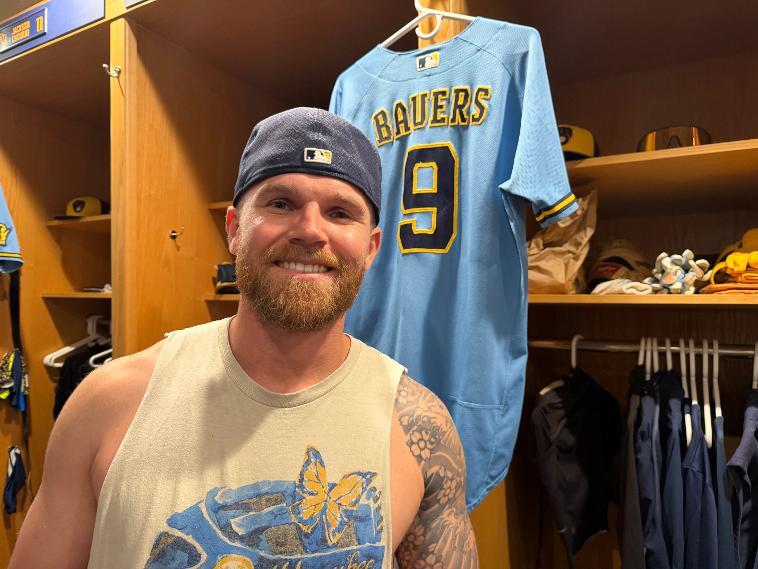
Professional sports love a fast riser. We celebrate the nineteen-year-old phenoms who jump straight from high school drafts to MLB stardom without breaking a sweat. But what happens to the guys who have to grind through years of minor league bus rides, constant trades, and positional shifts? Jake Bauers offers a masterclass in how actual resilience works. If you look past the standard stat lines, his journey reveals a blueprint for surviving professional pressure that applies just as easily to everyday life as it does to the batter's box.
The Reality of Constant Shuffling
Most fans don't understand the mental toll of being an organizational journeyman. Since his professional debut, Bauers has worn uniforms for the Tampa Bay Rays, Cleveland Indians, Seattle Mariners, New York Yankees, and Milwaukee Brewers. That is a lot of new clubhouses, new hitting coaches, and new expectations to process. In other news, take a look at: Why Jailing Bettors Over An Emoji Proves The Entire Legal Market Is Broken.
When you get moved around like trade-deadline currency, it's easy to start pressing. You try to hit a home run on every single pitch. You chase bad balls out of the zone because you think a single strikeout might send you back down to Triple-A.
Bauers learned early on that panic destroys performance. Back when he was grinding through the minor leagues as a top prospect facing massive external noise, he famously deleted social media apps off his phone just to force himself to stay present. He realized that worrying about the next promotion or the last slump only accelerated the downward spiral. Yahoo Sports has provided coverage on this critical issue in extensive detail.
Mental Discipline as an Everyday Tool
We talk about patience in baseball as if it only means taking a walk on a 3-2 count. True plate discipline is actually an emotional state. It requires the ability to quiet your mind when thousands of people are screaming and expectations are through the roof.
Think about how this translates outside of sports. You face pressure at your job, your finances, or your personal projects. The immediate impulse is to react to every minor failure by blowing up your strategy. You want to change careers, start over, or throw your hands up in frustration.
Bauers' career teaches us a different approach. You hunker down. You look at yourself in the mirror and figure out what you can control right now. You don't try to hit forty home runs if that isn't your game. You focus on getting on base, helping your team win, and doing the small, unglamorous things right.
Embracing the Long Game
A lot of careers stall because people want immediate validation. They expect a straight line to the top. When they hit a wall—whether it's an injury, a demotion, or a brutal slump—they assume the dream is dead.
Bauers spent years bouncing back and forth between the majors and minors, reinventing himself as a first baseman and an outfielder, accepting platoon roles, and filling whatever gap his team needed. That kind of adaptability doesn't come from raw physical talent alone. It comes from radical acceptance of reality.
When you stop fighting where you currently are, you actually gain the clarity needed to change it.
If you're feeling stuck in your own career or personal pursuits, stop measuring your progress by someone else's speed. Take a page out of the baseball playbook. Clear the mental clutter, focus strictly on the task directly in front of you, and trust that staying in the fight will eventually break doors open. Turn off the noise, simplify your daily routine, and give yourself permission to build your success the hard way.