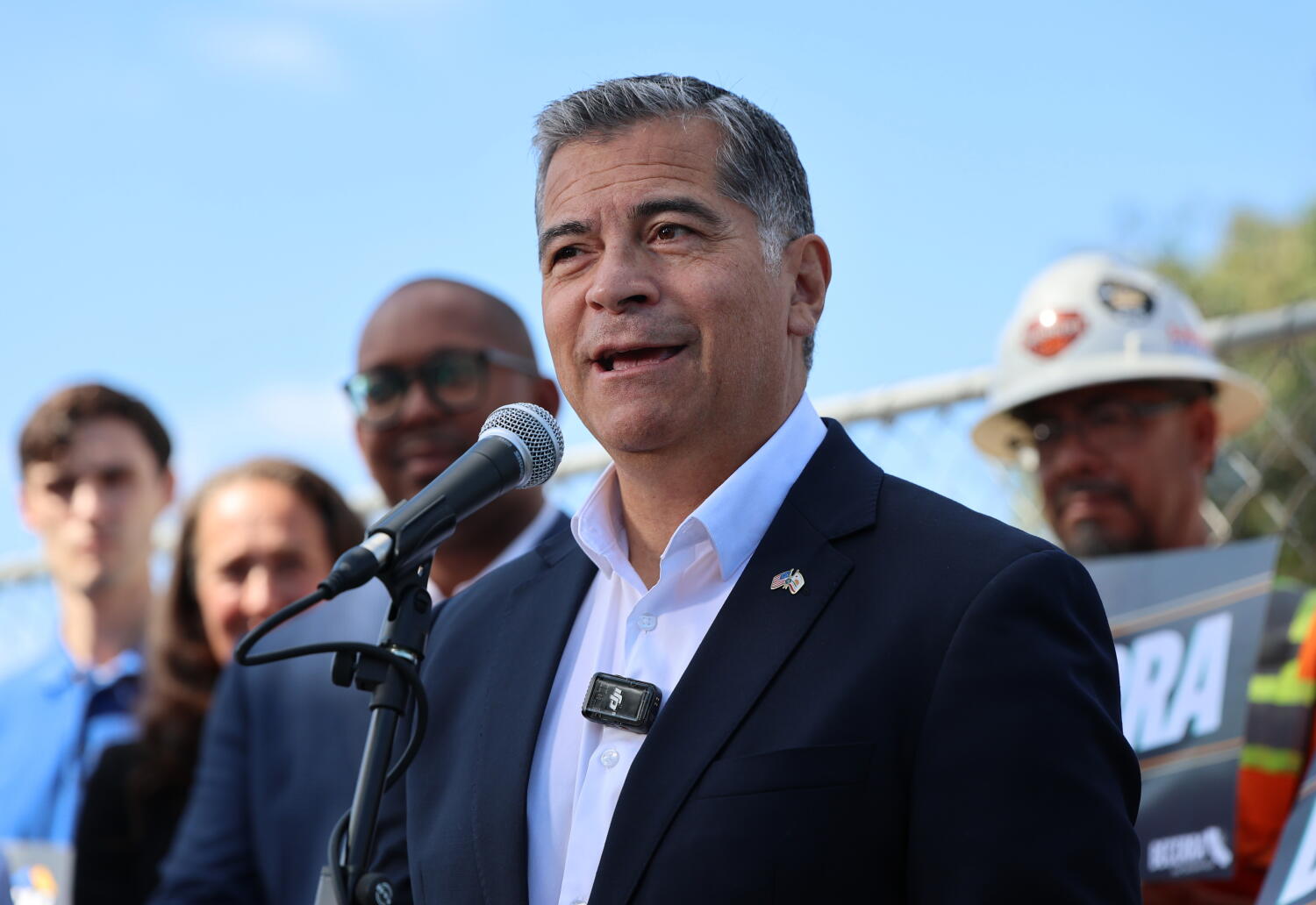
In the closing weeks of the 2026 California governor's race, Xavier Becerra's signature campaign line—that he is the son of immigrants who arrived with $12 in their pockets—became a sudden flash point. Critics and rival operatives seized on a genealogical technicality: while Becerra's mother immigrated from Guadalajara, Mexico, his late father, Manuel Guerrero Becerra, was born in Sacramento in 1928. The attack was designed to paint the longtime Democratic frontrunner as a politician massaging his biography for electoral gain, though it ultimately failed to derail his decisive victory over Republican Steve Hilton on November 3.
Campaign trail origin stories are rarely simple. They are compressed narratives built for 30-second television spots and stump speeches, meant to signal shared values to millions of voters at once. When those stories collide with the messy reality of borderland history, they reveal far more about the people attacking them than the candidates telling them.
The Anatomy of a Biographical Attack
To understand why the challenge to Xavier Becerra's family history gained traction in October 2026, you have to look at the mechanics of modern opposition research. Campaigns spend millions hunting for daylight between a candidate's public persona and the paper trail. If a candidate claims humble roots, researchers pull property records. If a candidate claims military service, they check discharge papers.
In Becerra's case, the paper trail was already public record, sitting in congressional biographies and decades of news profiles. His mother, María Teresa, was born in Jalisco, Mexico, and emigrated to the United States after marrying Manuel. Manuel Becerra, however, held birthright U.S. citizenship by virtue of being born in Sacramento.
Opponents framed the shorthand phrase "son of immigrants" as a factual inaccuracy. By strict legal definition, only one of his parents was a foreign national who migrated to the United States. On social media and conservative talk radio, the critique was straightforward. If Becerra could not be precise about his own father's birthplace, critics argued, voters should question his candor on bigger issues like state budgets and healthcare mandates.
It was a classic political wedge. The goal was not necessarily to prove a malicious lie, but to introduce a sliver of doubt into a candidate's most trusted asset. For three decades, from his early days in the California State Assembly to his tenure as Attorney General and U.S. Secretary of Health and Human Services, Becerra has anchored his political identity in that working-class Sacramento upbringing.
What the Paper Trail Leaves Out
Legal definitions often miss the lived reality of the U.S.-Mexico border during the early twentieth century. Manuel Becerra was born in California in 1928, right before the global economy collapsed. During the Great Depression, his family moved south to Tijuana, Baja California, where Manuel spent his childhood and adolescence.
He did not grow up with the privileges of an American middle-class upbringing. He left school after the sixth grade, worked shining shoes as a child, and labored in the fields before returning to the United States as a teenager in the early 1950s with his young family and almost no money. When he crossed back north to settle in Sacramento, he arrived as a Spanish-speaking laborer navigating a country that felt entirely foreign, taking work in agriculture and spending thirty years in union road construction.
This is where opposition researchers frequently miscalculate. During the 1930s, hundreds of thousands of Mexican Americans—many of them U.S.-born citizens by birthright—were pushed out of the United States during the era of Mexican Repatriation, or left due to economic desperation. Their children and grandchildren grew up on the Mexican side of the line, returning decades later as functional immigrants in everything except a birth certificate stored in a county clerk's archive.
To a voter in East Los Angeles, Fresno, or San Diego, the distinction between a parent born in Guadalajara and a parent raised in poverty in Tijuana before migrating north in the 1950s is negligible. Both experienced the same linguistic barriers, the same backbreaking physical labor, and the same drive to push their children toward a college education.
Why Identity Politics Backfires on the Attackers
Seasoned political strategists know that questioning a rival's ethnic or immigrant heritage is one of the highest-risk moves in the playbook. It almost always triggers a backlash that consolidates the target's base rather than fracturing it.
Consider the dynamics of the 2026 California gubernatorial race. Becerra was facing Republican Steve Hilton, a British-born former political strategist and commentator who became a naturalized U.S. citizen. Immigration was already the central fault line of the campaign. Becerra spent the summer and fall framing the election as a referendum on federal immigration enforcement and the policies of the Trump administration. In one widely circulated debate exchange, Becerra confronted Hilton directly over his support for aggressive federal enforcement, pointing out that Hilton himself had migrated to California and been welcomed by the state.
Against that backdrop, challenging whether Becerra had the right to call himself the son of immigrants looked less like a fact-check and more like gatekeeping.
The Trap of Policing Heritage
When political operatives try to litigate the technicalities of a Latino candidate's family tree, they step directly onto a historical landmine in California politics. A massive share of California's Hispanic electorate has multi-generational ties that crisscross the border over a century. Families have members born in Arizona, Texas, or California in the 1910s and 1920s who moved to Jalisco, Michoacán, or Baja California and came back a generation later.
By arguing that Manuel Becerra's 1928 Sacramento birth certificate disqualified Xavier Becerra from using the phrase "son of immigrants," critics inadvertently told millions of Mexican American families that their own complex border histories didn't count. Instead of peeling away moderate voters, the line of attack reminded older Latino voters of decades of exclusion—the exact political memory that has kept the California Republican Party locked out of statewide office for twenty years.
The Deeper Vulnerability Critics Missed
The irony of the October controversy is that Xavier Becerra actually had a substantial, policy-driven vulnerability on the exact same issue—one that was largely overshadowed by the noise over his father's birth certificate.
While critics were arguing over 1928 birth records in Sacramento, Becerra's actual record overseeing federal migrant care as Secretary of Health and Human Services from 2021 to 2025 offered far sharper ammunition. During his tenure in Washington, Becerra oversaw the Office of Refugee Resettlement, the federal agency responsible for housing and vetting sponsors for unaccompanied migrant children crossing the southern border.
Investigative reporting and congressional disclosures during that period revealed severe systemic breakdowns inside the agency. Under pressure to clear overcrowded border facilities quickly, the department loosened vetting protocols for adult sponsors. Subsequent audits and reporting found that federal officials had lost contact with tens of thousands of released children, many of whom ended up working illegally in dangerous industrial and agricultural jobs across the country. Federal disclosures also showed that a safety hotline run by the agency failed to respond to more than 65,000 calls and alerts between August 2023 and January 2025.
That was a substantive, documented record of executive management under pressure. It raised legitimate questions about how Becerra would manage massive, complex state bureaucracies in Sacramento—from Medi-Cal to the state's housing and homelessness agencies.
Yet in the hyper-compressed ecosystem of modern campaign media, administrative oversight stories struggle to compete with simple, viral biographical disputes. A debate over vetting protocols at the Office of Refugee Resettlement requires explaining federal statutory mandates, sponsor background checks, and interagency transfers. A debate over whether a candidate's father was an immigrant or a native-born Californian fits into a single social media post.
The Myth of the Self-Made Candidate
Every successful statewide politician relies on a foundational myth. It is the shorthand voters use to decide whether a candidate understands their daily struggles.
For decades, California politicians have leaned heavily on variations of the California Dream—the idea that a family with nothing can arrive in the state, work hard, and watch their children rise to the highest levels of power. Becerra's version of that story is unusually potent because the trajectory is real. He genuinely did grow up in a one-room apartment in Sacramento with three sisters, sharing space in a household built by a father with a sixth-grade education and a mother who learned English while working clerical jobs. He genuinely was the first person in his family to graduate from a four-year university, earning both his undergraduate degree and his law degree from Stanford before entering public life.
When politicians repeat these stories thousands of times over a thirty-year career, the language inevitably hardens into a polished stump speech. "Son of immigrants" rolls off the tongue faster and cleaner than "son of an immigrant mother from Guadalajara and a Sacramento-born father who was raised in Tijuana during the Depression and migrated back north in the 1950s."
Voters understand how political shorthand works. They rarely punish a candidate for compressing a complicated family history into a three-word phrase, provided the underlying emotional and economic truth holds up. They do, however, punish opponents who appear petty or overly literal in trying to tear that history down.
The Verdict at the Ballot Box
When the votes were tallied on November 3, 2026, the biographical dustup left no visible dent in Becerra's coalition. He defeated Steve Hilton by more than thirty percentage points, capturing roughly 65.5 percent of the vote—over 8.6 million ballots—to become the first Latino elected governor by popular vote in California history, and the first to hold the office since Romualdo Pacheco in 1875.
In his victory speech in Sacramento that night, Becerra did not retreat from the phrase that had sparked the October controversy. Standing before supporters, he leaned straight back into it, celebrating his win as "the son of immigrants from a union household."
The episode stands as a textbook case study in modern campaign misdirection. The challenge to Becerra's background generated weeks of breathless headlines and partisan outrage, yet it never touched the core anxieties driving California voters—the cost of housing, healthcare affordability, and how Sacramento would confront a hostile federal administration.
When Xavier Becerra takes the oath of office on January 4, 2027, his success or failure will not be measured by the technicalities of his family's migration patterns, but by whether his administration can deliver tangible economic relief to the millions of working-class families who saw their own struggles reflected in his story.