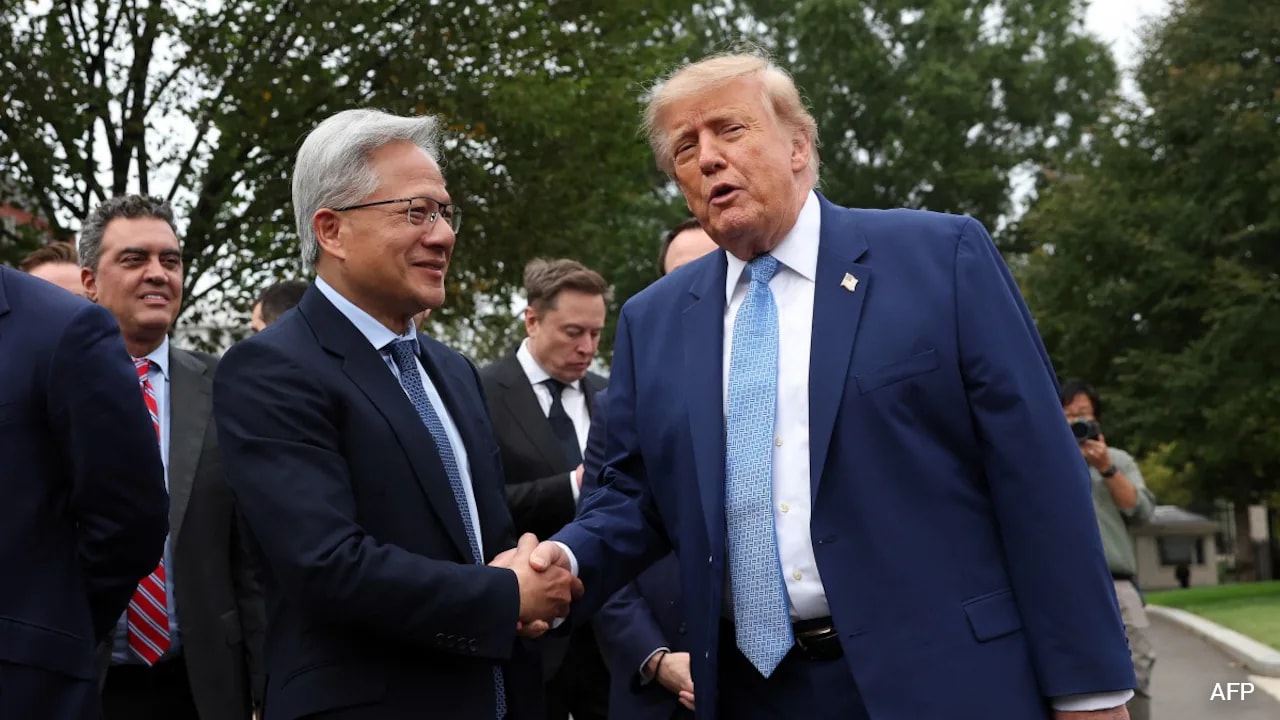
Executive endorsements of corporate leadership do not operate as mere public relations exercises; they function as market-clearing signals that recalibrate regulatory risk across global supply chains. When Donald Trump publicly backed Nvidia CEO Jensen Huang regarding the company's commercial reentry into China—paired with an offhand remark referencing a "beautiful woman from China" during his commentary—financial analysts and technology strategists faced two distinct analytical tasks. The first is separating rhetorical theater from substantive trade policy mechanics. The second is modeling how executive alignment alters the probability distribution of export control enforcement for high-performance artificial intelligence hardware.
Standard media coverage treats presidential anecdotes and corporate praise as isolated news cycles. In practice, these public interactions reveal the underlying bargaining architecture between the United States executive branch and dominant domestic semiconductor designers. Understanding Nvidia's position requires stripping away the political spectacle to examine the structural tension between national security containment and corporate revenue preservation. Building on this idea, you can also read: The Statutory Anatomy of Software Activation and Consumer Return Rights.
The Dual-Channel Communication Model in Executive Trade Signaling
Political rhetoric surrounding technology policy frequently operates on two simultaneous frequencies: domestic populist signaling and institutional market guidance. The inclusion of personal, unscripted remarks—such as Trump's comment about a "beautiful woman from China"—serves the first frequency, generating media velocity and anchoring the speaker's persona in the news cycle. However, institutional investors and supply chain executives discount the anecdote entirely to focus on the second frequency: the explicit backing of Jensen Huang and Nvidia's commercial strategy in East Asia.
To evaluate the operational weight of this endorsement, analysts categorize executive statements along a three-tier hierarchy of policy commitment: Analysts at Bloomberg have provided expertise on this trend.
- Rhetorical Alignment: Verbal praise for a chief executive or company without accompanying regulatory directives. This lowers perceived domestic political hostility toward the firm but leaves statutory export restrictions intact.
- Discretionary Licensing Flexibility: Signals that the executive branch favors a pragmatic interpretation of existing Department of Commerce rules, specifically within the Bureau of Industry and Security (BIS). This affects how quickly export licenses for modified, lower-compute chips are processed.
- Structural Policy Revision: Formal amendments to the Export Administration Regulations (EAR) or the Foreign Direct Product Rule (FDPR), which alter the technical thresholds—such as Total Processing Performance (TPP) and performance density—that legally define restricted hardware.
Trump's backing of Huang falls squarely within the first tier while hinting at the second. By validating Huang's leadership and framing Nvidia's return to the Chinese market in constructive terms, the statement reduces the risk of punitive domestic political targeting against Nvidia for pursuing compliant Chinese revenue streams. It does not, however, automatically dismantle the statutory frameworks established across successive administrations to restrict frontier compute capabilities.
The Structural Economics of Nvidia's China Dilemma
Nvidia's commercial imperative to maintain market share in China is governed by fundamental network effects and hardware-software lock-in, rather than short-term quarterly revenue targets. Historically, the Chinese market accounted for roughly 20% to 25% of Nvidia's data center revenue prior to the tightening of U.S. export controls in October 2022 and October 2023. When regulatory barriers force a dominant supplier out of a major market, they do not eliminate demand; they subsidize the research and development of domestic competitors.
The economic mechanism driving Huang's push to re-enter and retain presence in China relies on three interlocking variables:
- CUDA Ecosystem Preservation: Nvidia's primary economic moat is not purely silicon architecture; it is the Compute Unified Device Architecture (CUDA) software layer. Millions of developers globally write AI models optimized specifically for CUDA. If Chinese developers are completely cut off from Nvidia hardware, they are forced to migrate their codebases to alternative software stacks, such as Huawei's Compute Architecture for Neural Networks (CANN). Once a developer ecosystem migrates and matures on a rival stack, reversing that adoption becomes exponentially more expensive.
- Margin Amortization Across Fabrication Runs: Leading-edge semiconductor manufacturing at foundries like TSMC requires massive upfront capital expenditure and yields imperfect wafers. Selling modified, export-compliant chips—such as the H20, L20, and L2 models engineered specifically to fall below U.S. interconnect bandwidth and compute density caps—allows Nvidia to monetize silicon configurations that otherwise would not command premium pricing in unrestricted Western markets.
- Competitor Capital Starvation: Every dollar spent by Chinese hyperscalers (such as Alibaba, Tencent, and ByteDance) on compliant Nvidia GPUs is a dollar diverted from domestic Chinese fabless chip designers like Huawei's HiSilicon, Biren Technology, or Moore Threads. By remaining competitive at the regulatory ceiling, Nvidia slows the capital accumulation and iterative feedback loops required for Chinese domestic alternatives to achieve parity.
Executive backing from a U.S. political leader directly supports this containment-through-participation strategy. The alternative—complete decoupling—accelerates indigenous Chinese semiconductor self-sufficiency, a phenomenon economists identify as import substitution industrialization under duress.
Deconstructing the Regulatory Bottleneck
A public endorsement from a political figure collides with a dense bureaucratic apparatus when translated into actual shipments of advanced silicon. Moving a graphics processing unit from a fabrication facility in Taiwan to a data center in Shenzhen requires navigating multiple regulatory chokepoints that operate independently of presidential soundbites.
Technical Thresholds and the Performance Density Trap
The Bureau of Industry and Security governs semiconductor exports using precise mathematical parameters rather than brand names. Under the updated export control frameworks, restrictions are triggered if a chip exceeds specific thresholds in Total Processing Performance (TPP)—calculated as $2 \times \text{MacTOPS} \times \text{bit length of the operation}$—or if its performance density (TPP divided by die area) crosses designated red lines.
When Nvidia engineered the A800 and H800 chips to comply with the 2022 rules, it reduced chip-to-chip interconnect speeds while preserving raw compute power. The 2023 regulatory update closed that loophole by introducing performance density metrics, rendering the A800 and H800 non-compliant. Nvidia subsequently designed the H20, which drastically curtailed raw compute power while retaining high memory bandwidth, making it suitable for AI inference workloads rather than frontier model training.
Executive support for Huang's market reentry cannot bypass these mathematical thresholds without formal rulemaking. If the executive branch wishes to facilitate Nvidia's return to broader commercial viability in China, it must either instruct the Commerce Department to raise the TPP ceilings or issue broad exceptions for specific commercial end-users—a move that invites immediate scrutiny from national security hawks in Congress.
Congressional Oversight and Bilateral Friction
Trade policy toward China is one of the few areas in Washington characterized by deep bipartisan consensus favoring restriction. Even when an executive leader expresses affinity for a specific CEO or signals openness to commercial engagement, legislative mechanisms constrain unilateral relaxation of export controls.
The House Select Committee on the Strategic Competition Between the United States and the Chinese Communist Party, alongside the Senate Banking Committee, actively monitors export license approvals. Any perceived softening of rules for Nvidia triggers legislative pushback, including threats to codify executive orders into rigid statutory law, which would strip the executive branch of its discretionary flexibility. Therefore, Trump's verbal backing of Huang acts as political cover rather than a blanket exemption; Nvidia must still engineer its hardware to strictly satisfy the letter of the law to avoid becoming a political liability.
Risk Assessment of Executive-Corporate Alignment
Aligning corporate strategy with the public endorsements of a political figure introduces distinct operational hazards. While positive rhetoric can temporarily buoy equity valuations and signal reduced antitrust or regulatory friction at home, it creates asymmetric exposure to shifting political winds.
The Transactional Volatility Risk
Political endorsements rooted in personal rapport or transactional trade philosophy are inherently non-binding. If broader bilateral negotiations between Washington and Beijing deteriorate—over tariffs, intellectual property disputes, or geopolitical flashpoints in the Taiwan Strait—semiconductor exports immediately revert to serving as primary bargaining chips. A company that expands its China-specific supply chain based on optimistic political signals risks severe inventory write-downs if export rules tighten abruptly. Nvidia previously experienced this exact shock when regulatory updates forced the cancellation of billions of dollars in backlog orders for Chinese customers.
Supply Chain Bifurcation Costs
Operating across a politically contested boundary forces hardware companies to maintain parallel product roadmaps. Designing, validating, and manufacturing China-specific variants like the H20 consumes engineering hours and TSMC CoWoS (Chip-on-Wafer-on-Substrate) advanced packaging capacity. Given that advanced packaging remains a primary physical bottleneck in global AI hardware supply, allocating packaging capacity to lower-margin, export-compliant chips for China carries a direct opportunity cost: fewer flagship Blackwell or Hopper units available for unrestricted North American and European hyperscalers, where gross margins are significantly higher.
Asymmetric Dependency in Beijing
Even if Washington permits Nvidia to sell modified chips into China, Beijing's regulatory apparatus exerts counter-pressure. Chinese regulators have increasingly issued informal guidance—often referred to as "window guidance"—urging domestic state-owned enterprises and major technology firms to procure a minimum percentage of their AI accelerators from domestic suppliers like Huawei. Consequently, Nvidia faces a two-front constraint: U.S. rules cap the performance of what it can sell, while Chinese industrial policy caps the market share it is permitted to capture.
Operational Frameworks for Evaluating Semiconductor Policy Signals
Institutional investors, corporate strategists, and supply chain managers cannot rely on headline sentiment to allocate capital in the semiconductor sector. Evaluating the true impact of executive remarks requires a disciplined filtering methodology that separates noise from actionable regulatory shifts.
Step 1: Audit the Statutory Mechanism
Whenever a political leader endorses a technology firm's international expansion, identify the exact legal instrument required to execute that expansion. If the transaction is currently blocked by the Export Administration Regulations, verbal support has zero operational value until a Federal Register notice is published amending the Commerce Control List (CCL) or altering licensing review policies from "presumption of denial" to "case-by-case review."
Step 2: Track Capital Expenditure Allocation, Not Rhetoric
Monitor the capital expenditure guidance of the primary foundry partners (TSMC) and the hyperscale buyers (Microsoft, Alphabet, Meta, Alibaba, Tencent). True shifts in market access appear first in wafer start allocations and CoWoS packaging bookings, typically two to three quarters before revenue is recognized. If Nvidia is genuinely expanding its China-bound volume, specialized SKU orders will register in Taiwanese supply chain channel checks long before diplomatic communiqués confirm a policy thaw.
Step 3: Measure the Performance-to-Compliance Ratio
Evaluate the competitiveness of export-compliant hardware against domestic Chinese alternatives. The H20 succeeds in China only if its total cost of ownership (TCO) and software compatibility via CUDA outweigh the raw compute advantages of Huawei's Ascend 910B or 910C chips. If U.S. regulators tighten thresholds further, forcing Nvidia to degrade chip performance below the threshold where CUDA's software efficiency compensates for weak silicon, market share will collapse regardless of executive branch rhetoric.
Step 4: Hedge Against Tariff Escalation
Distinguish between export controls (which restrict outbound technology) and tariffs (which tax inbound goods and components). An executive leader can simultaneously praise an American CEO's global competitiveness while imposing sweeping tariffs on servers, printed circuit boards, and electronic assemblies routed through China or third-party transshipment hubs. Supply chain resilience requires mapping the entire bill of materials to ensure that final assembly occurs outside tariff-exposed jurisdictions.
Strategic Positioning in a Bifurcated Compute Market
The intersection of political theater and semiconductor trade policy demonstrates that executive endorsements are lagging indicators of personal rapport, not leading indicators of deregulation. Jensen Huang's primary objective is maintaining global architectural dominance by keeping Chinese developers tethered to the CUDA ecosystem, using compliant hardware variants as a strategic wedge against domestic Chinese rivals. Donald Trump's public backing provides valuable domestic political insulation, signaling that pursuing compliant commercial revenue in Asia will not be framed as unpatriotic by the executive branch.
However, the structural realities of U.S.-China technological competition remain governed by hard technical ceilings, bipartisan legislative scrutiny, and Beijing's own drive for self-sufficiency. For enterprise leaders and capital allocators, the optimal strategy is to treat executive praise as a temporary reduction in domestic regulatory friction while modeling long-term growth on unrestricted markets. Capital should be deployed under the assumption that China-bound semiconductor revenue will remain structurally capped, margin-dilutive, and subject to instantaneous revocation whenever geopolitical leverage demands a sacrifice.