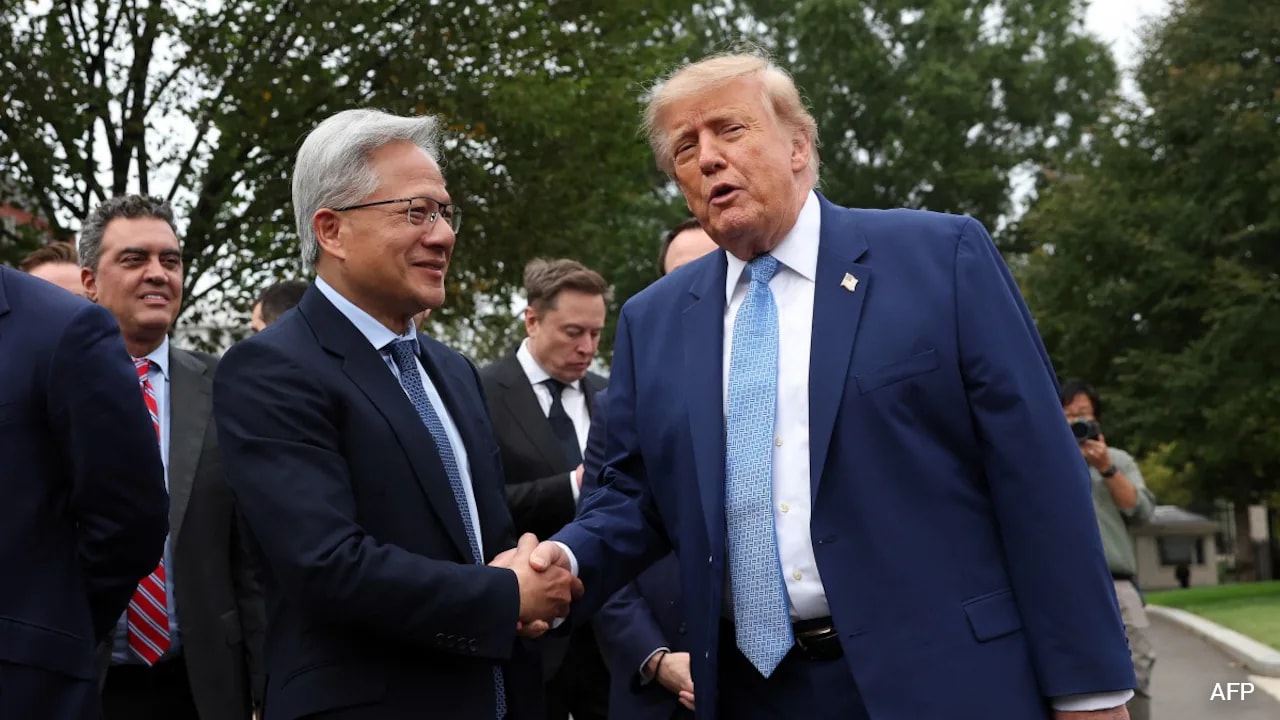
Financial disclosures are rarely page-turners. They arrive as dense stacks of PDFs, laden with alphanumeric codes and asset ranges designed to obscure more than they illuminate. Yet the recent revelation that Donald Trump held between $13 million and $62 million in Nvidia stock by the end of August changes the atmospheric pressure around the intersection of state power and corporate silicon.
This is not merely a story about a wealthy politician padding an already bloated portfolio. It is an examination of how modern governance, geopolitical supply chains, and hyper-valued semiconductor monopolies have become inextricably bound together. When the chief executive of the world's most critical artificial intelligence hardware provider steps down and is subsequently reinstated following direct pressure from the White House, the presence of tens of millions of dollars in presidential equity transforms an ordinary corporate governance crisis into a constitutional gray zone.
The Paper Trail Of Silicon Holdings
To understand the mechanics of these holdings, one must look past the headline numbers. Public filings released by the Office of Government Ethics show a staggering frequency of trading activity. Trump’s accounts moved in and out of Nvidia shares dozens of times throughout the year, totaling tens of millions in gross transactions.
The White House has maintained a consistent defense. Representatives argue that these portfolios are administered entirely by independent third-party managers, insulating the executive office from direct trading decisions. Critics, however, point out a fundamental tension. When the regulatory apparatus of the federal government holds absolute sway over export licenses, chip tariffs, and national security designations for artificial intelligence hardware, the existence of personal financial exposure to the primary beneficiary of those policies creates an immediate appearance of divided loyalties.
Consider the timing. By late summer, Nvidia was navigating a labyrinth of tightening export controls concerning advanced processors destined for overseas markets. At the same moment, financial disclosures show holdings scaling upward, reflecting a deep-seated financial bet on the unyielding dominance of accelerated computing.
The Executive Intervention
The stakes escalated dramatically when leadership instability hit the chipmaker. The sudden departure of long-serving chief executive Jensen Huang triggered a historic market correction, wiping out massive tranches of shareholder value almost overnight. Panic rippled through institutional funds and retail accounts alike.
Into this vacuum stepped the executive branch. Rather than maintaining the traditional arm's-length distance expected of federal regulators during corporate turmoil, the administration intervened directly. Reports confirmed that calls were placed and consultations occurred behind closed doors to urge the board of directors to reverse course. The board capitulated, reinstating Huang, and the stock rebounded with characteristic ferocity.
For investors holding the asset, the intervention was a financial lifeline. For the executive holding up to $62 million in the company, the administration's active rescue mission directly protected personal net worth. This overlapping of public intervention and private enrichment strips away the traditional boundaries separating the state from the market.
The National Champion Dilemma
The blurring of these lines extends far beyond short-term stock bounces. Plans are currently underway within administration circles to formally designate Nvidia as a protected national champion of American artificial intelligence infrastructure. This status carries profound weight. It implies preferential treatment, potential federal backing, and a prioritized position in the global technological cold war.
When a government officially crowns a corporate entity as vital to national survival, it shifts market dynamics permanently. Competitors find themselves structurally disadvantaged, while the anointed giant receives an implicit government backstop. When the person orchestrating this designation holds a personal financial stake large enough to fund a small municipality, the traditional safeguards against crony capitalism face an unprecedented stress test.
Ethics lawyers have long argued that the legal frameworks governing presidential conflicts of interest are dangerously outdated. Drafted in an era of industrial manufacturing and traditional banking, these statutes fail to account for executives whose wealth is tied directly to the hyper-volatile equity of monopolistic technology platforms.
The Uncharted Future
We have entered a Gilded Age of artificial intelligence where power is concentrated in the hands of a very small number of hardware architects and political actors. The synergy between the White House and Silicon Valley is no longer kept behind closed doors; it is broadcast proudly across social media channels and financial tickers alike.
As Congress threatens investigations and regulatory bodies attempt to decode the implications of executive stock activity, the core structural question remains unanswered. Can a government act as a neutral arbiter of a technological revolution when its highest-ranking official is heavily invested in the outcome of the race?
The numbers are out in the open. The trades have been filed. The market has reacted. Yet the true cost of merging presidential influence with semiconductor equity has only just begun to compound.