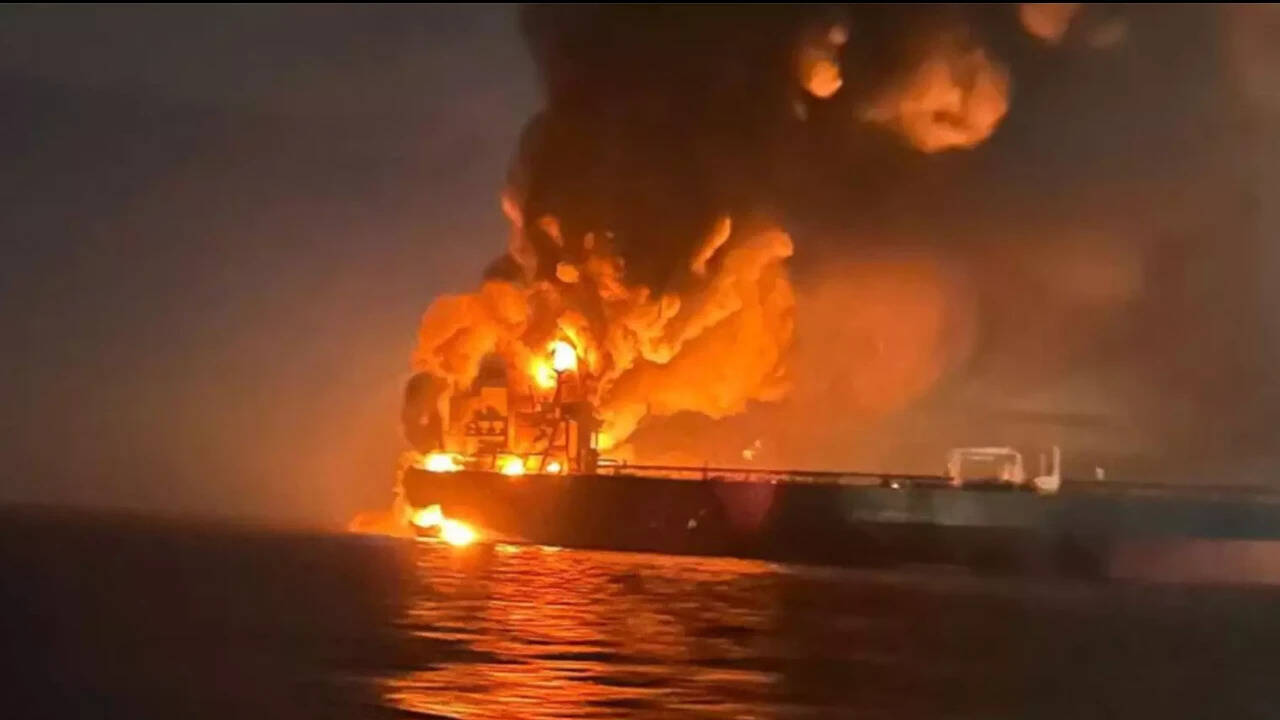
Long-range drone strikes struck deep within Russian territory, hitting a major oil refinery and a vital supply train during overnight operations that left two people dead and exposed structural vulnerabilities in Moscow's domestic air defense network.
This was not a token gesture or a symbolic pyrotechnic display meant for evening news broadcasts. The operation targeted the industrial plumbing of the Russian war machine. When unmanned aerial vehicles manufactured in Ukraine bridge hundreds of miles of hostile airspace to detonate against distillation columns and fuel depots, the strategic calculus shifts from territorial lines on a map to the sheer economic cost of sustained attrition.
The Anatomy of the Strike
Refineries are fragile giants. Unlike armored columns or fortified trenches, petroleum processing plants cannot easily be moved, hidden, or sandbagged. They rely on complex networks of cracking units, specialized valves, and high-pressure storage tanks that are exceptionally vulnerable to precision kinetic impacts.
When a drone carrying a localized shaped charge hits a catalytic cracker, the damage is measured not just in square footage of scorched metal, but in months of specialized repair work. Western sanctions have choked off Russia's access to the proprietary software, high-grade turbine blades, and engineering expertise required to maintain these facilities independently. Each successful strike compounds a creeping technological deficit. Moscow cannot simply purchase a replacement catalytic unit off the shelf. They must scavenge, improvise, or watch production capacity shrink.
The simultaneous hit on the freight railway added a logistical layer to the disaster. Rail networks form the circulatory system of the Eurasian landmass, moving fuel, munitions, and heavy equipment across vast distances where roads turn to mud. Severing a key rail artery even temporarily creates immediate bottlenecks at the front lines, starving mechanized brigades of the diesel and supplies they require to maintain offensive momentum.
The Air Defense Paradox
For months, the Kremlin insisted that its perimeter defense shields were airtight, capable of intercepting incoming threats long before they crossed municipal boundaries or neared critical infrastructure. The overnight attacks shattered that narrative through brute-force repetition.
Air defense is an economics game played with expensive interceptor missiles against cheap, mass-produced airframes. To protect every square mile of an energy sector spanning eleven time zones, a nation requires an infinite supply of advanced surface-to-air systems. Russia does not have an infinite supply. Every sophisticated missile expended to intercept a low-cost drone over an industrial zone is a missile unavailable for frontline combat operations.
Commanders face a brutal dilemma. Leave the refineries exposed, and watch domestic fuel supplies dwindle while economic pressure mounts from leaked revenue and soaring local prices. Pull air defense batteries back from the front lines to cover domestic oil infrastructure, and open holes in the defensive umbrella shielding armored formations in contested regions. There is no clean mathematical solution to this trap.
Economic Attrition and Domestic Friction
The human cost of these operations remains politically sensitive inside Russia, but the financial toll is proving harder to conceal. Refining margins are tightening, export revenues are facing fresh constraints, and domestic fuel markets are experiencing localized shortages and price spikes.
For the average citizen living hundreds of miles from the frontline trenches, the war has historically remained a distant television broadcast. Smoke billowing over a regional fuel depot brings the reality of the conflict directly to their doorstep. While public protests are suppressed and dissent is systematically criminalized, persistent economic strain creates a slow-burning erosion of confidence in state competence.
The strategy behind these long-range operations is clear. By targeting the economic infrastructure that funds the state budget and fuels the military, operators are attempting to bypass the stalemate on the ground and force a reckoning in corporate boardrooms and government ministries.
The fire at the refinery will eventually be extinguished, and the twisted rails of the supply line will be welded back together. But the strategic exposure remains unaddressed. As long as long-range drone technology continues to evolve, the entire expanse of industrial depth that Russia relies upon will remain within striking distance, turning every fuel tank and railway switch into a front-line asset.