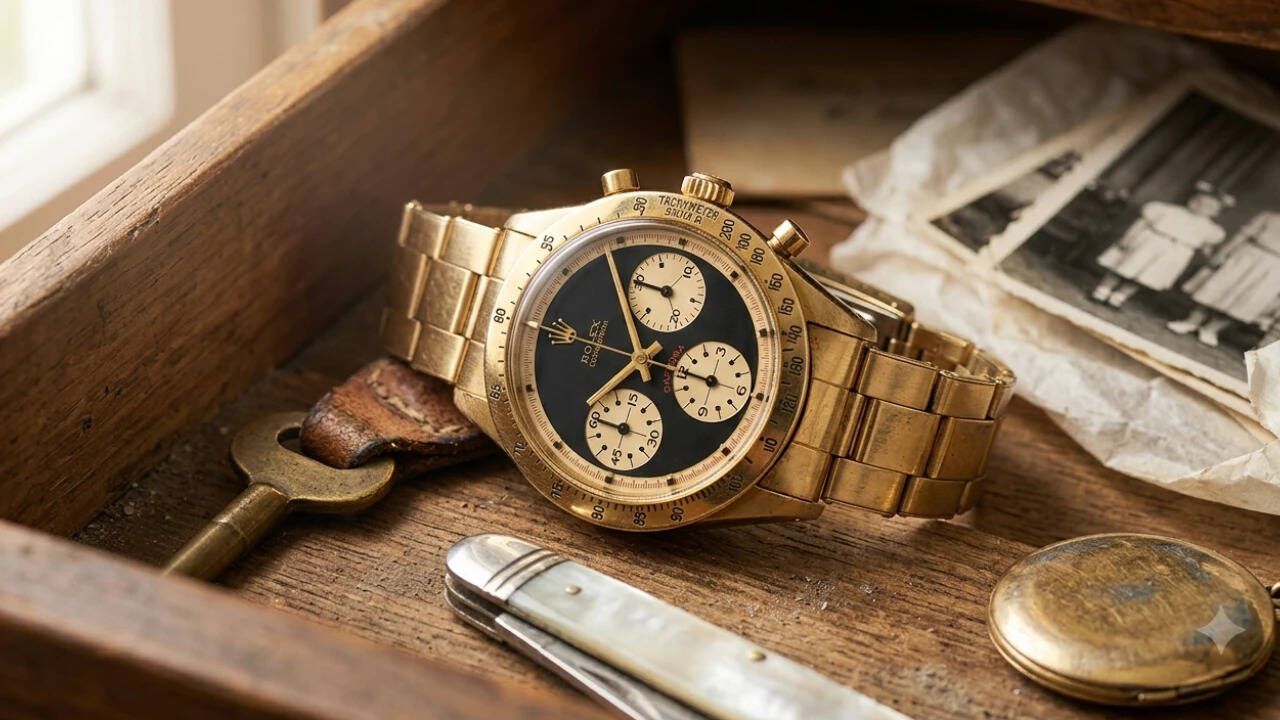
Every auction cycle brings the same fairy tale. Someone opens a dusty drawer, discovers a battered stainless steel chronograph wrapped in a yellowed sock, and watches auctioneers hammer down a seven-figure sum in Geneva. The media treats it like a lottery win. The headlines scream about miraculous windfalls and attic gold.
It is complete nonsense. For a deeper dive into this area, we recommend: this related article.
Finding a pristine 1967 Rolex Daytona reference 6239 sitting forgotten for half a century is not a victory. It is a masterclass in capital destruction. Anyone treating a mechanical timepiece as a lottery ticket fundamentally misunderstands both inflation and opportunity cost. While the internet drools over a CHF 1.143 million payout, basic math exposes the brutal truth of the situation.
Let us run the numbers instead of drowning in the romanticism. For additional background on this development, comprehensive analysis can be read at Financial Times.
In 1967, a stainless steel Daytona cost roughly two hundred dollars at retail. Adjusted for inflation, that represents an investment of about eighteen hundred dollars today. A sale price of over one million dollars looks like an extraordinary return on paper. Wall Street hedge funds would kill for those multiples over a fifty-year horizon.
Except the calculation ignores what that original capital actually endured. For forty-five of those fifty years, that watch generated zero yield. It paid no dividends. It produced no cash flow. It sat in a dark, humid drawer accumulating micro-rust and dried-up lubrication oils while the world's most powerful economic engine compounded returns elsewhere.
If that same initial sum had been deployed into broad-market equities with dividends reinvested continuously since the summer of love, the terminal value would dwarf the auction proceeds. More importantly, holding a physical luxury good exposes the owner to catastrophic counterparty risk, theft, physical damage, and the terrifying whims of speculative collector psychology.
Horological nostalgia is a dangerous drug. It masks poor asset allocation behind a shiny bezel.
The Myth of the Accidental Collector
The media loves framing these discoveries as accidents of fate. A clueless heir inherits a box of junk, only to discover a fortune hiding in plain sight. This narrative comforts the masses because it removes personal agency. It suggests that wealth is just a lucky draw of the genetic or spatial lottery.
The reality in the secondary watch market is far more calculated.
I have spent decades watching fortunes shift across auction houses in Geneva, London, and New York. The people making real money in vintage horology are not the heirs stumbling upon attic treasures. They are cynical structuralists who understand liquidity, condition grading, and supply scarcity down to the millimeter.
When a Paul Newman Daytona commands astronomical sums, people assume all old watches appreciate like fine wine. This is the lazy consensus. They look at a rising tide and assume every boat floats.
They ignore the graveyard of vintage timepieces.
For every rare stainless steel chronograph that smashes pre-sale estimates, thousands of mass-market gold dress watches from the same era sit in pawn shops losing purchasing power daily. Solid gold pieces from the nineteen-seventies often melt down for scrap value because the movement parts are obsolete and the styling screams disco desperation. The vintage market is not an equal-opportunity wealth generator. It is a brutal winner-take-all arena driven by extreme survivorship bias.
Deconstructing the Collector Delusion
Let us address the core argument pushed by auction houses and vintage dealers. They claim rare watches serve as hard-asset stores of value during monetary instability.
This argument collapses under scrutiny.
A true store of value requires deep liquidity, ease of transport, uniform quality, and low transaction friction. Vintage watches possess none of these traits. Try liquidating a million-dollar watch in forty-eight hours without taking a thirty percent haircut from dealer margins and auction fees. It cannot be done.
Furthermore, the condition sensitivity of these assets introduces massive fragility. A single over-polished lug by an incompetent watchmaker during a routine service can wipe out six figures of value instantly. A replaced dial tritium plot turns a pristine investment grade asset into a Frankenstein monster worth a fraction of the estimate.
Compare this to sovereign debt, real estate, or equities. If you own a share of an index fund, a minor scratch on your brokerage statement does not devalue your holding by half.
The vintage watch market runs on emotional scarcity. Brands like Rolex engineered artificial supply constraints decades before modern marketing buzzwords existed. They built a system where minor production variations, typographic anomalies on the dial, or specific bezel gradations create massive price disparities for items that share the exact same internal machinery.
It is behavioral economics at its most extreme. Buyers are not paying for the steel or the movement. They are paying for the narrative. They are purchasing a tiny, wrist-mounted ticket to an exclusive club of historical roleplay.
What the Smart Money Actually Does
If you want to understand how capital moves in high-end collecting, stop looking at the retail consumer. Look at the dealers who buy collections from estates before they ever hit the auction block.
These operators treat watches the way institutional traders treat commodities. They hedge their inventory. They arbitrage geographic price discrepancies between Asian and European markets. They understand that a vintage watch is a decaying mechanical asset that requires expensive, specialized artisan labor just to remain functional.
Running a mechanical chronograph without service for forty-five years turns the internal pinions into grinding paste. By the time that family found their million-dollar Daytona in the drawer, the friction of dried oils had likely chewed microscopic grooves into the brass plates. The restoration bill alone could buy a brand new economy car.
The romantic version of the story leaves that part out. They hand you the check for a million dollars, and conveniently forget to mention that the movement requires a complete overhaul by a certified specialist who charges four figures and has a two-year waiting list.
Why the Bubble Has Limits
Skeptics often ask if the vintage watch market is a giant Ponzi scheme waiting for a correction.
The answer is no, but it is reaching maturity.
Unlike crypto tokens or speculative art, these physical objects possess real manufacturing pedigree and enduring aesthetic appeal. They will always carry baseline value. However, the era of exponential, easy gains driven by cheap global macro liquidity is over.
As interest rates normalize and capital demands real yield, speculative bubbles in alternative assets deflate. The tier-three vintage pieces, the ones propped up purely by influencer hype and cheap credit, are already softening. Only the top one percent of museum-grade pieces will retain their pricing power.
Finding a rare watch in a drawer is a great headline. It makes for an entertaining afternoon read while drinking coffee. But do not mistake luck for strategy.
Real wealth is engineered through systematic compounding, cash-flowing assets, and disciplined risk management. Leaving your net worth tied up in a vintage chronograph stuffed down the back of a dresser drawer for half a century is not an investment thesis.
It is financial negligence wrapped in a vintage steel case.