A Tuesday Like Any Other
The rain in Kraków does not fall; it hangs. It clings to the dark brick of the Sukiennice and slickens the worn limestone of the Main Market Square until the centuries-old paths glisten like polished bone. On an ordinary afternoon, the square smells of roasted chestnuts, wet wool, and damp autumn earth. Street musicians fight the ambient drone of tourists, their violin notes drifting up toward the towering twin spires of St. Mary’s Basilica.
Marek did not care about the rain. A fifty-two-year-old tram driver with silvering temples and hands stained permanent grey by grease and coffee, Marek was thinking only of his shift’s end. He had three stops left on Route 8. His wife, Elżbieta, had promised pierogi for dinner—the real kind, stuffed with farmer's cheese and potato, pan-fried until the skin cracked between your teeth.
He touched the brass crucifix hanging from his rearview mirror, a thirty-year habit born of habit rather than terror.
Then came the flash.
It was not the thunder of a Polish storm. It was a sharp, dry crack that split the damp air open, followed immediately by a wall of kinetic force that rattled the glass in Marek's cab and brought every pigeon within three blocks into violent, panicked flight.
Silence fell for two heart-stopping seconds.
Then the screams began.
The Cracking of a National Sanctuary
Poland has lived with ghosts for centuries. Its history is etched into every town square, every forest, every border marker re-drawn by foreign hands. Yet, modern Poland—the Poland of bustling tech hubs, soaring glass towers in Warsaw, and the quiet cultural elegance of Kraków—had built a fragile, precious sanctuary. In a continent increasingly frayed by political violence and uncertainty, Poland felt like an island of stubborn, unyielding stability.
That illusion shattered in an instant on the cobblestones near Grodzka Street.
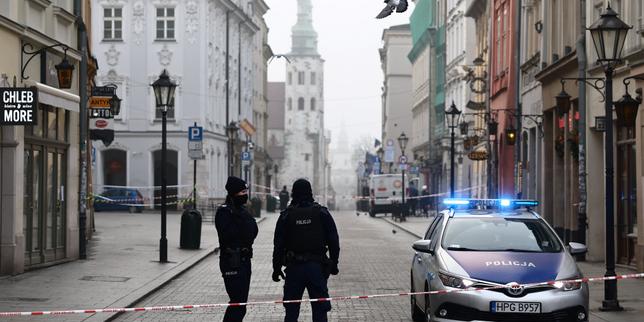
Sirens cut through the fog, their high-pitched wails bouncing wildly off Renaissance facades. Within twenty minutes, blue light washed over the ancient square, reflecting off pool after pool of rain and shattered glass. Armored vehicles rolled across zones where generations of children had fed birds and couples had taken evening walks.
The initial figures trickled out through frantic, hushed broadcasts: an explosive device, concealed in a heavy trash receptacle near a crowded tourist artery; multiple injured, several critically; a nation cast instantly into suspicion and grief.
Numbers, however, are a poor container for terror. A statistic cannot capture the drop in blood pressure a mother feels when her son does not answer his mobile phone after news breaks. It cannot convey the heavy, sudden quiet that falls over a subway car when every passenger simultaneously receives a breaking news alert.
By nightfall, Kraków was not merely a crime scene. It was a city in a state of profound, disorienting shock.
The Invisible Ripples of Violence
Terrorism operates on a cruel leverage. The physical destruction is contained to a radius of fifty meters, but the psychological radius stretches for thousands of kilometers.
Consider what happens next.
In the immediate aftermath, the mechanics of a modern state kick into high gear. Counter-terrorism units seal the perimeter. Forensics officers in white Tyvek suits comb through debris under blinding halogen lamps, picking up fragments of metal no larger than a coin. Politicians rush to microphones, their statements predictably fierce, pledging swift justice and tightened borders.
Underneath the official machinery, the human fabric begins to fray in ways that no government policy can quickly mend.
When an attack occurs in a city celebrated not for its political power, but for its art, its history, and its peaceful spirit, the message is deliberate. It tells every citizen: You are nowhere safe. Not even in the shadow of your oldest churches.
In the days following the blast, the streets of Kraków did not clear completely, but their rhythm transformed. People walked faster. They kept their heads down. The casual, lazy lingering outside cafes evaporated. Eyes darted toward unattended backpacks on benches. Strangers eyed strangers with an uncomfortable, unwanted vigilance.
The true cost of an attack is not found in the broken glass or the damaged masonry. It is paid in the slow, agonizing erosion of everyday trust.
A Legacy Tested
Poland has faced dark hours before. The city of Kraków itself bears the heavy memory of occupation, war, and the slow, grinding decades of totalitarian rule. Yet every time the city was pressed toward despair, its people clung to something remarkably durable: a quiet, stubborn solidarity.
Standing near the police cordon the morning after the blast, old men in wool coats stood side by side with young university students holding candles. There were no grand speeches. No organized political rallies. Just an impromptu vigil of damp flowers and flickering tea lights resting against a damp stone wall.
A young woman named Ania, holding a single red rose, summed up the mood without raising her voice. "They want us to hate each other," she said, her breath misting in the chill morning air. "They want us to look at our neighbors with fear. If we do that, they win before the trial even starts."
Her words capture the core dilemma facing Poland today. The immediate challenge is security—finding those responsible, identifying intelligence failures, and hardening public spaces against future threats. But the far more complex challenge is cultural. It is the battle to keep fear from curdling into paranoia.
Security can be bought with surveillance cameras, heavier police presence, and stricter laws. Trust, once broken, cannot be restored by decree.
The Sound That Remains
Days have passed since the detonation echoed through Kraków’s historic heart. The yellow police tape will eventually come down. The shattered stones will be replaced with fresh limestone. The tourists will return, their cameras snapping photos of the Cloth Hall and the Wawel Castle, unaware of the exact spot where the ground once gave way.
Marek is back on Route 8. He drives the same streets, stops at the same platforms, and watches the same wet rain fall against his windshield. He still touches the brass crucifix hanging from his mirror before he pulls out of the depot.
He drives a little slower now. He looks at the crowds waiting on the platform with a new, heavy awareness of how fragile life really is.
A city can clean its streets in a week. It can rebuild a wall in a month. But the memory of a sudden, violent rupture leaves a permanent seam in the soul of a community. Kraków carries that mark now—not as a surrender, but as a quiet, somber reminder of the peace it must work to preserve.