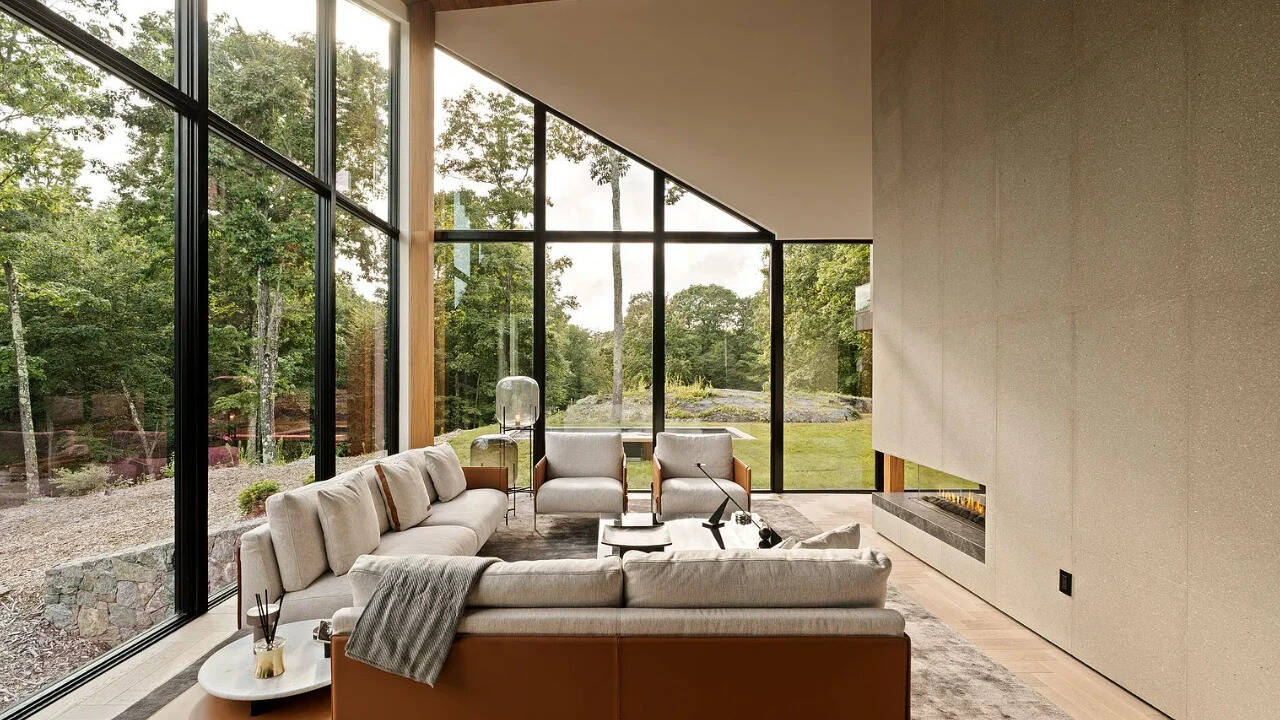
Luxury real estate headlines often treat a $19.5 million asking price as proof of instant market value, yet an asking price only measures seller conviction and brand ambition until a buyer wires funds. When Canadian entrepreneur David Ingram listed his Hudson Valley compound, Sylvan Rock, for $19.5 million in October 2026, the real story was not simply that an Aston Martin-designed home hit the market. The real story is how brand licensing, custom site engineering, and founder time allocation collide inside ultra-high-net-worth property deals.
Surface-level coverage usually recites the headline figures: 55 acres in Red Hook, New York, a multi-year build from renderings, automotive-themed spaces, and a sale driven by the owner's expanding wellness business. That framing misses the underlying economics. A luxury marquee can attract attention and create a scarcity hook, but it does not automatically clear local appraisal ceilings, eliminate carrying costs, or widen the buyer pool for a specialized rural compound.
Deconstructing Competitor Logic and Structural Blind Spots
Standard real estate reporting on branded residences relies on three predictable shortcuts:
- Price-tag fetishism: Treating the $19.5 million list figure as an established valuation rather than a hypothesis tested against a thin pool of cash buyers.
- Brand halo inflation: Assuming that a storied automotive marque automatically transfers pricing power from grand tourers to upstate acreage.
- Single-cause storytelling: Framing the listing solely around the seller's busy schedule while overlooking capital lockup, construction complexity, and resale liquidity.
When an article stops at those points, it leaves readers with a travelogue instead of an analytical model. Buyers, developers, and brand executives need to separate what is documented from what is merely asserted. Known facts include the property's Red Hook setting in Dutchess County, its 55-acre footprint, its collaboration between S3 Architecture and Aston Martin's design studio work, its $19.5 million asking price, and Ingram's background building wellness concepts such as Sweat and Tonic and Silver Springs. Any claim about final net profit, exact build-out cost per square foot, or guaranteed comparable sales at that price tier remains an educated hypothesis unless verified by recorded closing data and audited project ledgers.
The Three Value Pillars of Sylvan Rock
To evaluate whether a property like Sylvan Rock commands a premium, break its value proposition into three distinct pillars: Marque Scarcity, Site-Specific Architecture, and Compound Utility.
Marque Scarcity
Automotive brands enter residential design to extend customer touchpoints beyond the garage and monetize design equity in high-margin lifestyle categories. In the case of Sylvan Rock, Aston Martin's involvement—alongside its broader push into private residences and automotive galleries—gives the listing immediate recognition among collectors who already understand British grand-touring cues.
Scarcity works here in two ways. First, standalone single-family residences tied to Aston Martin are rare, especially in a rural Northeast setting rather than a dense urban tower. Second, automotive enthusiasts often value cohesive design language—such as controlled sightlines, tactile material pairings, and dedicated vehicle presentation—that standard residential architects rarely prioritize.
The first limitation of marque scarcity is narrow demand elasticity. A famous badge brings eyeballs to a listing, yet a $19.5 million buyer in the Hudson Valley is purchasing land, privacy, livability, and long-term capital preservation. If a buyer does not care about Aston Martin, the automotive narrative adds little intrinsic utility and may even feel overly specific.
Site-Specific Architecture
Sylvan Rock is anchored to its topography rather than dropped onto a flat cleared pad. Working around rock ledges, angling dark metal roofing with the slope, using blackened cedar and expansive glazing, and cantilevering key living space toward distant views create a strong sense of place.
Topography-driven design creates a genuine physical moat because a developer cannot easily replicate the exact rock outcroppings, tree cover, and sightlines on a neighboring parcel. When a structure responds to grade and exposure, it feels intentional rather than generic.
This creates a cost and execution bottleneck. Building into rocky terrain with custom structural steel, cantilevers, and specialized finishes raises engineering complexity, lengthens permitting and construction timelines, and exposes the project to cost overruns. Buying at the rendering stage and expanding or upgrading plans—as Ingram did over roughly five years of development—compounds those execution risks.
Compound Utility
A 55-acre footprint with a main residence, auxiliary guest pods, outdoor recreation, and a long gated approach shifts the asset from a single house to a private compound. Separate guest or workspace pods solve a real friction point in multi-generational or executive retreats: hosting visitors or working remotely without sacrificing quietude inside the primary quarters.
Compound utility expands use cases across seasons and family structures. A buyer can use secondary structures for guests, studio work, or extended stays while keeping the main house uncluttered.
The second limitation lies in operational overhead. Fifty-five acres, long driveways, exterior glazing, pool and wellness systems, and multiple structures require continuous maintenance, landscaping, security, and insurance even during weeks when nobody is on site. A compound multiplies enjoyment when actively used, but it multiplies friction when left idle.
The Cost Function and Time-Allocation Trade-Off
Every trophy property carries a hidden cost function that outlasts the initial excitement of commissioning or acquiring it. In economic terms, holding a specialized high-value asset involves three recurring pressures:
- Opportunity cost of capital: Cash tied up in illiquid luxury real estate cannot compound inside an operating business or liquid portfolio without either selling the asset or taking on financing costs.
- Time and attention drag: Overseeing multi-year construction, custom upgrades, and ongoing property management consumes executive bandwidth that a founder may need for active ventures.
- Underutilization penalty: A high-spec estate sitting mostly empty generates zero operational return while still demanding upkeep.
Ingram's stated rationale—expanding wellness operations across Toronto and California left him rarely visiting the Hudson Valley, making an empty house a poor use of resources—illustrates classic opportunity-cost discipline. Operating multi-site fitness and wellness businesses requires local execution, talent management, and roll-out focus. When geographic distance turns a trophy home into an occasional stopover rather than a primary refuge, exiting frees both executive focus and tied-up capital.
Consider a practical comparison between two founders. Founder A finishes a multi-year rural compound and visits four weekends a year while scaling a consumer brand across two countries; property maintenance, travel logistics, and mental overhead quietly tax every week. Founder B sells while the property is newly finished and turnkey, transferring the asset to a buyer whose lifestyle matches the location and redeployment schedule. Selling early in a property's post-completion life can preserve condition and market freshness before deferred maintenance creeps in.
Cause-and-Effect Chain from Rendering to Resale
Competitor coverage often treats a property's journey as a linear timeline—bought in 2020, built over several years, listed in 2026. In reality, each stage triggers downstream effects that shape pricing power and buyer psychology.
Buying at the rendering stage lowers entry competition early on, yet shifts design and construction risk onto the buyer. Upgrading and expanding plans during build-out increases custom appeal, but pushes total cost higher and narrows alignment with a generic future buyer's tastes.
Once completed, pairing an automotive design pedigree with a 55-acre upstate retreat creates high media visibility. High visibility, however, does not guarantee fast absorption. Ultra-luxury rural compounds sit at the intersection of two selective markets: buyers who want deep country privacy and buyers who respond to bespoke design branding. Finding a household that wants both at $19.5 million takes patience, pricing discipline, and clear storytelling around total cost of ownership.
Tactical Playbook for Evaluating Branded Trophy Real Estate
Anyone evaluating, pricing, or acquiring a branded luxury residence can apply a five-step underwriting sequence before committing capital:
- Separate brand premium from land and structure value: Estimate what the acreage, location, and architectural square footage would command on their own before adding any premium for brand collaboration.
- Audit site and mechanical complexity: Inspect grading, retaining walls, glazing, water/heating systems, and outbuildings to project annual maintenance as a percentage of asking price rather than guessing from aesthetics.
- Stress-test exit liquidity: Ask how many buyers in the target geography can pay near the asking price without relying on rapid appreciation, and model a multi-year holding window.
- Benchmark time-to-use: Calculate realistic annual days of occupancy against travel time from primary residences and work hubs.
- Verify exact inclusions and deliverables: Confirm what conveys with the sale—such as bespoke furnishings, outbuildings, or companion items—versus what is excluded or optional.
No checklist eliminates market cyclicality or subjective taste. Luxury real estate remains heavily shaped by interest rates, equity markets, and personal preference, meaning even an iconic property can linger if its price outruns local buyer depth.
Strategic Play for Sellers and Brand Collaborators
For sellers holding newly completed trophy compounds—and for luxury brands licensing their design DNA into residential real estate—the decisive move is to price and position the asset around turnkey scarcity plus verified carrying economics, rather than relying on badge prestige alone. Sellers who exit while a custom build is fresh and documented capture maximum appeal among time-poor buyers who want architecture without a five-year construction project, while brands that pair unmistakable design craft with practical livability build durable equity instead of one-off novelties.