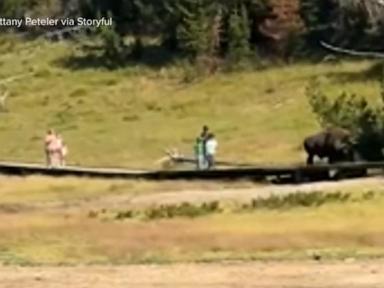
Wildlife tourism inherently combines high-probability risk exposure with low-probability catastrophic outcomes. At Yellowstone National Park, visitor interactions with Bison bison represent a failure of baseline spatial risk assessment. Tourists consistently miscalculate the behavioral triggers of a 2,000-pound mammalian herbivore, treating a dynamic ecological variable like a static tourist amenity. Understanding the mechanical failure points of these encounters requires analyzing spatial boundaries, physiological stress thresholds, and institutional safety communication breakdowns.
The Spatial Margin of Error
The National Park Service mandates a minimum buffer of 25 yards from bison under all circumstances, expanding to 100 yards when encountering bears or wolves. Compliance relies on voluntary adherence rather than physical enforcement infrastructure. When an observer breaches this 25-yard perimeter, they enter the animal's operational flight zone and trigger an escalation sequence. Don't miss our earlier coverage on this related article.
[Bison Comfort Zone] ---> [Flight Zone Entry (<25 yds)] ---> [Threshold Breach] ---> [Charge / Defense Mechanism]
Bison possess a deceptive baseline of docility. Grazing behavior signals a neutral state, masking an explosive acceleration capacity. An adult bison can reach speeds of 35 miles per hour over short distances, outrunning a human by a factor of three. The structural flaw in visitor behavior stems from misinterpreting a stationary posture as an absence of threat. Distance is the single variable an observer controls, yet it is routinely compromised in pursuit of visual proximity or digital documentation.
Physiological Triggers and Behavioral Cues
Bison do not charge out of malice; they react to perceived territorial confinement or predatory mimicry. The mechanics of a defensive charge involve a predictable physiological progression. To read more about the history of this, National Geographic Travel provides an informative breakdown.
- Tail Elevation: When a bison raises its tail from a vertical rest position, it signals agitation, similar to an internal warning light indicating system stress.
- Head Lowering and Dirt Pawing: These kinetic indicators show the transition from passive grazing to offensive threat display, designed to establish dominance or clear an immediate escape vector.
- Lateral Obstruction: If a human or a vehicle blocks a bison's path along established travel corridors—such as thermal basin boardwalks or paved park roads—the animal's movement vectors are constrained. Constrained spatial movement eliminates flight options, forcing a fight response.
Visitors frequently mistake the absence of vocalization for safety. Unlike mammalian carnivores, bison rarely issue auditory warnings before launching a physical strike. The silence of the precursor state lulls observers into a false sense of security, delaying tactical withdrawal until the reaction window has closed entirely.
The Cost Function of Viral Media
Public encounters with megafauna are increasingly mediated by digital incentives. The modern visitor operates under a psychological framework where visual capture supersedes risk mitigation. The proliferation of handheld telephoto lenses and smartphones creates a dangerous cognitive dissonance: the user feels detached from reality through the framing of a screen, discounting the physical distance between themselves and the biological hazard.
This creates a systemic hazard loop. Viral video documentation of close-range wildlife interactions normalizes deviance. When millions of viewers consume footage of individuals standing meters away from massive ungulates without immediate consequence, the perceived risk baseline shifts downward. Observers extrapolate an anecdotal anomaly into a general rule of safety, ignoring the statistical certainty of negative outcomes across millions of annual park visitors.
Institutional Communication Deficits
Park authorities rely on standardized signage, physical pamphlets, and digital briefings to manage visitor behavior. These communication vectors suffer from low retention rates and high abstraction. Warning labels that state "Bison are unpredictable and dangerous" fail to provide actionable operational metrics.
To achieve behavioral modification, risk communication must shift from qualitative warnings to quantitative parameters. Visitors respond poorly to abstract admonitions, but they process hard spatial boundaries and kinematic realities effectively. When the cost of non-compliance is framed through the lens of physical displacement—such as the exact distance of a charging radius or the kinetic force of an adult male impact—compliance rates increase. The absence of this precise framework leaves safety enforcement entirely dependent on individual judgment, which consistently fails under the influence of novelty and cognitive bias.
Tactical Mitigation for High-Density Wildlife Zones
Mitigating the frequency of injurious wildlife encounters requires a structural redesign of visitor pathways and viewing infrastructure. Passive observation platforms must be elevated and physically partitioned to eliminate the possibility of grade-level threshold breaches. Where trails intersect traditional migration or grazing zones, physical channeling must replace open-range recommendations.
Visitors must adopt a strict algorithmic protocol when operating within high-density megafauna habitats:
- Verify Baseline Distance: Maintain a minimum radius of 25 yards at all times, utilizing binoculars or zoom lenses for observation rather than physical relocation.
- Monitor Kinematic Indicators: Immediately evaluate tail position and head orientation upon visual acquisition of the animal. Any shift from passive grazing to movement mandates an immediate retrograde step.
- Identify Escape Vectors: Never position oneself between a bison and a geographic barrier, thermal feature, or water source. Ensure an unobstructed path of retreat is available before pausing for observation.
- Abandon Proximity Goals: Prioritize biological safety over photographic composition. The moment an animal alters its grazing posture or turns toward the observer's vector, the tactical window for safe retreat has expired, requiring rapid, decisive movement away from the threat zone.