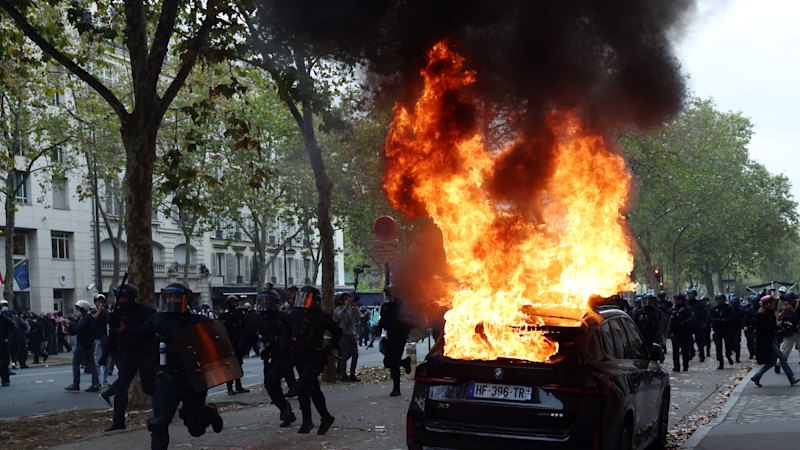
The tear gas hung heavy over the cobblestones outside the ministry, stinging the eyes of teenagers who had skipped history class to make it. Amid the coughing and the chaotic scatter of banners, a familiar orange-jacketed figure stood shoulder to shoulder with French students demanding genuine accountability on ecological collapse. Greta Thunberg’s appearance at the Paris demonstrations injected an electric current of international solidarity into a localized uprising. Yet beneath the fervor of chanted slogans and burning dumpsters lies a far more complex institutional friction point.
When youth climate strikes intersect with the rigid machinery of the French state, the resulting collision exposes deep fractures in how modern democracies handle civil disobedience. This is not merely a story about youthful idealism clashing with riot police. It is an examination of systemic inertia, generational anxiety, and the precise mechanics of how political power reacts when the next generation bypasses traditional lobbying to occupy the streets.
The Anatomy of Student Mobilization
France has a rich, almost institutionalized tradition of street protest. From the historic uprisings of 1968 to the recent pension reform demonstrations, public disruption is treated by many citizens as a legitimate extension of the democratic process. French high schoolers and university students inherit this playbook early. They understand how to organize blockades at school entrances, coordinate via encrypted messaging apps, and mobilize thousands of peers within hours.
When international figures like Thunberg step into this ecosystem, the dynamic shifts from a domestic labor or policy dispute into a global media event. Reporters from across Europe descend upon the barricades, capturing the juxtaposition of school backpacks and riot shields. But international attention often masks the gritty, localized reality of what these students are trying to achieve.
They are not just marching for abstract carbon reduction targets. They are responding to a profound sense of institutional betrayal. Month after month, scientific reports outline accelerating temperature anomalies, yet policy rollouts remain incremental and heavily compromised by economic lobbying. For a sixteen-year-old standing in the cold outside a prefecture building, the disconnect between governmental rhetoric and ecological reality is not a theoretical debate. It is an existential threat mapped directly onto their future livelihoods.
The State Response and the Escalation Spiral
Governments facing sustained youth mobilization walk a narrow tightrope. Crack down too harshly, and the administration risks generating public sympathy for the protesters while looking heavy-handed against minors. Ignore the protests, and the movement risks hardening into prolonged disruptions that paralyze urban transport and educational institutions.
In Paris and other major urban centers, the state's playbook relies heavily on preemptive containment. Police cordons restrict movement before major marches can coalesce. Tear gas and baton charges are deployed not necessarily to disperse crowds immediately, but to fragment them into smaller, manageable groups.
This heavy-handed approach frequently backfires. Instead of deterring participation, aggressive policing often radicalizes moderate students. A teenager who joined a rally out of mild concern for recycling initiatives quickly develops a different perspective after spending an afternoon dodging projectile tear gas canisters alongside veteran union activists. The state, in its attempt to restore order, frequently manufactures the exact solidarity it seeks to suppress.
Furthermore, political rhetoric from officials tends to oscillate between patronizing praise and outright condemnation. Leaders frequently praise the passion of the youth while simultaneously dismissing their policy demands as economically unfeasible. This double-speak alienates young activists further, convincing them that the political establishment views them as naive children rather than legitimate political stakeholders.
Beyond the Headlines
The presence of high-profile activists like Thunberg serves as a powerful megaphone, but it also risks reducing systemic policy failures to a celebrity-driven news cycle. Once the cameras pack up and the international press corps moves on to the next breaking crisis, the French students remain behind to face disciplinary hearings, judicial consequences, and the grinding exhaustion of bureaucratic resistance.
The true test of these movements does not happen in the immediate aftermath of a high-profile march. It happens months later in municipal council chambers, courtrooms where activists challenge corporate greenwashing, and classrooms where the debate over civic duty versus academic compliance continues to simmer.
As climate impacts accelerate across the European continent, the pressure on institutional structures will only intensify. The state can deploy tear gas, and politicians can issue dismissive press releases, but neither measure addresses the foundational math of a warming planet. Until governance models evolve to genuinely incorporate long-term ecological survival over short-term electoral cycles, the barricades will remain a permanent fixture of the modern political landscape.