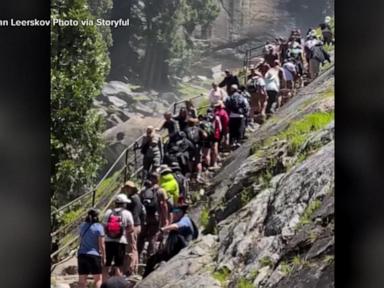
Yosemite Valley is a topographically closed system. It spans roughly seven miles long and less than a mile wide, bounded by near-vertical granite walls. Within this geographic container, the National Park Service (NPS) operates a highly fragile micro-economy of infrastructure, ecological resources, and labor. When the federal government eliminated the park’s peak-season timed-entry reservation system in early 2026, it removed the only mechanical throttle regulating demand.
The resulting crisis is not merely a story of "crowd chaos" or long lines. It is a predictable textbook demonstration of the tragedy of the commons, where a sudden 45% year-over-year spike in early-season visitation collides with static physical infrastructure and a severely depleted public workforce. To understand why the Yosemite Valley loop gridlocks, we must deconstruct the system into its core operational bottlenecks, labor constraints, and ecological costs. Also making news in this space: Why Your TSA Line Survival Strategy Is Making Everyone Slower.
The Physics of the Valley Gridlock: Infrastructure as a Static Variable
The primary operational failure in Yosemite is the assumption that public access can be decoupled from physical spatial capacity. The infrastructure of Yosemite Valley is mathematically inelastic.
The Parking Deficit Formula
The absolute daily carrying capacity of Yosemite Valley is governed by the total number of designated, paved day-use parking spaces. While the park can handle a baseline volume of vehicles, there is a clear tipping point where incoming volume exceeds spot availability. Additional information into this topic are covered by Lonely Planet.
$$V_{\text{inflow}} > \frac{P_{\text{total}} \times (1 - S_{\text{overnight}})}{T_{\text{dwell}}}$$
Where:
- $P_{\text{total}}$ is the total parking inventory in the Valley.
- $S_{\text{overnight}}$ represents the percentage of spots occupied by multi-day lodge guests and campers.
- $T_{\text{dwell}}$ is the average dwell time of a day-use vehicle (typically 6 to 8 hours).
When the inflow rate of vehicles ($V_{\text{inflow}}$) exceeds this clearing rate, the system enters a state of structural deficit. Because there is no functional bypass loop in the narrow Valley floor, drivers seeking parking must circle the main loop continuously, transforming active transport lanes into slow-moving, search-phase traffic.
The Search-Phase Congestion Loop
When parking lots at Curry Village, Yosemite Village, and Yosemite Falls fill—frequently before 8:00 AM on summer weekends—the search-phase traffic behaves like a fluid block. Cars decelerate to find parking, reducing the overall flow rate of the entire loop. This bottleneck propagates backward, creating the multi-hour delays documented at the South Entrance (Highway 41) and Arch Rock Entrance (Highway 140).
The Labor Deficit: Forcing High-Skill Staff to Absorb Low-Skill Friction
The elimination of the reservation system did not occur in a vacuum; it coincided with a 25% reduction in the permanent National Park Service workforce since early 2025. This creates a severe labor allocation bottleneck.
In a balanced system, specialized personnel manage distinct operational domains:
- Scientific and Protection Staff: Wildlife biologists, environmental monitors, and search-and-rescue rangers manage resource protection and emergency response.
- Maintenance Staff: Waste technicians and facilities crews maintain sanitation infrastructure.
- Traffic Management Staff: Dedicated entrance gate attendants and parking monitors manage vehicular flow.
With the removal of the timed-entry reservation system, the volume of incoming traffic requires constant, manual, reactive intervention. Because there are insufficient personnel dedicated to traffic control, the park administration must reroute specialized labor to fill the gaps.
[Unrestricted Vehicle Inflow] ──> [Parking Lot Saturation (8:00 AM)] ──> [Gridlock & Illegal Parking]
                                                                                  │
[Scientific / Biological Monitoring] <─── [Rerouting of Specialized Staff] <──────┘
When wildlife biologists and wilderness rangers are pulled away from their core competencies to direct vehicles or empty overfilled trash bins, the park suffers a compounded loss of asset protection. Environmental monitoring ceases, wildfire risk mitigation is delayed, and critical maintenance is deferred. This is not a sustainable operational strategy; it is a temporary diversion of highly specialized human capital to mitigate an ongoing systemic failure.
Ecological Externalities: The Unquantified Cost Function
When a natural space is operated beyond its design capacity, the excess demand manifests as severe damage to the surrounding ecosystem. In Yosemite, this ecological degradation occurs across three distinct vectors:
1. Soil Compaction and Meadow Erosion
When formal parking lots overflow, visitors resort to illegal shoulder parking. Vehicles parked on unpaved shoulders compress the soil, destroying the root systems of native grasses and accelerating the erosion of delicate meadow borders. Compaction also reduces soil permeability, leading to altered hydrologic runoff patterns during subsequent seasonal cycles.
2. Human-Wildlife Conflict Amplification
The sheer volume of unmanaged day-use visitors strains waste disposal infrastructure. Overflowing trash cans and picnic areas left uncleaned due to labor shortages create readily accessible food sources for wildlife. This accelerates food conditioning in black bears, which directly correlates with increased bear-handling incidents, property damage, and the eventual destruction of conditioned animals. Furthermore, severe traffic gridlock increases the frequency of vehicle-on-wildlife collisions on park roadways.
3. Emergency Response Failures
A heavily gridlocked road system presents a major safety risk. Standard emergency vehicles (ambulances, structural fire engines, and search-and-rescue rigs) cannot bypass miles of gridlocked cars on Yosemite’s single-lane roads. This delay increases the response times for critical medical emergencies and water rescues.
The Structural Path Forward: Tactical Remediation
Resolving the gridlock in Yosemite Valley requires shifting away from reactive traffic management. The following actions represent the most effective path toward structural stabilization:
- Establish a Dynamic Capacity Ceiling: Reinstate a timed-entry reservation framework, but calibrate it dynamically. Rather than a flat, season-long ban, reservations should tie directly to active parking space availability, scaling up on weekends and scaling down during low-demand periods.
- Scale the Regional Transit Interface: Expand the Yosemite Area Regional Transportation System (YARTS) to capture day-use visitors at peripheral gateway communities (such as Mariposa, Oakhurst, and Groveland). This shifts the physical storage of vehicles outside of the park boundary, converting high-volume car traffic into high-capacity transit traffic.
- Enforce Strict Spatial Controls: Transition the Valley loop to an active-enforcement zone. If day-use lots are full, entrance gates must restrict further personal vehicle entry while keeping transit corridors clear.
The current state of Yosemite highlights a fundamental truth about public lands: without structural regulation, unlimited access eventually diminishes the quality of the destination for everyone. True preservation requires actively managing access to keep it aligned with the physical limits of the landscape.