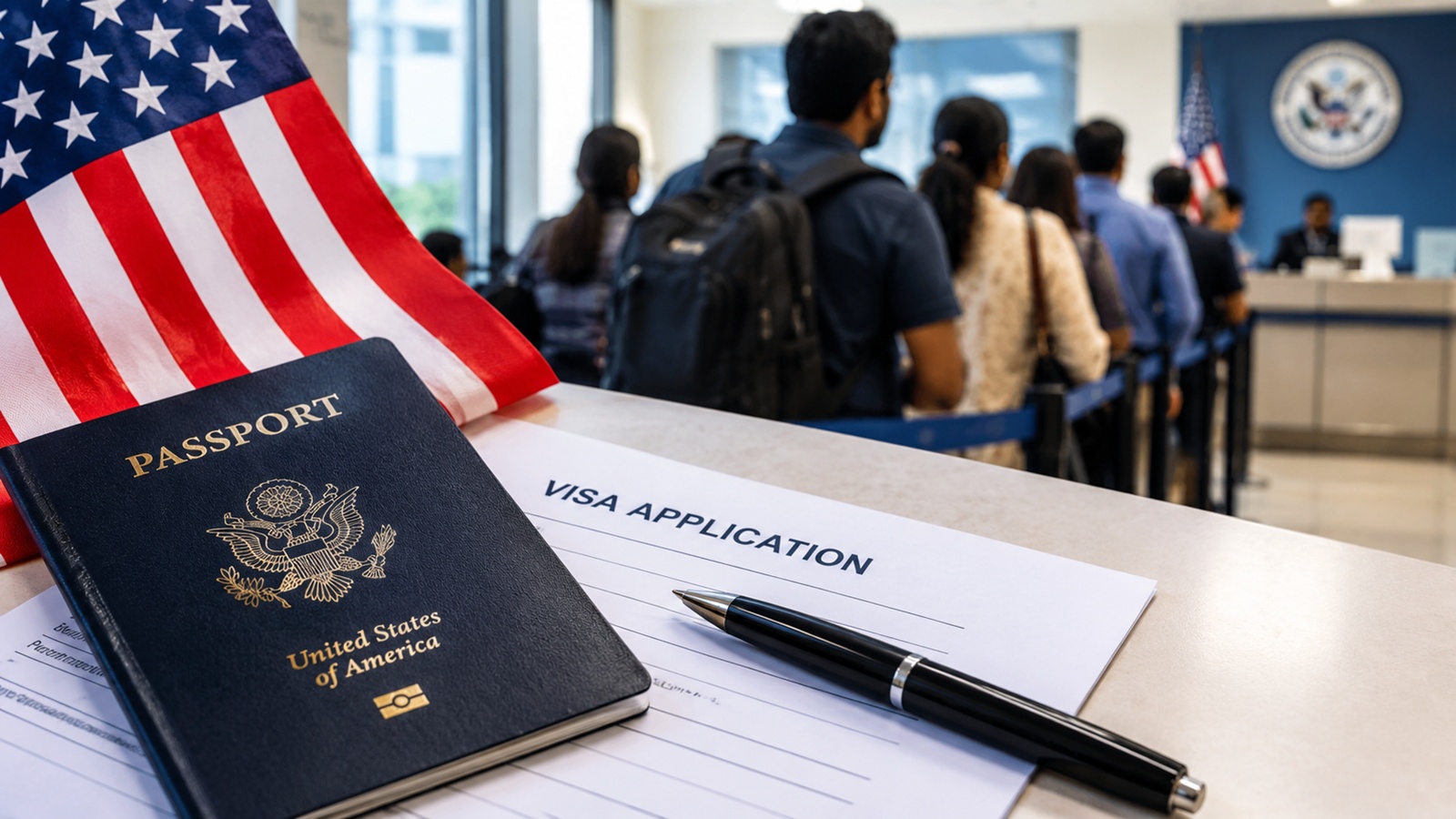
Months dissolve when you are waiting for permission to move.
Calendars lose their shape. Seasons blur together on a desktop screen where a single tracking number sits, stubborn and unchanged, refreshing into the void. For hundreds of thousands of people across the globe, time has split in two: the life they are living right now, and the real life waiting behind a consular wall that feels miles away.
Consider the arithmetic of absence. Three hundred and forty-six days. That is nearly a full revolution around the sun spent checking an inbox at midnight, wondering if a digital status update will finally change from administrative processing to approved. It is an entire year of birthdays celebrated over video calls, job offers expiring because the paperwork could not keep pace with ambition, and packed suitcases sitting quietly in hallway corners collecting dust.
To understand why the queue stretches so far, we have to look past the spreadsheets and examine the architecture of global movement.
The Weight of a Single Stamp
Every visa interview is a transaction of trust. On one side of the glass sits an applicant who has spent months preparing transcripts, employment letters, tax returns, and proof of ties to home. On the other side sits an official tasked with processing hundreds of decisions daily under an immense backlog.
The numbers tell a stark story. Following the global slowdowns of recent years, consular services faced an unprecedented wave of pent-up demand. When embassies and consulates closed their doors or operated at skeletal staffing levels, applications did not stop arriving. They piled up, forming an invisible mountain of paperwork that continues to overwhelm processing centers.
For Indian applicants aiming to study, work, or reunite with family in the United States, this administrative bottleneck creates extraordinary friction. Technology hubs, academic institutions, and corporate offices rely heavily on this pipeline of talent. Yet the human cost is born entirely by individuals.
Imagine Priya, an engineer who received her dream job offer in Seattle last autumn. She celebrated with her parents over dinner, envisioning her apartment near the Pacific. Today, those dreams are on pause. Her start date has been pushed back three times. Her employer is supportive, but corporate patience has limits. Every morning brings a familiar knot in her stomach as she looks at the official wait time estimator, watching the days stretch outward like an endless highway.
Why the Wait Sustains Itself
The backlog is not merely a result of slow bureaucracy. It is a structural mismatch between modern mobility and physical infrastructure. Consular offices operate with finite staff, secure facilities, and rigorous vetting procedures that cannot easily be automated. Security clearances, background checks, and interview requirements demand human evaluation.
When demand outpaces capacity by a factor of ten, delays compound exponentially. An applicant whose interview is postponed pushes into next month's slot, crowding out someone else who was scheduled later. The ripple effect touches every category, from seasonal workers to skilled professionals and international students whose academic calendars wait for no one.
Critics often ask why the process cannot simply move online or scale instantaneously. The reality of international diplomacy and immigration law makes complete automation impossible. Each file requires careful scrutiny to ensure compliance with federal statutes. The system is built for security and caution, which inherently clashes with the velocity of the modern global economy.
Living in Suspended Animation
There is a unique psychological toll that accompanies prolonged uncertainty. Psychologists call it ambiguous loss—a grief without closure, a state of waiting where you cannot make long-term plans because your future is entirely contingent on a decision you cannot influence.
People postpone weddings. Families delay buying homes. Children are enrolled in local schools with the unspoken understanding that they might leave mid-term, or perhaps not at all. This limbo alters relationships. It forces friends and relatives into temporary goodbyes that stretch into multi-year separations.
Yet resilience persists in quiet ways. Applicants form online communities, sharing tips on appointment drops, cancellation slots, and embassy updates. They trade advice on coping mechanisms, turning anonymous forum boards into support groups for the displaced. They become amateur experts in consular scheduling algorithms, looking for patterns in a system that often feels completely random.
The Horizon Ahead
Diplomatic missions are fighting back against the backlog. Extended interview waivers for certain categories, increased staffing at key consular posts in Mumbai, New Delhi, Chennai, Hyderabad, and Kolkata, and weekend processing drives have all been deployed to chip away at the mountain. Slowly, average wait times in specific tiers have begun to stabilize or decrease from their historic peaks.
Still, the system remains fragile. The hunger for international mobility continues to grow faster than administrative systems can adapt.
As the evening light fades through the window, Priya closes her laptop. The status on her screen remains unchanged. But tomorrow is another day, and the suitcase in the corner remains packed, waiting for a green light that has to come eventually.