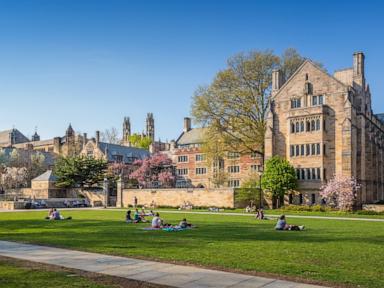
Yale is cornered, and the university's response is making almost everyone angry.
In May 2026, the U.S. Department of Justice leveled a massive accusation against the Yale School of Medicine, claiming the elite institution was running a race-based admissions system in direct defiance of the law. It was the latest salvo in a aggressive federal campaign targeting elite medical programs. But instead of preparing for a prolonged legal showdown to defend its principles, Yale quietly did what elite institutions often do when the heat gets turned up. They hired a high-powered law firm and started talking about a settlement.
This quiet scramble for a deal has sparked a fierce civil war on the New Haven campus.
Students are furious. Faculty groups are issuing scathing public warnings. Conservative watchdogs are accusing the school of trying to dodge accountability. By attempting to avoid a public courtroom battle, Yale risks doing something far worse: bargaining away the basic rights, academic freedom, and privacy of its own community just to protect its federal funding.
The Medical School Data That Triggered the Federal Threat
The current crisis started when Assistant Attorney General Harmeet Dhillon, head of the DOJ’s civil rights division, sent a blistering notice to Yale’s legal team. The federal government accused Yale of running a system that intentionally favored Black and Hispanic applicants at the expense of White and Asian peers.
The DOJ pointed to specific data from the incoming medical school classes of 2023, 2024, and 2025. According to the federal analysis, Black medical students admitted to Yale had a median Medical College Admission Test (MCAT) score of 518. Hispanic students had a median score of 517. Meanwhile, White and Asian admitted students had a median score of 524—putting them in the top percentile of all test-takers nationwide.
The DOJ took these numbers and ran a statistical model. Their conclusion was shocking. The agency claimed a Black applicant had up to 29 times higher odds of receiving an admissions interview than an Asian applicant with the exact same academic credentials.
Federal investigators argued that because Yale's diversity numbers barely shifted after the Supreme Court's landmark 2023 ruling ending race-conscious admissions, the university was actively circumventing the law. In its court filings during the original Harvard case, Yale had explicitly stated that no race-neutral alternative could yield the student diversity it desired. The DOJ essentially used Yale’s own words against it: if you said you couldn't maintain diversity without using race, and your diversity numbers didn't budge after the ban, you must still be using race.
Why Faculty and Students Are Accusing Yale of Cowardice
The backlash inside Yale is not coming from people who want to end affirmative action. It is coming from the very people who support it.
Faculty members and student organizers are deeply alarmed by reports that Yale is looking for an easy exit. In a scathing letter sent to Yale President Maurie McInnis and General Counsel Alexander Dreier, lawyers representing Yale’s chapter of the American Association of University Professors (AAUP) urged the university to reject any settlement.
The AAUP’s legal counsel, from the firm Sher Tremonte, tore into the DOJ's case. They pointed out that the federal government’s statistics were highly misleading because they isolated test scores and grades while completely ignoring other factors like socioeconomic background, geography, and prior clinical work experience.
They also challenged the DOJ’s "smoking gun" evidence: an orientation slide given to Yale admissions officers that referenced post-Supreme Court guidance. The DOJ claimed this slide proved that admissions staff were being given verbal instructions to bypass the law. Yale's faculty lawyers called this claim pure, unsupported speculation.
The real fear is what Yale will trade away to make the DOJ go away.
Historically, when elite universities settle civil rights investigations with a hostile executive branch, the students pay the price. Activists point to Columbia University, which recently agreed to release internal records of its international students to settle a federal probe. They point to Northwestern University, which bargained away student flyer-posting privileges to settle a separate dispute.
If Yale settles, will it hand over private student records? Will it restrict campus protest policies? Will it allow federal monitors to dictate classroom curricula?
Student leaders say any settlement that sacrifices these rights is a complete betrayal. International students at Yale are already expressing anxiety that their legal status in the country could be compromised if the university decides to share sensitive documentation with federal investigators.
The Massive Financial Threat Behind the Scenes
It is easy to wonder why Yale does not simply fight this out in court. After all, Yale has some of the best legal minds in the world on its payroll and an endowment worth tens of billions of dollars.
But the federal government holds an economic weapon that no university, no matter how wealthy, can ignore.
The Yale School of Medicine and its affiliated hospital systems rely on hundreds of millions of dollars in federal research grants and contracts every single year. The National Institutes of Health (NIH) funds the vast majority of academic medical research in America. If the DOJ files a formal lawsuit and finds Yale in violation of Title VI of the Civil Rights Act, that federal funding stream can be completely severed.
For a major medical center, losing NIH funding is an existential threat. It would shut down laboratories, halt clinical trials, and ruin the school's reputation overnight.
This financial reality explains why Yale hired McGuireWoods, a high-powered Virginia law firm. McGuireWoods has a track record in this area; they recently helped the University of Virginia settle its own high-profile dispute with the federal government in 2025. The strategy is obvious. Yale is hoping to write a check, tweak its admissions paperwork, and keep the federal money flowing, even if it means admitting to statistical disparities they otherwise would have defended.
The Death of Multi-Factor Student Review
This battle highlights a much larger structural crisis in American higher education.
Ever since the Supreme Court struck down affirmative action, universities have relied on individualized, multi-factor reviews to build diverse classes. They look at an applicant's life story, their challenges, and their unique talents, rather than relying solely on standardized test scores.
But the DOJ’s actions against Yale and UCLA show that the federal government now views these multi-factor policies as a illegal smokescreen. The government is arguing that looking at socioeconomic status or regional recruitment is simply using "racial proxies" to achieve the same old diversity goals.
If the DOJ succeeds in forcing Yale to settle, it will set a dangerous precedent. It will mean that any university using non-numerical criteria to evaluate students can be accused of racial bias if their final enrollment numbers do not perfectly mirror standardized test scores.
It forces universities into a corner where the only safe option to avoid federal investigation is to rely purely on GPA and test scores. This would fundamentally change the nature of American medical education, turning it into a system that values test-taking ability above clinical empathy, community service, or diverse perspectives.
What Yale Needs to Do Next
Yale's leadership cannot afford to take the easy way out. Capitulating to the DOJ might save their immediate research funding, but it will permanently damage the trust between the administration, the faculty, and the student body.
If Yale wants to preserve its integrity, it must take three immediate steps.
First, the administration must establish clear red lines for any negotiation. Under no circumstances should the university agree to hand over confidential student records, restrict student speech, or allow federal oversight of its academic curriculum.
Second, Yale needs to be entirely transparent with its faculty and students about the negotiation process. Holding closed-door talks with federal investigators while keeping the campus in the dark only breeds distrust and fuels the current backlash.
Finally, Yale must join forces with other targeted institutions, like UCLA, Stanford, and Ohio State, to mount a coordinated legal and public defense of comprehensive admissions policies.
Yielding to federal pressure will not satisfy the critics. It will only embolden them to demand more concessions, leaving Yale’s values completely hollowed out.