The chai wallah outside the grand hotel in Kazan moves with a rhythm older than empires, pouring boiling milk into clay cups from a height that defies gravity. Steam rises, mixing with the crisp autumn air of Russia, where leaders from every corner of a shifting globe have gathered. Inside the summit halls, heavy oak doors close. Handshakes are exchanged under chandeliers that have witnessed centuries of shifting thrones. But outside, on the dusty trading posts stretching from the ports of Chabahar to the sprawling bazaars of Tehran, the real story is being written in ink and ambition.
Consider what happens when two men who carry the weight of ancient civilizations sit across a mahogany table. Meanwhile, you can explore other events here: The Narrow Thread Holding the World Together.
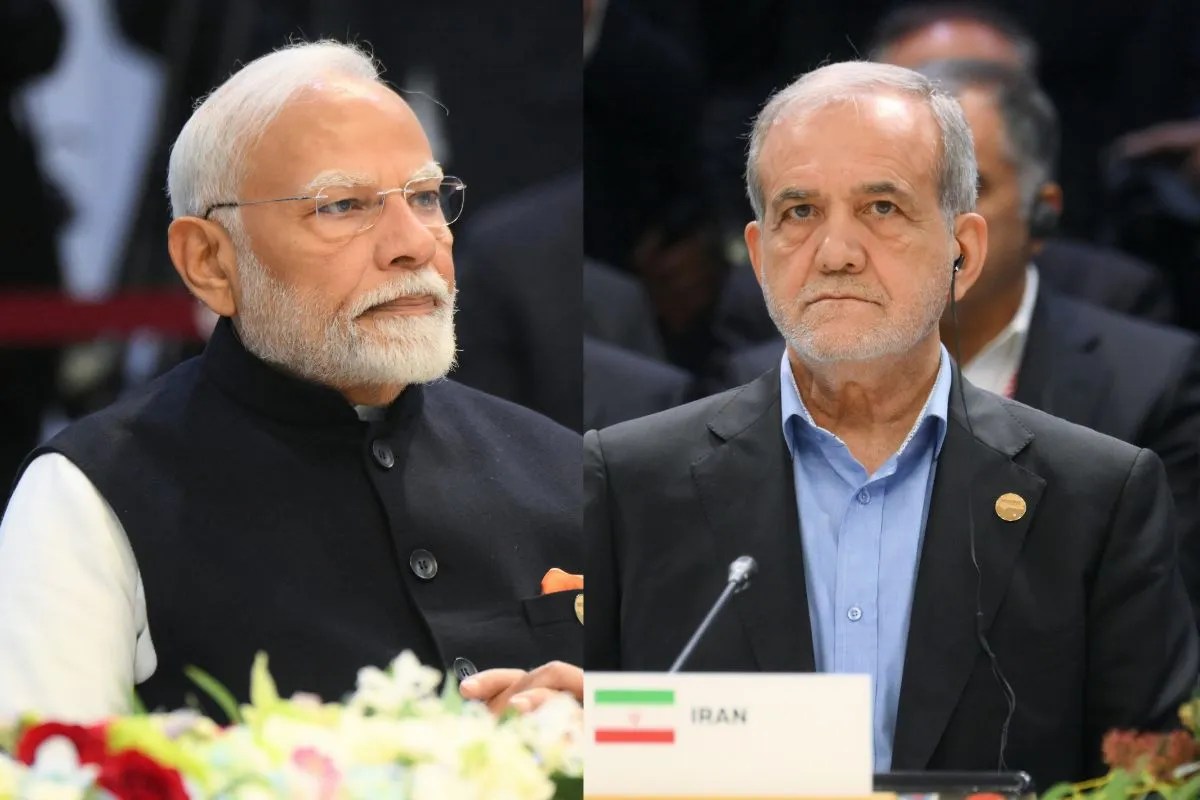
Indian Prime Minister Narendra Modi and Iranian President Masoud Pezeshkian did not just pose for cameras under the glaring lights of the international press. They carved out a space in a fractured world. For decades, the narrative of international relations has been written in Washington and Brussels, dictated by sanctions, embargoes, and the cold arithmetic of exclusion. Yet, history has a stubborn habit of finding alternative routes. When water is dammed in one place, it simply carves a new canyon through the stone.
The meeting between Modi and Pezeshkian on the sidelines of the BRICS summit was precisely that. A new canyon. To see the full picture, check out the recent report by Reuters.
To understand why this matters, you have to look beyond the sterile press releases about bilateral trade and geopolitical strategy. Walk with me down the narrow alleys of a carpet warehouse in Isfahan, where the scent of lanolin and aged wool hangs heavy in the afternoon light. Here, old men with eyes like weathered parchment tie knots that take months to complete. For years, their masterpieces have struggled to find their way to the bustling living rooms of Mumbai or Delhi. Not because the demand wasn't there. But because the invisible walls of financial blockades and maritime restrictions made the simple act of buying and selling feel like smuggling contraband.
Sanctions are often discussed in boardrooms as percentages and policy vectors. On the ground, they are human friction. They are the merchant whose cargo sits idle on a container ship while bureaucrats debate insurance liabilities. They are the student who cannot wire tuition, the family waiting for medicine, the entrepreneur whose dreams are choked by the sheer weight of bureaucratic distance.
Now, imagine the sound of those walls cracking.
When President Pezeshkian made his post-meeting announcement regarding the expansive new horizons of trade through the BRICS coalition, he was not just speaking to diplomats. He was speaking to that merchant in Isfahan. He was talking to the freight forwarder in Gujarat staring at a map of the Indian Ocean, tracing a line from the western coast of India straight up into the sun-baked stones of Iran's Chabahar Port.
Chabahar is more than a dot on a map. It is an economic lifeline.
For India, landlocked from direct access to Central Asia and Afghanistan due to complex regional rivalries, Chabahar has long been the open door to the north. It is the modern iteration of the ancient Silk Road, paved not with camel tracks, but with container cranes, deep-water berths, and strategic foresight. Through this port, Indian goods can bypass traditional bottlenecks, sliding past geopolitical tripwires and flowing directly into the heart of Eurasia.
During their talks, Modi and Pezeshkian focused sharply on accelerating this connectivity. They spoke of the International North-South Transport Corridor—a multi-modal network of ship, rail, and road route designed to move freight faster, cheaper, and safer than ever before.
Listen closely to the mechanics of this shift. When transit times drop from weeks to days, the entire calculus of commerce changes. A shipment of pharmaceuticals leaving a laboratory in Hyderabad reaches a hospital in Central Asia not after a grueling, circuitous journey around hostile borders, but via a streamlined, predictable artery. That is not just efficiency. That is human relief.
Yet, skeptics will point to the shadows. They will whisper of Washington's watchful eye, of the complex web of secondary sanctions that makes dealing with Iran a high-stakes chess match. They will argue that ambition often outstrips execution, that grand communiques issued in opulent summit halls rarely survive the harsh contact with reality.
They are not entirely wrong. Geopolitics is a brutal, unforgiving sport. Trust is a rare commodity traded on the dark market of national self-interest.
Yet, the gravitational pull of BRICS changes the physics of the room. By expanding its membership and economic architecture, BRICS is deliberately building an alternate financial and logistical gravity. It is creating a space where nations constrained by Western-dominated financial systems can trade, settle accounts, and build infrastructure without constantly looking over their shoulders. It is the financial equivalent of building a parallel electrical grid because the main power plant keeps cutting the lights in your neighborhood.
When India and Iran lean into this framework, they are betting on a multipolar future. They are acknowledging a fundamental truth of the twenty-first century: power is no longer concentrated in a single capital. It is dispersed, fluid, and multipronged.
Think of the young software engineers in Tehran collaborating remotely with logistics startups in Bengaluru, or the agricultural trade exchanges that ensure food security in regions prone to supply shock. These are the invisible threads weaving nations together long before the headlines catch up. The political meeting in Kazan was merely the spark. The fire is already burning in the warehouses, the shipping lanes, and the quiet negotiations of merchants who have traded across the Arabian Sea for three thousand years.
The tea in the clay cup cools. The world outside the hotel window shifts from afternoon gold to twilight blue. Leaders pack their briefcases, board their gleaming jets, and fly back to domestic crises and roaring parliaments.
Back in the ports, however, the cranes keep turning. The ships keep moving. The ancient routes, long dormant under the winter frost of isolation, are waking up to the sound of a new century.
And no amount of diplomatic static can silence that noise.