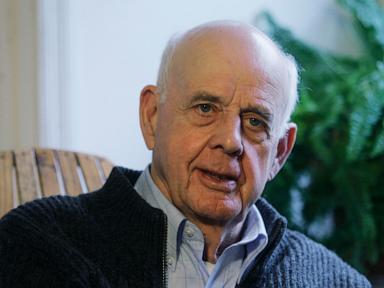
Wendell Berry did not die an easy prophet, because an easy prophet is just a mirror for whatever cultural vanity is currently in style. When the Kentucky agrarian and essayist drew his last breath at his Port Royal home at the age of ninety-two, the digital wire services rushed to frame him as a gentle grandfather of the back-to-the-land movement. They painted him as a quaint eccentric who preferred horses to tractors and wrote lovely poems about wood ducks and clearing brush. This is a comforting lie. It sanitizes a fierce, uncompromising radical whose life’s work was a direct indictment of the economic machinery that every single one of us relies upon every hour of the day.
Berry was never interested in simple nostalgia. He understood that industrial capitalism was eating the soil, hollowing out communities, and treating human beings as disposable inputs for a quarterly growth metric. Long before climate collapse became a standard corporate marketing talking point, Berry diagnosed the rot. He pointed out that you cannot mortgage the physical integrity of the earth to pay for short-term financial convenience without eventually facing a foreclosure that no central bank can bail out. Don't forget to check out our recent article on this related article.
The Price of Convenience
We live in an era built on the absolute elimination of local responsibility. If a lightbulb burns out, a widget breaks, or a package needs moving across three continents, an army of invisible algorithms and low-wage logistics workers ensures it happens with minimal friction. Berry spent six decades arguing that this friction-free existence is actually a moral catastrophe. When you sever the connection between the person who consumes a good and the place where that good is produced, you destroy the capacity for care.
Consider how we treat food. To a modern agricultural conglomerate, a calorie is just a unit of financial exchange produced by fossil-fuel-driven machinery, heavy chemical inputs, and topsoil exhaustion. To Berry, food was the primary bond joining humanity to the earth. If you poison the creek running through your bottomland to squeeze an extra bushel of corn out of the acreage, you are stealing from your grandchildren. To read more about the background of this, NPR provides an informative summary.
The mainstream obituaries praise his eloquence while neatly ignoring his specific demands. Berry did not just write essays; he practiced a severe form of localism. He walked behind draft horses when he could have bought a diesel tractor. He refused to participate in cultural ceremonies he found spiritually hollow. He argued that true freedom is not the ability to buy anything from anywhere at any time, but rather the local competence to provide for your own community without destroying it in the process.
The Myth of Sustainable Growth
Modern institutions love to talk about sustainability. It is a wonderful word because it means absolutely nothing until you define the limits. Corporations want to sustain their profit margins while changing the color of their delivery vans to green. Governments want to sustain endless GDP expansion while hitting arbitrary emissions targets three decades down the road.
Berry exposed the absurdity of this logic with the cold precision of a man who actually knew how to fix a broken fence gate. Infinite growth on a finite planet is the ideology of a cancer cell.
When corporate titans and technocrats talk about saving the world, they usually mean inventing a new app or subsidizing a new class of billionaire-owned green energy infrastructure. Berry argued that the work cannot be outsourced to distant experts or solved by clever gadgets. It requires the slow, unglamorous, localized labor of restoration. It means planting trees you will never sit under. It means repairing what is broken instead of throwing it away. It means staying put in a single place long enough to care about what happens to it when you are gone.
Most people who read Berry treat him the way tourists treat a national park. They visit for the scenery, admire the moral clarity of his prose, and then return to their hyper-mobile, consumption-driven lives unchanged. They compartmentalize his warnings as poetry rather than policy.
The Cost of Leaving Home
One of the central tragedies Berry diagnosed was the great evacuation of rural America. For generations, the economic design of the country has functioned like an extraction engine, pulling bright young minds out of small towns and farming communities and funneled them into metropolitan hubs to work in finance, tech, and corporate law.
We celebrate this migration as social mobility. Berry saw it as cultural stripping. When you drain a place of its people, its memory, and its local economic capacity, you are left with hollowed-out landscapes plagued by despair, addiction, and economic dependency. The people left behind are mocked by urban elites as backwards, while the cities themselves become hyper-densified pods of alienation where nobody knows their neighbor's last name.
Berry stayed in Henry County, Kentucky, not out of stubbornness, but out of structural integrity. He insisted that you cannot love humanity in the abstract if you despise the actual neighbors who live down your road. He wrote that eating is an agricultural act, meaning every meal is an ecological vote. Every choice we make either builds up a local community of care or feeds the distant, ravenous maw of the global supply chain.
What Remains After the Prophet
Now that he is gone, the temptation will be to canonize him safely behind glass. Universities will establish lecture series in his honor. Politicians who vote for industrial deregulation will tweet lines from his poems. Corporate PR departments will use his imagery of rivers and soil to wrap their latest extraction schemes in a shroud of rustic authenticity.
Do not let them get away with it.
Wendell Berry left behind a body of work that makes most modern political discourse look like children playing with blocks. He did not offer a neat political platform that fits into the left-right binaries of our polarized age. He rejected the industrial left's obsession with centralized state management just as fiercely as he rejected the industrial right's worship of unfettered corporate greed.
The challenge he left behind is far more difficult than voting for a candidate or buying organic produce at a specialty grocery store. It requires us to look at the supply chains we feed, the land we occupy, and the communities we abandon in our relentless pursuit of personal advancement.
The soil in Henry County will keep turning without him. The creeks will rise with the spring rains, and the oak trees will drop their acorns into the dark earth. The only question left is whether anyone is paying attention to the blueprint he spent a lifetime drawing in the dirt.


