The salt air of the Pacific carries more than just cargo. It carries uncertainty.
Stand at the edge of the Port of Long Beach at three in the morning, and the world feels small, suspended between towering cranes and ink-black water. Every container stacked six high represents a promise made months ago across an ocean. A factory in Guangdong finished the molds. A freight forwarder in Chicago booked the rail space. A family in Ohio ordered the patio set. Behind every steel box lies a quiet machinery of human effort, entirely dependent on decisions made thousands of miles away by two men who have never shared a quiet cup of coffee without an army of aides watching every blink.
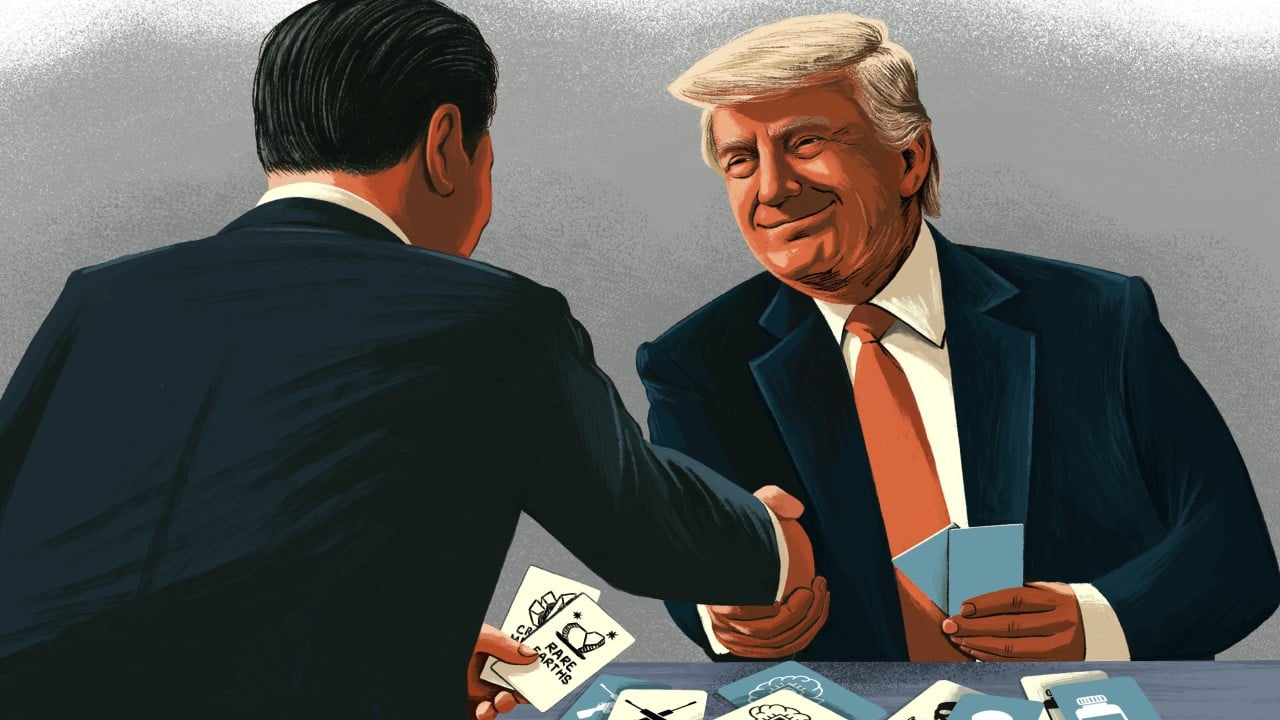
Donald Trump and Xi Jinping occupy spaces of monumental gravity. When they meet, the financial ticker tape in New York pauses. Currency exchanges twitch in Frankfurt. Rice traders in Sichuan adjust their pricing. Yet the reality of their interaction is rarely found in the polished communiques released to the press. It lives in the quiet friction between political survival and economic gravity.
Consider what happens when a tariff is signed into law. To a television audience, it is a stroke of a pen. To Arthur Vance, a supply chain director in St. Louis who has spent twenty-eight years managing industrial valves, it is an earthquake.
Arthur remembers the spring of 2018 vividly. He sat in his cramped office surrounded by blueprints, watching a morning broadcast announce a sudden escalation in duties on Chinese steel imports. His phone rang before the anchor finished the sentence. His primary supplier in Zhejiang was weeping over a crackling connection, asking if twenty shipments already on the water would be honored or blocked. Arthur did not care about geopolitical strategy that morning. He cared about his payroll, his delivery timelines, and the three hundred workers in his Missouri warehouse whose livelihoods depended on components that suddenly cost twenty-five percent more than they did twenty-four hours prior.
That is the human baseline of superpower friction. It is not abstract. It is concrete, messy, and relentless.
Both leaders carry immense domestic weight. Xi Jinping rules a nation of 1.4 billion people whose collective memory is scarred by foreign humiliation and fueled by an unshakeable national rejuvenation narrative. For Beijing, strength is absolute. Concession is weakness. Every policy emanating from Zhongnanhai is calibrated to project stability, technological self-reliance, and absolute authority of the party. To back down under external pressure is to risk the foundational social contract of modern China: economic growth traded for political obedience.
Across the ocean, Donald Trump commands a populist movement born from the hollowed-out industrial towns of the American Rust Belt. For his base, the decline of domestic manufacturing was not a natural economic shift; it was a betrayal by globalist elites who traded American futures for cheap consumer goods. His political currency is disruption. He measures strength by his willingness to shatter established norms, impose unilateral demands, and treat international trade as a zero-sum contest where a win for the other side is an inherent loss for home.
Put these two forces in the same room, and physics takes over.
An immovable object meets an unstoppable force. Except neither object is immovable, and neither force is truly unstoppable. Both men face severe constraints. China's domestic economy faces real estate headwinds, demographic aging, and mounting local government debt. The United States contends with persistent inflation, ballooning national debt, and deep political polarization that turns every legislative victory into a partisan war.
When they sit down to negotiate, they do not just bargain over trade deficits or intellectual property theft. They negotiate their own political survival. Every concession must be packaged as a triumph for domestic consumption. Every compromise must be disguised as strategic patience.
This is why traditional diplomacy often fails when applied to this dynamic. Bureaucrats love frameworks, memorandums of understanding, and multi-year phased agreements. Neither Trump nor Xi operates comfortably inside the slow machinery of multilateralism. They prefer personalism. They believe in the power of the summit, the direct phone call, the handshake deal struck away from the blinding lights of the diplomatic corps.
Yet personalism has a fatal flaw. It is entirely dependent on the moods, egos, and immediate political incentives of the individuals involved.
Imagine a hypothetical scenario inside a private dining room in Florida or a secluded estate in Hangzhou. The cameras are gone. The translators speak in hushed tones. The two leaders sit across from each other, surrounded by porcelain tea sets and heavy silence.
Trump leans forward, pointing out that American voters will punish any administration that permits the hollowing out of domestic industries. He speaks in terms of bargaining power, of tariffs as weapons, of absolute limits. He wants immediate purchases, tangible concessions on agricultural exports, and a visible reduction in the trade imbalance.
Xi listens calmly, his expression carefully neutral. He counters with the long view, reminding his counterpart of history's arc. He speaks of sovereignty, of technological independence, and of the indignity of foreign dictation. He makes it clear that China will endure economic pain before it accepts public humiliation. He holds cards of his own: control over critical mineral supply chains, massive holdings of American treasury bonds, and a domestic market so vast that multinational corporations cannot afford to abandon it.
In that room, a realization inevitably hangs in the air. Total victory is impossible for either side.
If Trump pushes too hard, American consumers face skyrocketing prices, stock markets plunge, and his own economic narrative collapses before an election cycle. If Xi stands too firm, factories close across eastern China, youth unemployment rises, and the promise of national rejuvenation stutters.
Interdependence is a cage built by decades of globalization. Neither man likes the cage, but neither man possesses wire cutters strong enough to break it without bringing the roof down.
Consider how this dynamic plays out in the modern tech arena, where the stakes are existential rather than merely commercial. Silicon chips are the oil of the twenty-first century. Every smartphone, fighter jet, medical scanner, and financial network relies on microprocessors that pass through multiple borders before reaching their final destination. American design meets Taiwanese manufacturing, powered by Dutch lithography machines and raw materials sourced from half a dozen developing nations.
When Washington attempts to choke off advanced semiconductor exports to Beijing, it is not merely throwing sand in the gears of a competitor. It is attempting to sever a nervous system that took thirty years to grow. In response, Beijing pours billions into indigenous research, rallying scientists and engineers around a singular, urgent mission of technological autonomy.
Both sides believe they are securing their future. Both sides are also creating permanent structural scars.
Step back from the summit rooms and look at the broader pattern. Over the past decade, the relationship has evolved from naive engagement to strategic competition, and finally to managed containment. Yet trade continues to flow across the Pacific like a relentless tide. Ships leave Shanghai every hour. Cargo unloads in Los Angeles. Billions of dollars in commerce move quietly beneath the roaring headlines of geopolitical posturing.
Why? Because the economic gravity between the two largest economies on Earth is stronger than the political rhetoric of any single leader.
Consider the quiet resilience of supply chains. When tariffs were slapped on electronics and machinery, businesses did not simply pack up and vanish. They adapted. They rerouted components through Vietnam, Mexico, and India. They paid higher costs, absorbed thinner margins, and passed some of the burden onto consumers. They built redundancy where there was once only efficiency. It was expensive, slow, and frustrating, but human ingenuity proved far more flexible than political edicts.
This adaptation reveals a fundamental truth about modern power. Governments can build walls, but markets carve rivers.
When people ask whether these two leaders can make progress, they usually mean: Can they sign a grand bargain that solves everything once and for all?
The answer is no. Grand bargains belong to a different era. The structural distrust is too deep, the ideological divergence too wide, and the domestic political incentives too misaligned for a permanent truce.
Instead, progress takes a different, less glamorous shape. It looks like de-escalation around the edges. It looks like establishing emergency communication channels to prevent a naval collision in the Taiwan Strait or a sudden financial panic. It looks like tacit agreements to exempt critical pharmaceutical ingredients from trade wars, or coordinating on climate research even while competing for artificial intelligence dominance.
It is a cold, pragmatic dance.
Back in St. Louis, Arthur Vance does not care about geopolitical theory or strategic doctrines. He cares whether his next shipment of hydraulic valves clears customs without a twenty-day delay. He cares whether his costs will spike unpredictably next Tuesday.
As the sun rises over the Port of Long Beach, illuminating the endless rows of colorful shipping containers, the cranes begin to move again. Steel cables groan under heavy loads. Diesel engines rumble to life. Thousands of workers clock in, loading trucks that will carry goods across a continent.
The leaders in Beijing and Washington will wake up soon to a new cycle of briefings, headlines, and political calculations. They will posture for their audiences. They will draw red lines in the sand. But beneath their grand strategies and high-stakes maneuvering lies the quiet, relentless momentum of human commerce—a vast, interconnected web of labor, ingenuity, and desire that refuses to stop spinning simply because two powerful men are locked in a room, testing each other's weight against the limits of the world.


