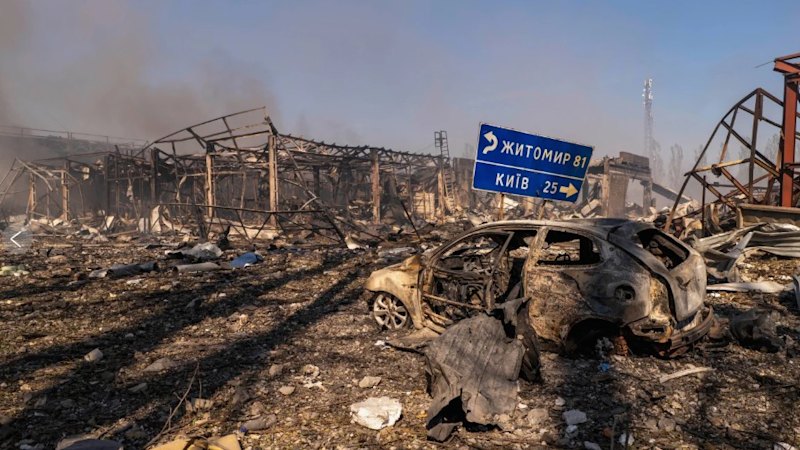
The morning air in western Ukraine tasted of damp earth and coming rain, the kind of quiet that feels too heavy to last. In towns miles away from the front lines, people still woke to the familiar ritual of brewing coffee while listening for the low, distant thrum of the morning news. They lived in the margins between survival and ordinary routines, where an open grocery store or a running bus felt like a small act of defiance.
Then came the flash.
It was not a sound at first, but a pressure against the chest, a sudden vacuum that pulled the breath right out of the lungs. Windows rattled in their frames. Distant birds scattered into a gray sky. Somewhere beneath that smoke lay an ammunition warehouse, a sprawling storage facility holding the literal iron and thunder required to keep a nation's defense alive.
When the official reports finally flickered onto screens later that day, they arrived stripped of breath. They spoke in the sterile language of logistics and military accounting. They noted it as the deadliest strike of the year.
Numbers. Percentages. Tonnes of ordnance lost.
Military statistics are designed to distance the mind from the reality of the event. We read about a warehouse, and we picture a concrete box with steel doors, empty shelves, perhaps a forklift sitting idle. But behind that sterile term lies a complex ecosystem of human effort, sweat, and desperate necessity.
Consider what a logistics hub actually looks like on the ground. (Note: The following scene is a hypothetical reconstruction based on standard military supply operations to illustrate the human element behind the headlines.) Picture a sergeant named Mykola, fifty-two years old, his hands permanently stained with grease from working old diesel trucks. He spent his nights checking inventory lists by the dim, flickering light of a battery-powered lamp, matching serial numbers of artillery shells to unit requests coming in from muddy trenches in the east. To Mykola, those wooden crates were not just abstract supplies. They were the thin barrier keeping an enemy mortar battery five hundred meters further away from a village schoolhouse.
When a facility like that is targeted, the loss echoes far beyond the cratered earth. It is felt in the sudden, terrifying silence of an artillery unit three days later when they are forced to ration their remaining rounds. It is felt in the hurried phone calls made in low, tense whispers, calculating how many days of resistance remain before the next shipment can possibly be rerouted through blocked roads and congested rail lines.
War is often romanticized as a clash of grand strategies, of maps pushed across mahogany tables by commanders in distant capitals. But the raw truth is far more fragile. War is maintained by grease, sweat, paper forms, and tired people working in cold warehouses under the constant, humming threat of the sky.
The strike this year stands out not merely because of the tonnage destroyed, but because of what it represents in the brutal mathematics of attrition. Modern defense does not run on courage alone; it runs on steel, propellant, and copper. Every shell lost in a warehouse blaze is a delayed counter-offensive, a prolonged night under bombardment for civilians huddled in damp basements, and an extra week of uncertainty for families waiting for loved ones to return home.
We struggle to comprehend the scale of modern conflict because our brains are wired for the personal, the local, the tangible. We understand the loss of a single home, a single street, a single friend. When numbers climb into the dozens, the hundreds, the thousands, they blur into an abstract haze.
Yet every single projectile that went up in smoke in that warehouse had a story of procurement behind it. It had been manufactured in a distant factory, loaded onto a flatbed truck, driven across international borders through snow and rain, checked by inspectors, and stacked meticulously by hands that probably ached from the bitter cold.
When that supply line is severed by a sudden missile strike, the fracture travels outward in widening ripples.
We must ask ourselves what remains when the smoke finally clears and the emergency responders pack up their gear. The crater will eventually fill with rainwater. The twisted iron will be cleared away. The casualty lists will be folded, filed, and stored in government archives.
What remains is the quiet test of endurance.
In the hours after the explosion, emergency crews did not stop to debate the grand strategy of the conflict. They pulled survivors from the rubble. They patched their equipment. They lit lanterns and went back to work in the dark, because the fundamental reality of their situation had not changed, even if the landscape around them had been irrevocably altered. The line had to be held. The supply had to be replaced.
The sirens wailed again before the sun had even fully set, a thin, mechanical screech cutting across the bruised evening sky, urging everyone back down into the earth.