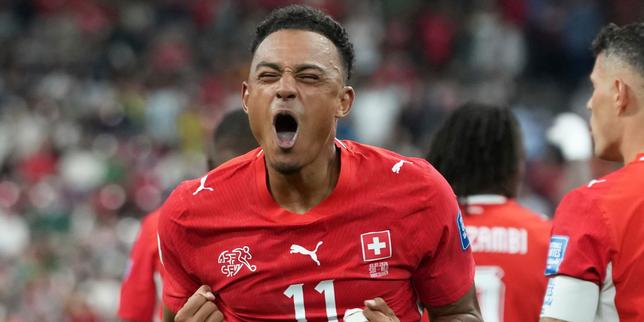
The grass underfoot at full-time does not care about statistics. It feels heavy, damp, and unforgiving, holding onto the scuff marks of ninety minutes of desperation. For Neftali Manzambi, standing in the center circle while the echoes of the final whistle still vibrated through the stadium structure, the dampness of the pitch felt like validation.
Switzerland had just defeated Algeria. On paper, it reads like a standard international fixture, a notation in a tournament bracket, a data point for analysts to dissect over morning coffee. But football is rarely about the ink on the ledger. It is about the suffocating pressure that builds in the tunnel before the lights hit your eyes. It is about the quiet, terrifying knowledge that a single misstep can turn a lifetime of sacrifice into a footnote of failure. Don't forget to check out our earlier article on this related article.
For weeks leading up to the match, a quiet skepticism hung over the Swiss camp. The pundits spoke in measured, doubtful tones. They questioned the chemistry. They analyzed the formation like it was a flawed mathematical equation. They looked at the squad and saw a collection of individual names rather than a cohesive unit capable of dismantling a fiercely passionate Algerian side.
Manzambi felt that skepticism. Every player does, no matter how loudly they claim to ignore the noise. It sits in the back of the throat during warm-ups. It sharpens the focus. If you want more about the background of this, The Athletic offers an excellent breakdown.
Then, the game kicked off.
The Invisible Battle on the Pitch
International football is a brutal psychological experiment. You take athletes from different club systems, with different habits and rhythms, and force them into a singular identity within a matter of days. Algeria came with fire. They moved with a frantic, aggressive energy that threatened to swallow the Swiss midfield whole in the opening twenty minutes.
Consider the anatomy of a high-stakes match. To the spectator in row twenty, it looks like twenty-two men chasing a leather sphere. Up close, it is a chess match played at sixty miles an hour. Every diagonal run requires a blind faith that your teammate will see the space before it vanishes. Every defensive block is a gamble against momentum.
The Swiss response was not flashy. It was deliberate.
Manzambi and his compatriots began to find the rhythm that had eluded them in training. They stopped reacting to the Algerian press and started dictating the geography of the pitch. The ball moved from the backline with a crisp, snapping certainty.
Imagine standing on a thin tightrope while thousands of people scream for you to fall. That is what it feels like to retain possession under a high press. One heavy touch, one lazy pass, and the stadium explodes. But the Swiss touches were light. Clean. Precise.
When the breakthrough came, it was not a product of luck. It was the result of a collective exhale. A sequence of three passes—each one slightly more daring than the last—sliced through the Algerian midfield, leaving the defenders chasing shadows. The back of the net rippled.
The Statement Beyond the Scoreline
Winning a match is one thing. Proving a point is another entirely.
"Hemos demostrado nuestra calidad."
We have demonstrated our quality. Manzambi uttered those words in the post-match mixed zone, the adrenaline still visibly coursing through his veins. It was not a boast. It was a correction of the record. It was the statement of a man who had heard the whispers and chose to answer them with ninety minutes of relentless work.
Quality in football is often misunderstood. People look for the step-overs, the fifty-yard volleys, the viral highlights that fit neatly into a fifteen-second social media clip. But true quality is boring. It is the unglamorous coverage of a teammate’s vacated space. It is the decision to keep the ball simple when the crowd is begging for a miracle. It is the mental stamina required to defend a one-goal lead when your lungs are burning and your calves are on the verge of seizing.
The victory over Algeria was a masterclass in that unglamorous quality. The Swiss team did not just survive the Algerian onslaught in the dying minutes of the match; they managed it. They slowed the tempo down, drew fouls in non-threatening areas, and turned the closing stages of a chaotic football match into a display of clinical efficiency.
The Echoes in the Dressing Room
The true shifts in a team’s destiny do not happen in front of the cameras. They happen behind heavy double doors, where the air smells of wintergreen oil, sweat, and muddy boots.
As the Swiss players filed off the pitch, the exhaustion was palpable. Neftali Manzambi sat on the bench, peeling the wet tape from his socks. The noise from the Algerian supporters outside was still audible, a distant, rhythmic thumping against the concrete walls of the stadium. But inside, there was a different kind of silence. A satisfied silence.
This victory did not solve every problem. It did not guarantee a trophy, nor did it mean the next match would be any easier. The skeptics would return tomorrow with new theories, new critiques, and new doubts. That is the nature of the beast.
But for one night, the narrative belonged entirely to the men who wore the red shirt. They had faced the fire of a proud opponent and the cold wind of public doubt, and they had stood firm. They had shown their quality, not just to the world, but to themselves.