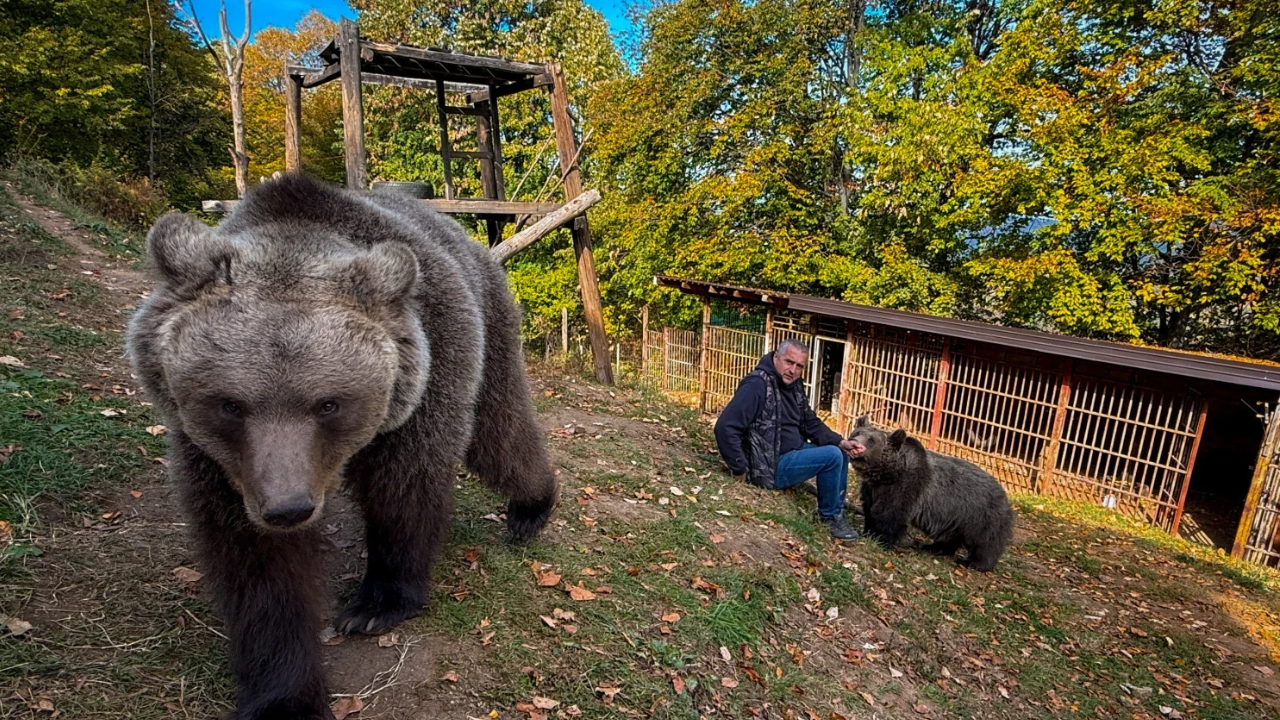
The smell hits you first. It is not the sharp, sterile ammonia of a municipal zoo, nor the wild, loamy musk of a deep forest floor. It is the heavy, sweet-and-sour scent of fermenting apples, damp pine needles, and three hundred kilograms of wet fur warming in the morning sun.
In a quiet valley near Gornji Vakuf-Uskoplje, a town scarred by the brutal geometry of the 1990s Bosnian war, a retired electrician named Emir Nailović wakes up every day to a problem that the European Union, the Bosnian government, and two hundred years of wildlife biology have failed to solve. He walks out of his back door, past the garden where his family used to plant potatoes, and comes face-to-face with three massive European brown bears.
Laka. Maša. Grizli.
They are not circus performers. They are not wild apex predators roaming the Dinaric Alps. They are orphans of human carelessness, rescued from illegal roadside cages, poachers' traps, and the quiet cruelty of being treated as novelties until their claws grew too long and their appetites too expensive. For years, Emir has poured his pension, his savings, and the physical space of his own family home into keeping them alive.
And now, the clock is running out.
The Architecture of an Accidental Sanctuary
To understand how an electrician ends up sharing his backyard with animals capable of shattering a cow's spine with a single swipe, you have to understand the postwar vacuum of the Balkans.
When the Dayton Accords silenced the guns in 1995, Bosnia and Herzegovina was left with a fractured administrative system—two entities, ten cantons, and a bureaucratic maze where environmental law frequently falls between the cracks. While the Dinaric Alps remain one of Europe’s last true strongholds for large carnivores, housing an estimated 1,000 to 1,200 brown bears, the legal infrastructure to protect them when things go wrong simply does not exist. There is no state-run bear sanctuary in Bosnia. There is no emergency wildlife rescue fund waiting on standby when a mother bear is shot by poachers and her cubs are left shivering in the snow.
Enter Emir Nailović.
Years ago, when the first cub arrived, it was supposed to be temporary. A mercy. You cannot look at a starving, whimpering ball of fur no bigger than a housecat and lecture it on jurisdictional funding gaps. So Emir built a pen. Then he reinforced it with heavy steel bars, bending the metal with the same patient, methodical precision he once used to wire high-voltage circuits. When a second bear needed shelter, the backyard shrank again. When a third arrived, the Nailović family’s domestic life was permanently rewritten.
Think of raising a brown bear in a residential yard like trying to hold back a rising river with sandbags. At first, a few sacks do the trick. The water laps gently at your boots. You feel heroic. Then the spring thaw hits, and suddenly you are stacking bags at three in the morning in the pouring rain, realizing that if you stop for even ten minutes, the entire valley floods.
Every day requires dozens of kilograms of food. Apples, corn, bread, meat, honey, fish. In a country where the average monthly pension hovers around 250 to 300 euros, feeding three adult brown bears is not a hobby. It is financial self-immolation. Emir does not go on vacations. He does not buy new tools unless the enclosures demand it. His hands, calloused and stained with grease and sap, belong entirely to the giants behind the mesh.
What Happens When Love Outgrows the Cage
Sit on the wooden bench outside Emir’s fence for an hour, and you begin to see the invisible friction between salvation and captivity.
When Laka lumbers toward the wire, his massive head swaying with that hypnotic, pendulum rhythm unique to ursids, he does not snarl. He huffs—a soft, rhythmic expulsion of air that sounds remarkably like a tired old man sighing into a pillow. He knows Emir’s footsteps. He knows the cadence of Emir’s voice. Through the thick steel grid, the electrician reaches out, his fingers brushing the coarse, dusty guard hairs behind the bear's ears. The predator leans into the touch, eyes half-closed.
It is an astonishing image. It is also a tragedy in slow motion.
Because here is the brutal truth that wildlife biologists know and animal lovers hate to hear: you cannot put these bears back in the wild. Never. A bear raised by human hands loses its foundational survival architecture. It does not know how to forage across fifty square kilometers of mountain terrain; it knows that food arrives in a plastic bucket at 7:00 AM. It does not fear the scent of woodsmoke or the sound of a diesel engine; it associates humans with calories and comfort. Releasing Laka, Maša, or Grizli into the Bosnian mountains would be a death sentence—either they would starve before the first frost, or they would wander into a neighboring village looking for an easy meal and be shot within forty-eight hours.
At the same time, a backyard in Gornji Vakuf-Uskoplje is not a forest.
Wild brown bears walk miles every day. They dig dens into steep, rocky slopes. They swim in freezing mountain rivers, strip bark from deadfall to hunt beetle larvae, and spend half the year in a state of metabolic suspension. Inside a domestic enclosure, no matter how lovingly maintained or how sturdily welded, a bear’s world is compressed into square meters. Concrete floors wear down their pads. Boredom creeps in like dampness through brick. And the man keeping them alive is not getting any younger.
The Invisible Stakes of a One-Man Safety Net
Let us step outside Bosnia for a moment and imagine a hypothetical scenario. Picture a suburban neighborhood in Ohio or Bavaria. Now imagine a retired mechanic in that neighborhood quietly housing three fully grown grizzly bears behind a chain-link fence because the local Department of Natural Resources refused to return his phone calls. Within forty-eight hours, helicopters would be circling the block. SWAT teams, veterinarians with tranquilizer rifles, and federal inspectors would descend on the cul-de-sac. The mechanic would be arrested, the bears seized, and a multi-million-dollar sanctuary mobilized to absorb them.
In Bosnia, there are no helicopters. There is only silence.
For years, local authorities looked the other way because Emir was solving an embarrassing problem for free. If the state confiscated the bears, the state would have to feed them, house them, and pay veterinarians to care for them. By leaving them in Emir’s backyard, officials could check a box, avoid a budget line item, and let a private citizen carry the moral and financial weight of an entire nation's failure to enforce its own hunting and wildlife laws.
Yet look at what happens to the Nailović family in the process.
Consider the psychological toll of living ten paces away from three animals that weigh as much as a small sedan. Every thunderstorm brings the anxiety of a fallen tree branch snapping a perimeter wire. Every winter brings the dread of inflation driving up the cost of grain and produce. Neighbors, initially sympathetic or curious, begin to murmur when a bear roars at two in the morning during mating season. Guests stop dropping by unannounced. Your home ceases to be a sanctuary for your own family and becomes a high-security ward where you are both warden and prisoner.
And the terrifying question hangs over every morning coffee: What happens if Emir gets sick?
If the retired electrician slips on ice tomorrow and breaks his hip, who mixes the feed? Who checks the latches? Who knows which bear is nursing a cracked molar and needs its apples chopped into smaller pieces? A sanctuary built on the back of a single mortal human being is not an institution. It is a countdown.
The Trap of Half-Measures
International animal welfare organizations—groups like Four Paws, which has spent decades dismantling the horrific "restaurant bear" culture across Eastern Europe and the Balkans—know this story all too well. They have seen it in Albania, in Kosovo, in Serbia, and in Bulgaria.
The pattern is always identical. First comes the poaching or the illegal exotic pet trade. Cubs are snatched from dens in late winter, sold in dark alleys or highway rest stops for a few hundred euros, and kept in basements or restaurant parking lots to attract tourists. When the novelty wears off or local police finally issue a half-hearted citation, the animals are dumped. Occasionally, a good-hearted citizen steps into the breach.
I remember standing years ago outside a makeshift enclosure in southeastern Europe, watching a rescued bear pace a figure-eight pattern into dirt so compacted it looked like poured asphalt. The caretaker was a kind man with tears in his eyes, swearing he would rather starve than let the animal suffer. He had spent his daughter's wedding fund on rebar and concrete. Yet as I watched the bear’s head bob endlessly from left to right—a classic neurological sign of captivity stress known as stereotypy—I felt a profound, sickening dissonance. We were looking at both the best of human empathy and the absolute limits of individual charity.
Love is not enough to build a forest.
To give a rescued brown bear a life that resembles what evolution intended, you need hectares of fenced woodland, deep ponds for thermoregulation, natural earth for digging hibernation dens, and a permanent veterinary team funded by an endowment that outlives any single founder. You need state recognition, cross-border transport permits, and political will.
In Bosnia and Herzegovina, getting a permit to move a protected wild animal across cantonal lines—let alone across an international border to a sanctuary in Austria, Germany, or Croatia—can take years of stamped folders gathering dust on unoccupied desks. Meanwhile, the bears keep eating. They keep growing. And Emir keeps welding.
A Reckoning in the Valley
There is a moment, just before dusk in Gornji Vakuf-Uskoplje, when the mountain air turns sharp and blue shadows spill down the slopes into the valley. The town’s minarets and church spires catch the last copper light of the sun. Down in the yard, the heavy steel gate clangs shut.
Emir stands with one hand resting on the latch, his shoulders slightly stooped from decades of lifting heavy loads—first copper cable, now sacks of corn and crates of bruised fruit. Inside the enclosure, Maša settles into a bed of fresh straw, letting out a long, rumbling breath that vibrates through the soles of your shoes.
Nobody asked this man to become the conscience of his country’s wilderness. He did not apply for a grant, draft a mission statement, or launch a social media campaign to brand himself a conservationist. He simply refused to walk away when three helpless creatures were placed at his feet. In doing so, he exposed a truth that governments across the Balkans would rather keep buried: that the real measure of a civilization is not how it treats the powerful, nor how grandly it writes its environmental statutes, but what happens when an ordinary citizen refuses to let the vulnerable die alone in the dark.
Yet mercy, left unsupported, eventually crushes the merciful.
The bears behind Emir’s house do not know about cantonal jurisdictions, EU accession criteria, or the price of diesel. They only know the man with the weathered hands who brings the apples, speaks to them in a low, steady murmur, and stands between them and a world that has nowhere left to put them.
Soon, someone in power will have to decide whether to build a real home for Laka, Maša, and Grizli—or wait until an old electrician’s heart finally gives out, and quietly sweep the problem back into the woods.

