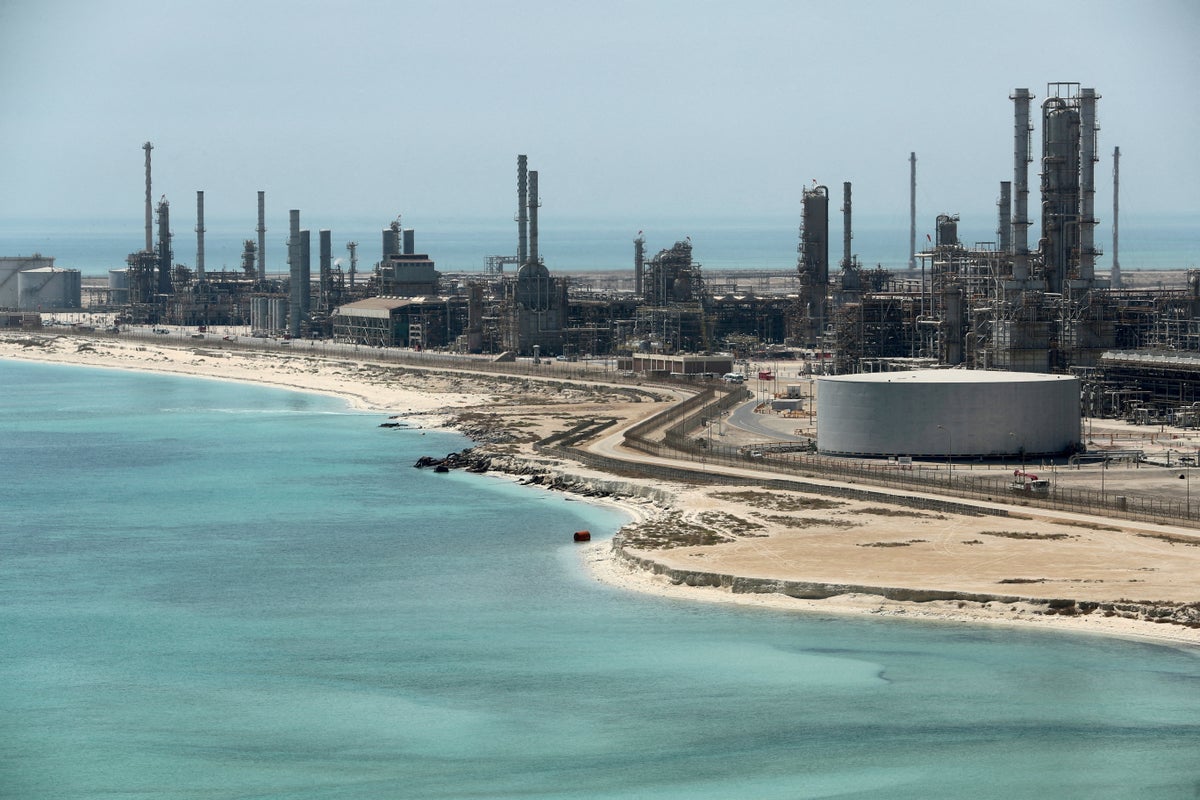
The rotor blades slice the desert air with a rhythmic, deafening thud. To the men buckled inside the cabin, it is the sound of a commute. It is the background noise of an extraordinary existence made ordinary by repetition. Below them, the vast expanse of the Arabian Gulf stretches out like a sheet of hammered silver, reflecting a blinding midday sun.
They are technicians, engineers, and specialists. They are fathers who promised to be home for dinner next week. They are sons sending money across oceans. In the global ledger of energy, they are the vital human machinery that keeps the world's most valuable company, Saudi Aramco, pumping the lifeblood of modern civilization.
Then, the rhythm breaks.
An unexpected vibration ripples through the airframe. The pitch of the engine shifts from a steady roar to an agonizing whine. In the cockpit, warning lights erupt in a chaotic dance of amber and red. Seconds feel like hours. The horizon, once a straight line dividing sea and sky, tilts violently.
Silence follows the impact. Not a peaceful silence, but the heavy, suffocating quiet that descends on a community when fourteen lives vanish in an instant.
The Mirage of Routine
We consume energy without thinking about the friction required to produce it. We flip a switch, start an engine, or heat a home, completely insulated from the physical reality of the extraction process. The global economy demands billions of barrels of oil, and to meet that demand, thousands of workers must be shuttled across harsh environments every single day.
Offshore oil platforms are isolated industrial islands. Reaching them requires navigating unpredictable weather patterns, intense heat, and the inherent risks of aviation. Helicopter transport is not a luxury in this industry. It is a necessity. It is the bridge between the mainland and the steel monoliths anchored in deep water.
Consider a hypothetical worker named Tariq. He has made this flight a hundred times. The pre-flight safety briefings have become white noise. He knows the exact moment the chopper will lift off, the precise angle it will bank over the coastline, and how the air conditioning always struggles against the desert heat until the aircraft reaches altitude. This familiarity creates an illusion of absolute safety.
But aviation in extreme environments offers no margins for error. A minor mechanical failure or a sudden shift in wind conditions can transform a routine transport flight into a catastrophic event. When an aircraft carrying fourteen people goes down, the shockwave extends far beyond the crash site. It shatters the collective confidence of an entire workforce.
The Ripple Effect in the Sand
The immediate aftermath of an industrial aviation disaster follows a predictable corporate script. Press releases are drafted with clinical precision. Statements of condolence are issued. Shares fluctuate on global markets. Investigations are launched to determine whether the cause was mechanical fatigue, pilot error, or atmospheric conditions.
The real story belongs to the families waiting in the residential compounds of Dhahran or in distant towns across the globe.
News of a crash travels faster than official confirmation. Mobile phones ring in the middle of the night. Whispers echo through office corridors. For several agonizing hours, nobody knows exactly who was on the flight manifesto. Every family with a relative on rotation holds their breath, praying that the knock on the door is meant for someone else.
This is the invisible tax paid for global energy dominance. Saudi Aramco operates on a scale that defies easy comprehension, managing oil reserves that dictate the financial health of nations. Yet, the entire apparatus relies on individual humans willing to step into a metal tube and fly out over the open sea.
The loss of fourteen lives is a statistic on a corporate spreadsheet, a brief mention in a global news feed buried beneath political theater and market updates. To the people who lived alongside them, it is an irreparable tear in the fabric of their daily existence. The empty chair in the cafeteria, the locker that remains locked, the tools left untouched on the workbench—these are the tangible markers of a sudden absence.
The Calculus of Risk
Every time a helicopter takes off from a desert tarmac, a complex calculation occurs. Engineers have checked the turbines. Pilots have calculated the fuel weight. Safety managers have reviewed the weather data. Everything aligns with rigorous industry standards.
Yet, predictability is a comfort we construct to hide our vulnerability.
The ocean and the sky do not care about corporate protocols. They do not respect the financial targets of an energy giant. When we push deep into hostile environments to harvest resources, we are operating on borrowed time and thin margins. The technology used to transport workers is highly advanced, but it is ultimately subject to the laws of physics and the harsh wear of the elements.
The true cost of oil cannot be measured solely in dollars per barrel or gallons at the pump. It must be measured in the structural risk absorbed by the people who do the work. It is found in the quiet bravery of a technician stepping back onto a helicopter the day after a fatal crash, knowing the sky offers no guarantees, but knowing also that the platform cannot run without him.
The wreckage is eventually recovered from the water. The investigation report will eventually be filed away in a secure archive. The rotor blades of another aircraft will start to spin, slicing through the heavy air, carrying the next shift toward the horizon. The work continues because the world demands it, but the memory of the fourteen who did not return remains anchored in the quiet spaces where the machinery stops humming.