The air inside the Lusail Stadium did not feel like air. It felt like wet wool, thick with the sweat of eighty thousand screaming souls and the suffocating scent of stale beer and expensive cologne. Down on the grass, the heat radiated upward in shimmering waves, blurring the white lines of the penalty box.
If you stood close enough to the pitch, you could hear the noise. It wasn't just cheering. It was a physical pressure, a low-frequency vibration that rattled your teeth and made your ribs ache.
In the middle of this cauldron stood a thirty-five-year-old man with bad knees and the expectations of forty-five million people strapped to his narrow shoulders.
Lionel Messi did not run. He walked.
He spent the first ten minutes of the World Cup semifinal wandering around the right flank like a tourist who had lost his hotel key. He adjusted his socks. He spat on the turf. He watched the young, hungry English defenders—men who had grown up with his posters on their bedroom walls—buzz around him like angry wasps.
To the untrained eye, it looked like laziness. It looked like age catching up to a god.
But it was actually a hunt.
The Art of the Invisible Man
To understand what happened next, you have to understand how Messi plays football in the twilight of his career. He does not compete in the same sport as everyone else. While twenty-one other men are playing a game of physical chess at breakneck speed, Messi is mapping the board.
He is looking for the seam.
In cognitive science, there is a concept called "inattentional blindness." It is the human tendency to miss something staring us right in the face because our attention is focused elsewhere. Messi has turned this psychological quirk into an art form. By doing nothing, he becomes invisible.
Consider the English defense. They had spent three days in tactical meetings hearing one word repeated like a mantra: Messi. Do not let him turn. Do not let him breathe.
So, they watched him. And because they watched him so intensely, they stopped seeing him.
Then came the thirty-fourth minute.
A loose ball squirmed out of a midfield tangle. In an instant, the lazy tourist vanished. A sudden, violent burst of acceleration shattered the quiet. Messi did not just run; he glided, his low center of gravity keeping the ball glued to his left boot as if by some unseen magnetic force.
Declan Rice lunged. Missed.
John Stones dropped back, his hips twisting in a desperate attempt to match the changing direction of a man who seemed to defy inertia.
It is a basic law of physics that an object in motion stays in motion unless acted upon by an outside force. Messi’s genius lies in his ability to convince defenders that he is about to go left, forcing them to commit their entire body weight to that direction, before he effortlessly cuts right. The defender's own momentum becomes their prison. Stones’ boots slid on the manicured grass.
By the time the English defense recovered their footing, the ball was already nestled in the side netting.
One-zero.
The stadium did not erupt; it gasped. It was the sound of eighty thousand people realizing they had just witnessed a magician pull a rabbit out of a hat they had been staring at for half an hour.
The Ghost of 1986
Football in Argentina is not a sport. It is a secular religion, and like all religions, it is haunted by its martyrs and its saints.
For nearly forty years, every Argentine player who put on the blue-and-white striped shirt was compared to one man: Diego Armando Maradona. Diego, who had danced through the English defense in 1986. Diego, who had won the World Cup almost single-handedly.
For Messi, this comparison has been a lifelong sentence.
He was too quiet. Too Spanish. Too cold. They accused him of not singing the national anthem with enough passion. They claimed he saved his best moments for Barcelona, leaving only the scraps for his homeland.
I remember talking to an old man in Buenos Aires during the 2014 tournament. He was sitting on a plastic chair outside a cafe, sipping mate through a silver straw.
"Messi is a genius, yes," he told me, shaking his head. "But Diego... Diego made us cry. Messi just makes us clap."
That was the invisible barrier Messi had to break. It wasn’t about goals or assists. It was about suffering. Argentine fans needed to see their hero bleed, to see him break, to see him drag himself through the dirt to bring them glory.
Against England, they got exactly what they wanted.
In the second half, the game turned brutal. The English team, realizing that tactical discipline was not enough to stop the wizard, turned to physical intimidation. Jude Bellingham caught Messi with a late, crunching tackle that sent the little playmaker tumbling onto the turf.
Messi stayed down.
For three agonizing minutes, the entire nation of Argentina held its breath. On the bench, coach Lionel Scaloni stared at the ground, unable to watch.
Messi grimaced, clutching his left hamstring. He rolled over, his face pressed against the grass. The ghost of past failures—the lost finals of 2014, 2015, and 2016—seemed to settle over the pitch like a heavy fog.
But then, he stood up.
He didn't call for the medical cart. He didn't complain to the referee. He simply wiped the dirt from his knees, spit a mouthful of blood onto the grass, and walked back to his position.
He was no longer just a genius. He was a gladiator.
The Pass That Defied Geometry
The defining moment of the match did not come from a goal. It came from a piece of creation so absurd that it felt like a glitch in the simulation.
With fifteen minutes remaining and England pressing desperately for an equalizer, Argentina launched a counterattack. Messi received the ball near the halfway line, tightly marked by Josko Gvardiol—one of the tournament's most expensive and highly-rated young defenders.
What followed was a slow-motion demolition of a young man’s pride.
Messi began to move down the right flank. Gvardiol stayed with him, using his superior strength to push the older man toward the touchline. There was no space. There was no angle.
Suddenly, Messi stopped dead. Gvardiol flew past him, carried by his own momentum.
Before the defender could recover, Messi spun, keeping his body between Gvardiol and the ball. He took three short, chopping steps, drove toward the box, and then, with his back partially turned to the goal, delivered a pass.
It did not make sense.
To find Julian Alvarez waiting in the six-yard box, the ball had to travel through a gap no wider than a dinner plate, passing between the legs of one defender and just out of reach of the diving goalkeeper.
The pass didn't just find Alvarez. It served the ball to him on a silver platter, practically begging him to kick it into the empty net.
Two-zero.
The young striker didn't run to the corner flag to celebrate. Instead, he pointed directly at Messi, sprinting toward him with his arms wide open. He looked less like a professional athlete and more like a kid who had just seen Santa Claus.
That assist was the final blow. It didn't just win the match; it broke the spirit of the opposition.
The Final Step
When the referee blew the final whistle, the contrast between the two teams was stark.
The English players collapsed onto the turf, exhausted and devastated. They had played well. They had followed the plan. But how do you prepare for a man who operates on a different temporal frequency?
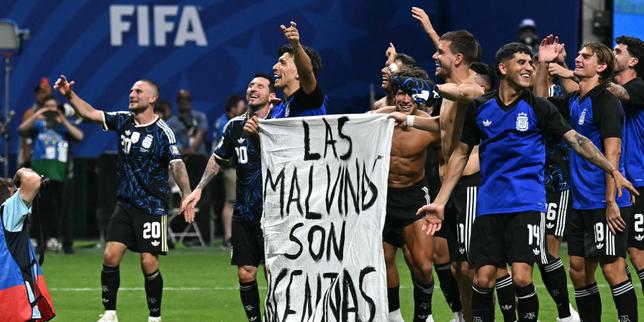
Messi did not celebrate wildly. He sank to his knees in the center circle, his head bowed, his hands covering his face.
His teammates did not run to the fans. They ran to him. They piled on top of him, a mountain of blue and white fabric, shielding their captain from the flashing lights of a thousand cameras.
The journey is not over. The final awaits, and with it, the ultimate test.
But as the fans sang into the night, their voices echoing off the concrete walls of the Lusail Stadium, something had shifted. The comparison with Maradona was gone, dissolved in the humid Qatar air.
Lionel Messi had finally made them cry.
Now, he just has to do it one more time.