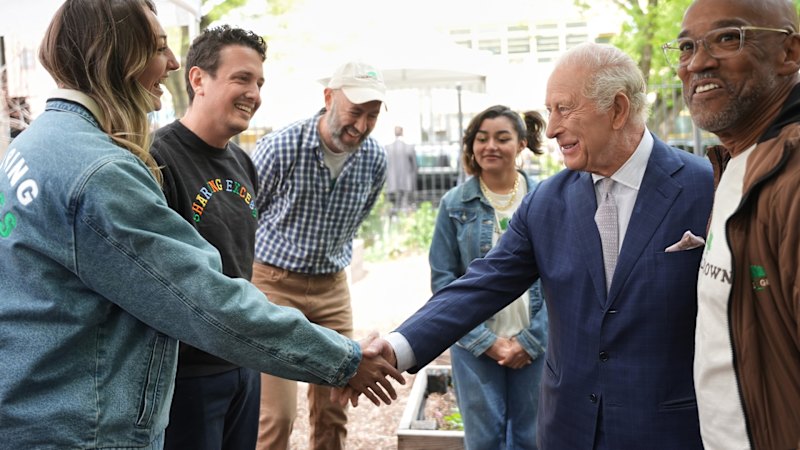
The wind whipping off the East River doesn't care about lineage. It bites just as hard at a monarch as it does at a taxi driver leaning against a yellow fender on FDR Drive. As the motorcade snaked toward the heart of Manhattan, the sirens were a high-pitched scream against the low hum of the city’s indifference. New York is a place that consumes celebrities for breakfast, yet there is something different about a State Visit. It isn't just about the person; it’s about the shadow they cast—a thousand years of history condensed into a single limousine.
The King stepped out into the crisp air, and for a moment, the cameras stopped clicking. There was a heartbeat of pure, unadulterated observation. We often view these events through the lens of geopolitics, trade agreements, and soft power. We talk about "strengthening ties" and "bilateral cooperation." But look closer at the knuckles gripped tight against a velvet railing, or the way the Queen adjusts her coat against a gust she wasn't expecting.
This is the theater of the impossible.
The Invisible Ledger
Every handshaking ceremony is a calculated risk. Behind the smiles at the United Nations and the solemn wreaths laid at Ground Zero, a massive machine of logistics hums in the background. It is a choreography of thousands. Secret Service agents with earpieces that never stop buzzing. Chefs arguing over the exact temperature of a sea bass. Protocol officers sweating over the seating chart because a three-inch misalignment could, in the hypersensitive world of diplomacy, be read as a snub.
Why do we still do this? In an era of instant Zoom calls and encrypted messaging, the act of flying a King and Queen across the Atlantic seems like an expensive anachronism. But humans are tactile creatures. We don't trust what we can't touch. A digital signature is a transaction; a shared meal in a room overlooking Central Park is a covenant.
Consider a mid-level diplomat. Let’s call him Arthur. Arthur hasn't slept in forty-eight hours. He is currently obsessing over a specific shade of blue ribbon. To the outside world, Arthur is a bureaucrat. To the mission, he is the glue. If the ribbon is wrong, the gift looks cheap. If the gift looks cheap, the sentiment feels hollow. This is the metaphor for the entire visit: the grandest gestures are built on a foundation of microscopic anxieties.
The Ghost in the Room
Walking through the 9/11 Memorial, the atmosphere shifted. The noise of the city seemed to hit a glass wall and bounce back. Here, the "State" part of the visit fell away, leaving only the "Human." When the King stood before the names etched in bronze, he wasn't representing a GDP or a military alliance. He was a man standing where thousands had fallen, some of them his own subjects.
The silence was heavy. It was a physical weight.
In these moments, the Crown functions as a vessel for collective grief. It is one of the few remaining roles in our fractured modern world that allows for a singular point of focus. The Queen stood slightly behind, her expression unreadable but her posture unwavering. It is a grueling job, standing still. We underestimate the physical toll of being a symbol. You cannot itch your nose. You cannot look tired. You must be a mirror, reflecting back the dignity of the occasion regardless of how much your feet ache inside bespoke leather shoes.
The Commerce of Connection
Later, the tone shifted to the frantic energy of the New York Stock Exchange. The juxtaposition was jarring. From the hallowed ground of Lower Manhattan to the temple of global capitalism. This is where the "dry facts" of the competitor’s article usually live—the statistics about British investment in US tech or the burgeoning green energy partnerships.
But the real story isn't the data. It’s the energy in the room.
Imagine the floor of the exchange. It’s a mosh pit of ambition. When the royal party arrived, the air changed. Even the most cynical traders, men and women who deal in billions without blinking, craned their necks. There is a psychological phenomenon at play here. The presence of ancient stability—the Monarchy—inside the engine of modern volatility—the Market—creates a strange sense of reassurance. It says, "The world is changing, but some things remain."
This visit wasn't just a vacation with better security. It was a sales pitch for a shared future. Every stop on the itinerary was a needle threading a complex fabric.
- The Climate Summit: A push for survival disguised as a policy briefing.
- The Literacy Program in Brooklyn: A reminder that the Crown’s reach extends to the smallest classroom.
- The State Dinner: A high-stakes theater where more business is done over dessert than in any boardroom.
The Cost of the Spectacle
Critics often point to the price tag of such endeavors. They see the motorcades and the gala dresses and see waste. They aren't entirely wrong, but they are missing the point of the investment. A State Visit is the ultimate "loss leader." You spend the millions on the spectacle to secure the billions in the handshake.
It’s an exhausting, high-wire act. One slip—a poorly timed comment, a perceived lack of interest—and the narrative sours. The King and Queen aren't just visitors; they are endurance athletes of the social elite.
By the time the sun began to set over the Hudson, casting long, orange shadows between the skyscrapers, the exhaustion was visible if you knew where to look. It was in the slightly slower step as they climbed the stairs of the plane. It was in the way the staff finally let their shoulders drop.
New York continued to roar below them. The sirens didn't stop. The taxis didn't slow down. The city had played its part as the stage, and now it was moving on to the next act.
We look at these two figures through the windows of a departing aircraft and realize that the Crown is not a piece of jewelry. It is a harness. It pulls the weight of a nation’s expectations across oceans, into rooms filled with strangers, and through the gauntlet of public opinion. They came to New York to remind us that despite the chaos of the news cycle, there is a thread of continuity that refuses to snap.
As the wheels left the tarmac, the lights of Manhattan twinkled like a spilled box of diamonds. The King looked out the window, a brief moment of solitude before the next ceremony began. He wasn't a headline anymore. He was just a traveler, carrying the heavy, invisible luggage of an empire that no longer exists, yet somehow, still manages to command the room.
The city remained, indifferent and electric, waiting for the next person brave enough to try and capture its attention.