The Razor Beneath the Surface
Reach your hand into the shallows of a Michigan lake on a summer afternoon, and you will find them before you see them. They do not swim. They do not flee. They wait.
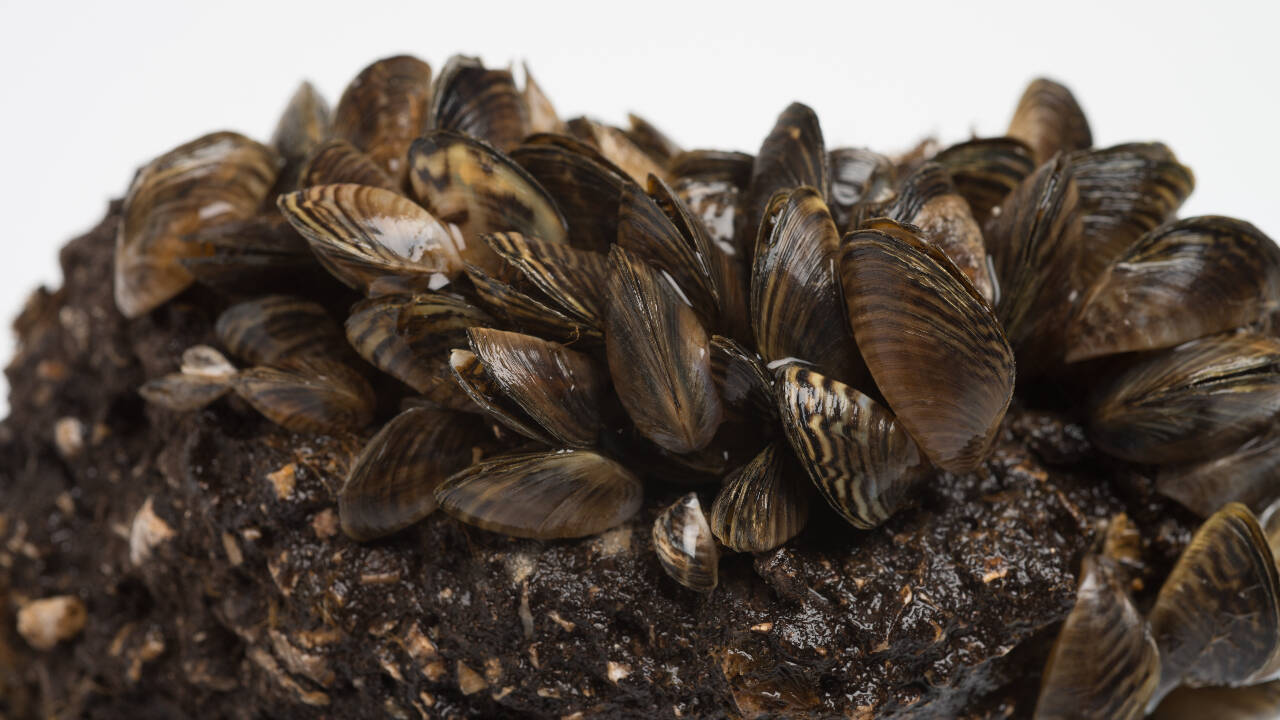
The lakebed, once a soft mosaic of silt, polished stone, and native unionid clams, has been paved over. Every rock, every dock piling, every discarded glass bottle and water intake pipe is armored in a jagged, yellowish-brown crust. Step bare-foot into the water, and your skin parts instantly. These are zebra mussels. Individually, they are no larger than a fingernail, shaped like a tiny, striped tent. Collectively, they are an occupying army. They turn clear water crystalline by filtering out every microscopic particle of food, starving the native zooplankton, collapsing the base of the aquatic food web, and encrusting municipal infrastructure with billions of calcified skeletons.
For decades, human beings fought this invasion with brute force and blunt chemistry. We scraped them by hand. We poisoned them with copper and chlorine, watching collateral damage spread to fish and amphibians. We poured money into industrial filtration plants just to keep the pipes breathing.
Then came a quiet morning off the coast of Michigan, a piece of heavy fabric, and a gas that we usually associate with the fizz of soda or the slow warming of the atmosphere.
An Accidental Empire
To understand the scale of what happened in those five days, you have to look backward.
In the late nineteen-eighties, a cargo ship crossing the Atlantic discharged its ballast water into the Great Lakes. Inside that dark, sloshing hold were microscopic veligers—the free-swimming larvae of Dreissena polymorpha, native to the Black and Caspian seas. They had no natural predators in North American waters. No native fish recognized them as prey; their shells were too sharp, their clustering too dense.
Within a decade, they colonized the Mississippi basin, the Hudson, and lakes across half the continent. Each female can release up to a million eggs a year. They did not just settle in the water; they colonized it. Power plants choked. Boat engines overheated. Native freshwater mussels, magnificent creatures that can live for decades, found themselves smothered beneath thousands of hitchhiking invaders, unable to open their shells to feed or breathe.
Biologists watched in dismay as the lakes changed. The water grew unnervingly clear—a deceptive beauty. Sunlight penetrated deeper, feeding massive mats of toxic algae that washed ashore in rotting, green sludges. The lakes were being sterilized from the inside out, one filtered gallon at a time.
The traditional response was warfare by poison. Pour copper sulfate into a bay, and the mussels die. But so do the mayflies, the perch eggs, and the microscopic life that sustains everything else. It was chemotherapy for an ecosystem—effective at killing the cancer, but devastating to the patient.
Science needed a scalpel. It found one in carbon dioxide.
A Breath Turned Lethal
Picture a research vessel bobbing on a gray Michigan lake, the wind kicking whitecaps across the surface. Beneath the hull, marine biologists and engineers lowered something that looked deceptively ordinary: heavy, flexible benthic mats made of impermeable rubberized fabric, weighted at the edges to hug the contours of the lake bottom.
These were not just covers designed to starve the creatures of oxygen. Starving mussels of oxygen takes weeks, and they can simply clamp shut, sealing their shells tight for days on end like tiny aquatic medieval castles waiting out a siege.
Carbon dioxide works differently.
Carbon dioxide is heavier than water when concentrated, and it is a master saboteur. When infused beneath these weighted mats, liquid or gaseous carbon dioxide creates a localized, hypercapnic nightmare. It drops the pH of the surrounding water instantly. It alters the chemistry of the hemolymph inside the mussel's tiny body.
Mussels breathe by drawing water across their gills. When they pull in water saturated with concentrated carbon dioxide, they cannot simply close their shells and sleep it off. The chemical gradient forces its way across their membranes. They suffocate not because oxygen is absent, but because their internal chemistry is violently disrupted. They yawn open in physiological distress, unable to regulate their metabolic balance, and die.
The hypothesis was elegant. The execution, however, remained to be tested in the messy, unpredictable reality of the open water.
Five Days in the Dark
For five days, the carbon dioxide mats stayed down on the targeted colonies.
On shore, scientists monitored the telemetry. Sensors tracked pH levels, temperature, and carbon dioxide diffusion beneath the rubberized sheets. The water under the tarps became an acidic, suffocating micro-climate, entirely contained away from the broader ecosystem. Fish swam past the edges unharmed. The surrounding flora remained untouched. The intervention was surgical, localized, and ruthlessly efficient.
Imagine the moment of retrieval.
The crew hauled up the edges of the heavy mats. The divers descended into the gloom, turning their waterproof flashlights toward the sediment that had been sealed off from the lake for one hundred and twenty hours.
The transformation was absolute.
Before the deployment, the rocks were a solid, jagged crust of living armor. Now, the shells were slack, gaping open. The tissue inside had degraded. A gentle sweep of a diver's hand cleared away eighty percent of the colony in a single motion, leaving behind clean, bare stone that had not seen the light of day in thirty years. No heavy machinery. No toxic runoff. No collateral damage to the surrounding fish populations. Just chemistry, applied with precision.
Eighty percent mortality in five days. In the brutal calculus of invasive species management, numbers like that are almost unheard of.
The Scalpel and the Shore
We are standing at a strange threshold in our relationship with the natural world. For generations, human intervention in ecosystems has been heavy-handed. We introduced cane toads to eat beetles in Australia, only to watch the toads conquer the continent. We sprayed DDT and poisoned raptors. We built dams that fractured rivers and dredged bottoms that choked spawning grounds.
Every time we tried to fix a biological imbalance, we introduced a new, clumsier mechanism.
The success of the carbon dioxide mats in Michigan represents a shift in philosophy. It whispers of a future where we stop treating environmental restoration as a war zone and start treating it as a craft. It proves that we can outsmart invasive species not by blanketing the water in poison, but by understanding the intimate biological vulnerabilities of the invader.
Zebra mussels will not vanish tomorrow. They are too entrenched, too prolific, too deeply wired into the vast plumbing of the North American watershed. A localized victory on a single patch of lakebed does not mean the war is won. Millions of acres remain armored.
Yet, as the sun dips below the tree line of the Michigan shore, casting long amber shadows across water that is finally beginning to remember its own history, something feels different. The water laps against the docks. Beneath the surface, the rocks are quiet. For the first time in decades, the native clams beneath the silt have room to breathe.
The lake is still heavy with its past, but the future feels a fraction lighter.


