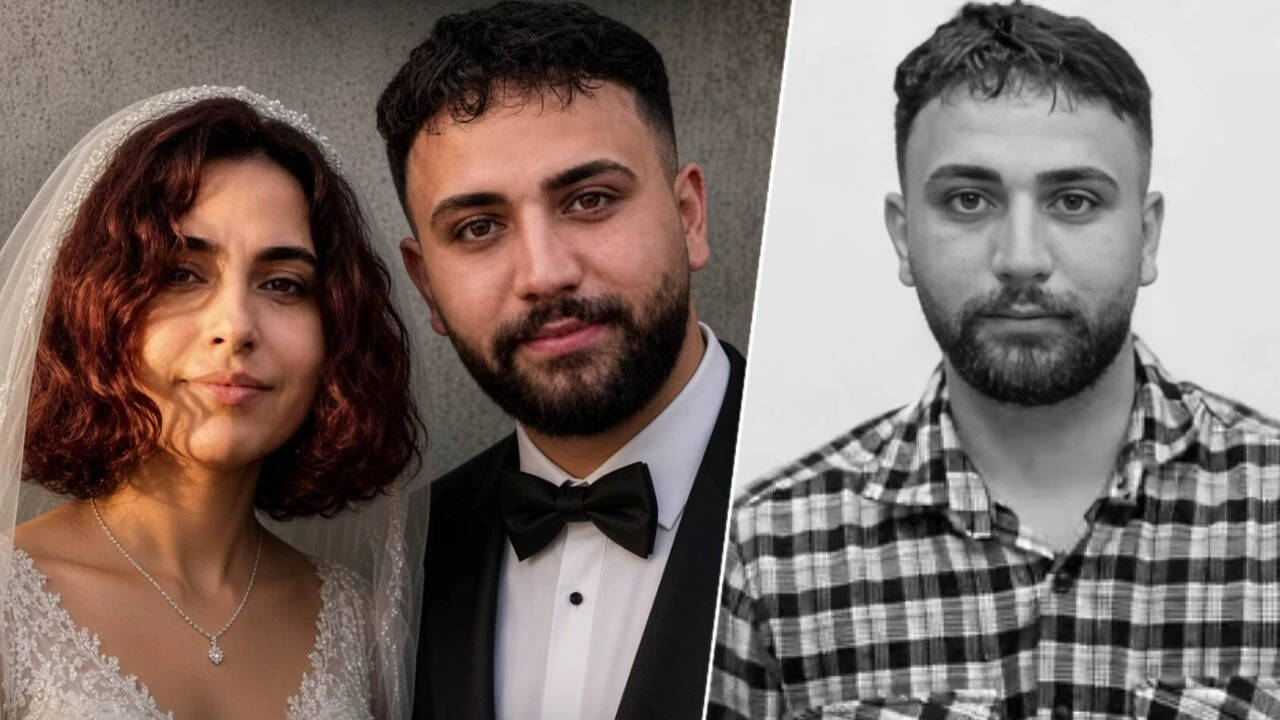
The phone line connected two worlds that should never have touched. On one end was a concrete box smelling of damp stone, unwashed blankets, and constant, low-grade fear. On the other end was a woman holding a receiver like a lifeline, her knuckles white, listening to a voice that had been half-starved of freedom for months.
They did not have flowers. They did not have an altar, or guests, or the slow, heavy swell of music that allows a couple to breathe out for the first time in front of the people who love them. They had a prison guard standing nearby, checking his watch. They had a legal system operating at the speed of vengeance. They had a connection that crackled with static, threatening to cut out at any second.
And yet, they married.
It was a ceremony stripped of every trivial luxury until only the skeleton remained. The vows were exchanged across a barrier of copper wire and state-sanctioned hostility. He was behind bars because he had dared to raise his voice in a country where dissent is treated as a fatal contagion. She was outside, waiting, hoping, fighting against an apparatus designed to crush individual hope into dust.
Marriage, in its most ancient form, is a declaration of defiance. Two people look at the chaos, cruelty, and uncertainty of existence and decide to tie their fates together anyway. But when performed inside the belly of an authoritarian machine, a prison wedding becomes something else entirely. It is a terrifying assertion of humanity. It says: You can take his liberty. You can lock his body away in the dark. You can starve him, silence him, and isolate him. But you do not own his soul. You do not own who he loves.
The state understood the threat of that defiance.
Less than twenty-hours after those words traveled through the copper wire, the phone rang again. This time, it was not to schedule a visit. It was not to discuss an appeal. It was an announcement of execution.
The rope did not wait for the ink on their marriage certificate to dry. It did not care about the legalities, the human rights petitions, or the desperate, trembling prayers whispered into the night air. The execution was swift, cold, and calculated—a public warning disguised as justice. The message sent by the authorities was crude and unmistakable: Do not hope. Do not bind yourselves to the condemned. Do not build a future against our will.
Consider the psychological weight of that sequence. To be given the brief, agonizing mercy of a prison phone-call wedding, only to be systematically murdered by the state the very next day. It is a cruelty so precise it feels engineered in a laboratory. It treats human affection not as a protected right, but as a final, cruel provocation.
When we read standard news reports about political crackdowns, numbers scroll past like stock tickers. We see casualty counts, arrest statistics, and dry summaries of judicial proceedings. The data washes over us because data lacks a heartbeat. It allows us to keep a safe, comfortable distance from the suffering of strangers.
We forget that behind every statistic is a kitchen table with an empty chair. We forget the sound of a voice breaking over a terrible connection. We forget that tyrants are always, at their core, deeply afraid of love because love cannot be bribed, coerced, or easily dismantled.
The newly minted wife did not get a honeymoon. She got a shroud. She got the impossible burden of carrying a memory that the state wanted to erase entirely from the public record. In totalitarian systems, the final weapon is not just execution; it is erasure. They want you to forget the person ever existed. They want the name to curdle into silence.
That is why storytelling matters. That is why we must look past the dry wire-service dispatches and stare directly into the human center of these tragedies.
When a man facing the gallows chooses to spend his final, precious hours binding himself legally and spiritually to the woman he loves, he is casting a vote for the future. He is betting everything on a world he will never get to see. He is saying that human connection outlasts concrete, iron, and hemp.
The phone line went dead on that second day. The receiver was placed back on its cradle. The cell door was opened for the last time.
But the words spoken across that static-filled wire cannot be unsaid. The legal union was forged in the shadow of the gallows, but it outlasted the executioner's rope. Long after the regime has crumbled into the footnotes of history, the record will remain: two people who loved each other so fiercely that they forced the prison system to acknowledge their bond, even if only for a single, fleeting evening.
The rope can break a neck. It cannot sever a vow.