The river did not knock. It arrived with the heavy, grinding roar of a freight train tearing through a living room, eating the earth beneath the foundations before anyone could draw a second breath.
In the valley of the Trishuli, the monsoon does not merely rain; it falls like lead, swelling ancient waterways until they forget their banks and reclaim whatever human hands dared to place in their paths. Mud smells distinct. It smells of crushed stone, pulverized roots, and the salt of old iron. When the floodwaters receded, they left behind a coating of gray silt that muffled the world, turning homes into tombs and streets into slick graves. Read more on a related issue: this related article.
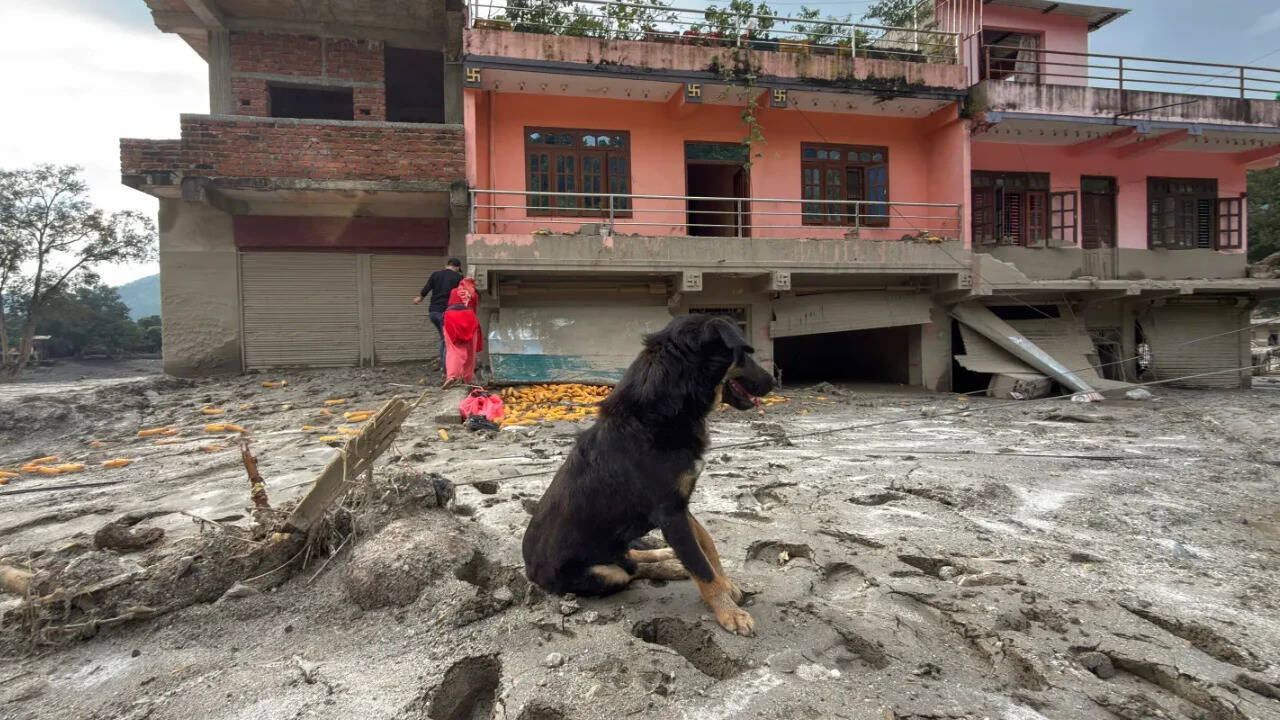
Yet, amid the wreckage of a house stripped down to its ribbed skeleton, something breathes.
It does not move much. It sits atop a precarious slab of concrete that used to be a doorway, a small silhouette against the vast, muddy scar of the valley. A dog. Shivering, caked in dried clay, eyes bloodshot and fixed entirely on the churned-up currents of the Trishuli River. Additional reporting by The Washington Post delves into similar views on this issue.
The owners are gone. Swept into the grey belly of the surge, swallowed by a calamity that left behind no notes, no farewells, and very few survivors. But the dog remains.
To understand loyalty like this, you have to look past the biological mechanics of domestication. We call them pets, as if they are decorative accessories to our busy lives, fuzzy stress balls we pet on the couch after a long commute. We invent clever words for their behaviors. We think in terms of stimulus and reward.
We are wrong.
When the water rose to the windowsills, when the walls began to groan and buckle under the immense hydrostatic pressure of the mudslide, there was a choice to be made. Panic is contagious. Fear smells sharp. A human being running for high ground makes a calculation in a fraction of a second: survival first.
The dog made a different calculation.
Consider what happens next in the quiet aftermath of a disaster. Rescue teams arrive in orange vests, boots sinking ankle-deep into the muck. They carry stretchers, ropes, and tally sheets. They look for bodies. They count the missing. They log the economic damage in neat columns on clipboards.
They found the house gutted. They found the rooms choked with debris, personal photographs turned to pulp, kitchen utensils buried yards away in the silt. And then, standing sentinel over the void, they found the dog.
When the volunteers tried to approach, offering a tentative hand and pieces of dry ration, the animal did not snarl. That would have been human. Instead, it braced its legs, lowered its head, and let out a low, vibrating whine that seemed to ask a question no one could answer.
Where are they?
We spend our lives building fortresses against uncertainty. We pour concrete, sign deeds, buy insurance policies, and lock our front doors at night, convincing ourselves that the world is an orderly place governed by logic and contract. We believe we own our spaces. We believe we master our environments.
Then the Trishuli rises.
In a matter of minutes, human mastery is exposed as a fragile illusion. The concrete cracks like dry bread. The television, the sofa, the framed wedding pictures, the clothes in the closet—all of it becomes mere weight, easily swept away by the indifferent muscle of nature.
Only the love stays behind.
It sounds sentimental to say it out loud. We live in an age that demands cynicism, an era where every emotional outburst is scrutinized for hidden angles, where sincerity is treated as a marketing strategy. We prefer our tragedies distant, mediated through the smooth glass of a smartphone screen, digested in three-sentence summaries before we swipe to the next distraction.
Look closer.
Look at the paws worn raw from pacing the perimeter of a missing floor. Look at the refusal to eat the offered food until the sun dips behind the jagged ridge of the mountains, because eating means giving up, and giving up is not in the vocabulary of a creature whose entire existence was anchored to two specific human beings.
The rescue workers left food. The dog ignored it. They tried to coax it into a crate, to haul it up the muddy incline to safety, away from the stench of rotting vegetation and the constant, hypnotic roar of the receding river.
The dog planted its feet.
It is a stubborn kind of grief. We recognize it because we have all felt it, even if we dress ours up in silence and late-night scrolling. It is the sudden, terrifying realization that the person who knew how you took your tea, who laughed at your worst jokes, who was simply there when you turned around, is suddenly nowhere.
Except the dog has the advantage of simplicity. It does not rationalize. It does not tell itself that time heals all wounds or that everything happens for a reason. It only knows a coordinate in space where the universe used to make sense, and it is determined to hold that coordinate until the world corrects itself.
Even if the world never does.
Down in the village, the elders shake their heads. They have seen the river change its course three times in fifty years. They know the monsoon has a long memory and a heavy hand. They talk about karma, about the balance of the elements, about the way the mountains are slowly washing down into the Bay of Bengal grain by agonizing grain.
They look at the dog on the ruin with a quiet, knowing sorrow. They do not chase it away. They leave a bowl of water a safe distance down the slope, knowing better than to crowd a grief that belongs to a different species.
We measure catastrophes by numbers. Fifty homes destroyed. Twelve bridges collapsed. Three missing. The figures roll across the ticker tape of our minds, clean and bloodless, designed to inform without disturbing our digestion.
Numbers are a lie.
The true scale of a flood is found in the centimeter-thick layer of mud coating a child's schoolbook. It is found in the way a grandmother’s copper pot ends up half a mile downstream, battered and unrecognizable. And it is found in the rigid, unyielding posture of a small animal staring down a muddy river, waiting for footsteps that are never coming back.
The rain has stopped now. The sky over the Trishuli valley has cleared into that brilliant, washed-out blue that only follows a violent storm, sharp enough to cut glass.
The silhouette on the concrete slab shifts its weight. One ear cocks toward the sound of distant voices on the bank. For a second, just a single heartbeat, the tail gives a tentative, hopeful twitch.
Then the river gurgles over a submerged boulder, the muddy water rolls on toward the plains, and the silence settles back over the ruins, heavier than any stone.