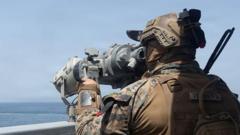
The United States military launched targeted strikes against Iranian-engineered drone installations and mobile radar stations in Yemen, attempting to blunt a persistent threat to global shipping lanes. Pentagons central command confirmed the operation followed a sharp escalation in anti-ship ballistic missile and one-way attack drone launches targeting commercial vessels. While Washington frames these tactical strikes as defensive successes, the reality on the water reveals a much harsher strategic calculation. The American Navy is using multi-million-dollar interceptors to shoot down cheap, mass-produced systems, exposing a massive economic and material mismatch in modern asymmetric warfare.
The Mathematical Trap of the Red Sea Campaign
Naval engagements in the Bab el-Mandeb strait have exposed an unsustainable reality for Western defense planners. A standard air-defense missile carried by an American destroyer costs between two million and five million dollars. In stark contrast, the delta-wing attack drones built with Iranian blueprints and assembled in Yemen cost somewhere between twenty thousand and fifty thousand dollars.
This is not a gap. It is a chasm.
Military commanders face an unforgiving equation every time an unknown radar track appears on their consoles. They cannot afford to let a single suicide drone impact a commercial tanker or a billion-dollar warship, meaning every threat demands a response. Over months of sustained operations, a destroyer can rapidly deplete its vertical launching system cells, forcing it to rotate out of the combat zone just to reload. The Pentagon is burning through precious, slow-to-manufacture precision munitions to defeat weapons built from off-the-shelf electronics and fiberglass.
The current strategy relies entirely on kinetic interception. By focusing heavily on destroying drones after they are airborne, Western forces allow the adversary to dictate the time, place, and tempo of every engagement.
The Problem with Whack-a-Mole Interdiction
Striking radar sites on the ground offers temporary relief, but modern mobile radar units can be concealed inside standard shipping containers or commercial trucks. Western intelligence networks track these signatures, but the cycle of detection to weapon release takes time. By the time a Tomahawk cruise missile or a carrier-based fighter jet arrives at the coordinates, the launch crew has often vanished into rugged terrain.
The Industrial Pipeline Washington Cannot Plug
To understand why these radar and drone strikes feel like a recurring loop, one must look at the supply chain feeding the assembly points. The components driving this conflict do not arrive as fully formed, military-grade weapons shipped on cargo hulls. Instead, they flow through fragmented, clandestine smuggling routes as dual-use industrial parts.
- Commercial GPS Modules: Standard guidance systems stripped from civilian agricultural equipment or hobbyist drones provide sufficient accuracy for targeting slow-moving commercial vessels.
- Small Displacement Engines: Multi-cylinder gasoline engines manufactured for remote-controlled model aircraft provide the range and speed required to transit from coastal hiding spots to shipping lanes.
- Carbon Fiber Profiles: Lightweight structural materials that evade traditional radar cross-section detection are easily sourced through legitimate maritime trade channels.
Stopping this flow requires more than naval blockades. It demands an airtight international sanctions regime that simply does not exist because many transshipment hubs operate in jurisdictions beyond Western economic leverage. The manufacturing blueprints are digitized and decentralized; a workshop hidden under a concrete overpass in a coastal city can churn out airframes as long as the raw resin and fiber sheets keep arriving.
The Limits of Sensor Networks
Air defense relies entirely on radar illumination. When American forces strike a coastal radar site, they blind the local launch cells temporarily, forcing them to rely on spotters stationed on commercial dhows or visual tracking tools. Yet, the proliferation of cheap electro-optical sensors means an adversary no longer needs a massive, high-powered radar dish to find a 300-meter-long cargo vessel. They merely need a line of sight from a coastal bluff and a satellite internet connection.
The Economic Strain on Maritime Trade
The military confrontation is fundamentally an economic war, and the shipping industry is absorbing the damage. When insurance premiums for transiting the Suez Canal spike by 400 percent, the math forces global logistics giants to make a costly detour around the Cape of Good Hope.
This diversion adds roughly ten to fourteen days to a standard voyage between Asia and Northern Europe. It burns thousands of tons of additional fuel, ties up container capacity, and disrupts just-in-time manufacturing supply chains across the globe.
Route Comparison: Asia to Northern Europe
+----------------------------+-----------------+-------------------+
| Route                      | Average Transit | Insurance Risk    |
+----------------------------+-----------------+-------------------+
| Suez Canal (Standard)      | 26 Days         | Critical / High   |
| Cape of Good Hope (Detour) | 38 Days         | Low               |
+----------------------------+-----------------+-------------------+
The goal of the drone campaigns is not necessarily to sink American warships. The goal is to make the waters too expensive to secure, forcing a de facto blockade that alters global trade dynamics. Washingtons current framework treats this as a localized security crisis, but the shipping data suggests it is an enduring structural shift in how global choke points are contested.
Restructuring the Defense Paradigm
Continuing down the path of firing multi-million-dollar missiles at wooden drones will exhaust the US Navies inventory long before the production lines in the Middle East run dry. A fundamental shift toward directed-energy weapons and electronic warfare is the only viable exit ramp from this resource trap.
Shipborne lasers and high-powered microwave systems offer a cost-per-shot measured in dollars rather than millions. These systems damage the delicate sensors on incoming drones or cook their internal wiring without consuming a physical missile cell.
The deployment of these systems remains bottlenecks by power-generation limits on older hull designs and slow procurement cycles. Until the fleet can field point-defense systems that match the cost profile of the incoming threats, the Pentagon will remain trapped in a cycle of expensive deterrence, burning through readiness to defend a status quo that grows more fragile by the week.