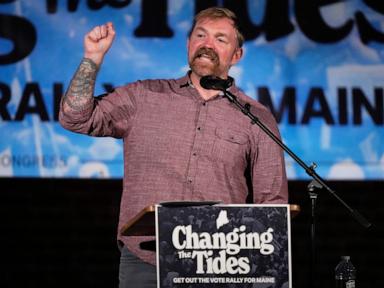
The June 2026 Maine Democratic Senate primary highlights a structural anomaly in modern American electoral physics: the survival mechanisms of an anti-establishment populist navigating acute personal compounding liability in a highly elastic, split-ticket state. Democrat Graham Platner, an oyster farmer and dual-service military veteran (Marine Corps and U.S. Army), has consolidated the progressive and working-class base of the state's Democratic electorate. This occurred despite an escalating series of behavioral, marital, and historical controversies that would mathematically neutralize a candidate in a less structurally complex state.
The political utility of analyzing this race lies not in tracking the sensationalism of the 24-hour news cycle, but in dissecting the structural friction between partisan polarization, candidate quality metrics, and the historical resilience of incumbent Republican Senator Susan Collins. Collins occupies a unique position as the sole Senate Republican representing a state carried by the Democratic presidential nominee in 2024. To evaluate whether Platner’s insurgent campaign can realistically unseat an incumbent who has historically defied generic ballot fundamentals, analysts must look past standard horse-race narratives and model the race through three distinct analytical frameworks.
The Tri-Centric Electorate Model
The Maine electorate does not operate as a standard bipolar distribution. Instead, voter behavior conforms to a tri-centric model split across distinct geographic, socioeconomic, and cultural axes. Understanding this distribution explains why Platner’s populist economic platform generated early velocity, and why his current liabilities threaten to trigger a specific electoral bottleneck.
       [District 1: First Congressional]
       - Coastal, Urban, Post-Industrial
       - High Educational Attainment
       - Values Behavioral & Institutional Norms
                      │
                      ├─► [Statewide Outcome determined by Ranked-Choice Allocation]
                      │
       [District 2: Second Congressional]
       - Rural, Agrarian, Working-Class
       - Economic Nationalist / Populist Focus
       - High Tolerance for Unorthodox Candidates
The First Congressional District (CD-1)
This region is primarily coastal, urban, and post-industrial, characterized by high concentrations of college-educated voters who prioritize institutional norms, progressive social policies, and behavioral standard compliance. This segment formed the natural constituency of Governor Janet Mills before her campaign suspension in April due to institutional fundraising bottlenecks. For these voters, candidate quality is directly tied to personal conduct and ethical consistency.
The Second Congressional District (CD-2)
This geography is vast, rural, and economically distressed, driven by agriculture, forestry, and marine industries. The prevailing political ethos here leans heavily toward economic nationalism and anti-establishment populism. Voters in CD-2 routinely exhibit a high tolerance for unorthodox personal profiles if the candidate's core message targets structural economic abandonment.
The Independent/Unenrolled Delta
Accounting for a significant plurality of registered voters, this segment decides statewide outcomes through Maine’s Ranked-Choice Voting (RCV) mechanism. These voters are highly elastic, frequently splitting tickets between a Democratic presidential candidate and Collins at the senatorial level.
Platner’s platform—explicitly built around dismantling what he defines as the "billionaire economy" and banning corporate capital in elections—was engineered to construct a cross-ideological bridge between CD-2 populists and CD-1 progressive ideologues. By substituting traditional progressive cultural rhetoric with raw class-warfare messaging, Platner successfully captured the structural vacuum left by Mills’ departure. However, this optimization strategy created an asymmetrical vulnerability: the exact personal traits that signal "authenticity" to rural populists act as catastrophic disqualifiers for suburban institutionalists.
The Coalescence and Compounding Risk Functions
A major analytical error in mainstream coverage is treating Platner's scandals as isolated moral failures rather than evaluating them as a compounding risk function that directly degrades his ceiling in a general election. The data points tracking Platner’s liabilities follow a clear trajectory of escalating severity.
Early cycle resistance focused on historic ideological liabilities, specifically an internet commentary trail and a Marine-era tattoo identified as a Nazi symbol. Platner utilized a mitigation strategy of public contrition, ideological re-education, and physical erasure (covering the tattoo). This satisfied the progressive wing's demand for performative accountability, allowing endorsement retention from national progressive figures like Senators Bernie Sanders, Elizabeth Warren, and Ruben Gallego.
The risk profile shifted from historical ideology to active marital discord following reports that Platner’s wife, Amy Gertner, informed the campaign of sexually explicit messages sent by the candidate to multiple women post-marriage. The campaign's operational response was insulation, framing the issue as a private marital optimization problem. This defense resonated with a durable segment of the base that views media scrutiny as institutional overreach.
The risk function converted from private infidelity to physical liability with reports detailing allegations of volatile, toxic, and physically threatening behavior toward past romantic partners. This included specific allegations of physical restraint and arm-twisting.
The structural consequence of these compounding inputs is mapped in recent polling data, which illustrates a severe decoupling of candidate favorability from generic party preference.
| Metric | Graham Platner (D) | Susan Collins (R) | Generic Democrat |
|---|---|---|---|
| Head-to-Head Polling | 48% – 51% | 43% – 49% | — |
| Favorability Rating | 42% – 43% | 36% – 41% | — |
| Unfavorability Rating | 41% – 51% | 53% – 57% | — |
| Baseline Party Metric | — | — | 55% |
The Tavern Research and UMass Lowell/YouGov data fields reveal an acute structural bottleneck for the Democratic ticket. A generic, unnamed Democrat outpaces Collins by ten percentage points (55% to 45%). Platner, conversely, operates at a statistical dead heat with the incumbent, underperforming the generic baseline by 4 to 7 percentage points.
This gap represents the Candidate Quality Tax. The data proves that while the structural conditions of Maine favor a shift toward the Democratic column, Platner's specific risk profile prevents the consolidation of that baseline. His high net-unfavorable ratings (reaching 51% in select cuts) match or exceed Collins’ historically high unfavorable marks (53% to 57%), neutralising the core advantage Democrats held at the cycle's inception.
The Incumbency Elasticity Coefficient
To predict the general election outcome, one must evaluate Collins’ historical survival mechanics against the specific strategic profile Platner presents. Collins has survived five consecutive electoral cycles by maintaining an exceptionally high incumbency elasticity coefficient—the ability to detach her brand from national Republican crosswinds.
In 2020, Collins secured reelection with 51% of the vote, even as her state voted decisively for the Democratic presidential nominee. Her model relies on a carefully calibrated equilibrium: executing highly visible defections from national party priorities to signal independence to Maine independents, while simultaneously delivering structural judicial and economic wins to preserve her baseline conservative turnout. Her recent high-profile votes—such as voting for Donald Trump's second impeachment conviction and opposing controversial cabinet nominations—serve as programmatic investments in this brand insulation.
Platner’s strategy aims to shatter this equilibrium by framing Collins' moderation not as independence, but as institutional complicity. His campaign focuses heavily on her 2018 vote to confirm Supreme Court Justice Brett Kavanaugh, linking that vote directly to the subsequent dissolution of federal abortion protections—a highly salient issue for the CD-1 suburban demographic.
The strategic failure of the Platner campaign, however, is that his own personal conduct liabilities hand Collins the exact counter-insulation mechanism she requires. For Collins to win, she does not need to rehabilitate her own underwater favorability numbers; she merely needs to depress Platner’s numbers among the identical demographic groups.
The primary electoral mechanism to watch is the "hold-your-nose" voter distribution. In a choice between an incumbent whose policy choices cause institutional frustration and an insurgent whose interpersonal conduct signals behavioral volatility, suburban moderates historically default to the status quo or blank the ballot. This structural reality severely undermines the efficacy of Platner's populist economic leverage.
Strategic Action Plan
The Democratic apparatus cannot reverse the primary outcome, as Platner is positioned to secure the nomination over nominal write-in opposition and David Costello following the structural exit of Janet Mills. The campaign must therefore pivot immediately to an aggressive general election optimization strategy designed to ring-fence his behavioral liabilities and maximize his structural economic advantages.
1. Enforce a Strict Separation of Brand and Behavior
The campaign must completely cease defensive, reactive communications regarding Platner’s personal history. Any future statement must be delivered exclusively via proxy—ideally through his spouse, Amy Gertner, whose existing statements framing the marital issues as an ongoing mental health and recovery journey have demonstrated measurable insulation properties among female voters. Platner himself must redirect every media inquiry back to structural macroeconomic variables, utilizing a hard pivot formula: “My past is imperfect and I am accountable for my recovery, but the economic destruction of Maine’s working class by private equity is the crisis on the ballot.”
2. Operationalize the Anti-Private Equity Narrative
Platner's most effective messaging asset is his highly targeted attack on institutional capital, exemplified by his aggressive public campaign against the private equity ownership of regional assets like the Boston Red Sox and local marine infrastructure. The campaign must scale this framework into a systemic indictment of corporate consolidation in Maine. By shifting the battlefield from cultural norms (where he loses) to regional economic exploitation (where he holds a populist advantage), he can force Collins to defend corporate tax structures and institutional donors, mobilizing the high-elasticity voters of CD-2.
3. Deploy National Surrogates for Demographic Stabilization
To counteract the severe erosion of support among college-educated suburban women in CD-1, the campaign must systematically deploy national progressive surrogates who command high institutional trust within that specific demographic. Ongoing, visible alignment with figures like Representative Ro Khanna and Senator Elizabeth Warren is mandatory. These surrogates must be utilized to explicitly legitimize Platner’s policy platform, effectively acting as ethical guarantors for voters who find the candidate’s personal profile objectionable but remain aligned with the party’s legislative objectives.