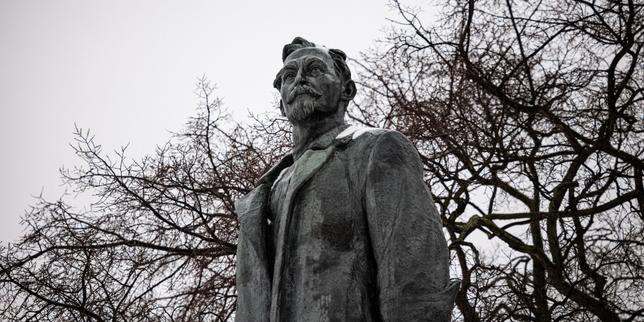
Vladimir Putin isn't just playing with history books anymore. He's rewriting the very soul of the Russian security state by dragging the ghosts of the Soviet past into the present. The recent "rehabilitation" of Felix Dzerzhinsky—the man who founded the Cheka and orchestrated the Red Terror—isn't a mistake or a historical quirk. It's a loud, clear signal about where Russia is headed. You don't put up statues of the man who invented the gulag system unless you're planning to use his methods.
When the statue of "Iron Felix" was unveiled at the SVR (Foreign Intelligence Service) headquarters in Moscow recently, it wasn't just a bronze monument. It was a coronation of a specific kind of violence. Dzerzhinsky wasn't a hero to the people; he was the architect of a system that purged "class enemies" with clinical efficiency. By bringing him back, the Kremlin is telling its modern agents that the old rules are the new rules.
The Iron Felix and the Birth of Systematic Terror
To understand why this matters, you have to know who Dzerzhinsky really was. He didn't just run a police force. He built a machine designed to liquidate anyone the state deemed a threat. In 1917, he founded the Cheka, the precursor to the NKVD and eventually the KGB. His philosophy was simple: "We stand for organized terror." He didn't hide it. He embraced it.
Under his watch, the Cheka executed tens of thousands of people without trials. They didn't care about guilt or innocence in the way we understand it today. They cared about "revolutionary necessity." If your existence was a problem for the Bolsheviks, Dzerzhinsky made sure you stopped existing. That's the legacy Putin is now polishing.
When the Soviet Union collapsed in 1991, one of the most iconic moments was the toppling of Dzerzhinsky’s statue in Lubyanka Square. It symbolized the end of a nightmare. People cheered as the crane lifted the heavy bronze figure. They thought the era of the secret police running the country was over. They were wrong. Today, the children of the KGB—the siloviki—are firmly in charge, and they want their patron saint back on his pedestal.
Why the Kremlin Needs a Dead Revolutionary Today
Putin’s Russia is currently fighting two wars. One is in Ukraine, and the other is at home against "internal enemies." This is where Dzerzhinsky becomes useful. The Kremlin is using his image to bridge the gap between the Russian Empire and the Soviet Union, creating a unified myth of a powerful, untouchable state.
It's a weird irony. Putin often blames Lenin for "creating" Ukraine, yet he celebrates the man who enforced Lenin's most brutal policies. This isn't about logical consistency. It's about power. By honoring Dzerzhinsky, Putin is validating the modern FSB’s crackdowns on journalists, activists, and anyone who dares to whisper a word against the "Special Military Operation."
I’ve watched this shift happen over years. It starts with a few mentions in textbooks. Then, a small bust in a provincial office. Finally, a massive monument at the heart of the intelligence service. It’s a process of desensitization. If you can make Dzerzhinsky respectable, you can make his tactics respectable too.
The Message to the Modern Siloviki
The siloviki—the elite security officials who make up Putin's inner circle—see themselves as the direct descendants of Dzerzhinsky’s Chekists. They don't see the Red Terror as a crime. They see it as a period of "state-building."
- They believe the state is everything.
- They view dissent as treason.
- They think law is a tool for the powerful, not a shield for the weak.
By rehabilitating "Iron Felix," Putin is giving these men a sense of historical destiny. He’s telling them that their current repression of the Russian public is part of a grand tradition. It's a way of saying, "You're not just thugs; you're the protectors of the Fatherland, just like Felix was." This psychological validation is crucial for maintaining loyalty within the ranks when things get messy.
The New Cult of the Secret Police
We're seeing a full-blown cult of the secret police emerging in Russia. It's not just statues. It's films, books, and public speeches that frame the early Soviet executioners as "ascetic monks" who sacrificed their lives for the greater good. They focus on Dzerzhinsky’s supposed incorruptibility—his nickname "Iron Felix" came from his discipline—while ignoring the blood on his hands.
This narrative is dangerous because it works. It appeals to a sense of order and strength. In a country that felt humiliated in the 90s, the image of a cold, efficient, and feared security apparatus is seductive. It promises stability at the cost of liberty. Most Russians aren't old enough to remember the actual terror, so they only see the curated version the Kremlin provides.
The International Implications of Russia’s History War
This isn't just a domestic Russian issue. When a nuclear-armed power begins idolizing the architects of mass terror, the world should pay attention. It signals a complete rejection of international norms regarding human rights and the rule of law.
If Russia views Dzerzhinsky as a hero, it’s basically saying it no longer recognizes the concept of "crimes against humanity" if they're committed in the name of the state. We see this play out in the way Russian forces operate abroad. The disregard for civilian life and the systematic use of filtration camps in occupied territories are straight out of the Cheka’s playbook. The tactics haven't changed much; only the technology has.
Mapping the Resurrection of Soviet Symbols
It's not just Dzerzhinsky. We've seen Stalin’s reputation undergo a massive makeover in the last decade. Monuments to the victims of the Great Purge are being removed or vandalized, while statues of the perpetrators are going up.
- 2021: Memorial, the group dedicated to documenting Soviet crimes, was shut down.
- 2023: New textbooks were released that downplay the scale of the gulags.
- 2024: The Dzerzhinsky statue at SVR headquarters is unveiled.
This is a systematic erasure of historical truth. If you control the past, you control the future. By wiping out the memory of the victims and elevating the executioners, Putin ensures there's no historical basis for criticizing his own authoritarianism.
How to Read Between the Lines
When you see reports of a new monument or a celebratory speech for a Soviet-era butcher, don't look at it as a history lesson. Look at it as a policy statement. The Kremlin is telling you exactly how it intends to treat its citizens and its neighbors.
The rehabilitation of Dzerzhinsky is an admission that the Russian state cannot survive without a climate of fear. It's a sign of weakness, not strength. A truly confident government doesn't need to dig up ghosts to keep its people in line.
If you want to understand where Russia is going next, stop listening to what they say in diplomatic meetings. Look at who they're building statues of. Those bronze figures tell the real story of Russia's future—a return to a dark, paranoid, and violent past that many hoped was gone for good. Pay attention to the local news coming out of Russian regions; when you see the small-town statues of Felix going up, you'll know the rot has reached the roots. Keep an eye on the curriculum changes in Russian schools too. That's where the next generation is being taught that "Iron Felix" is the model citizen. It's a grim transformation, but it's happening in plain sight.


