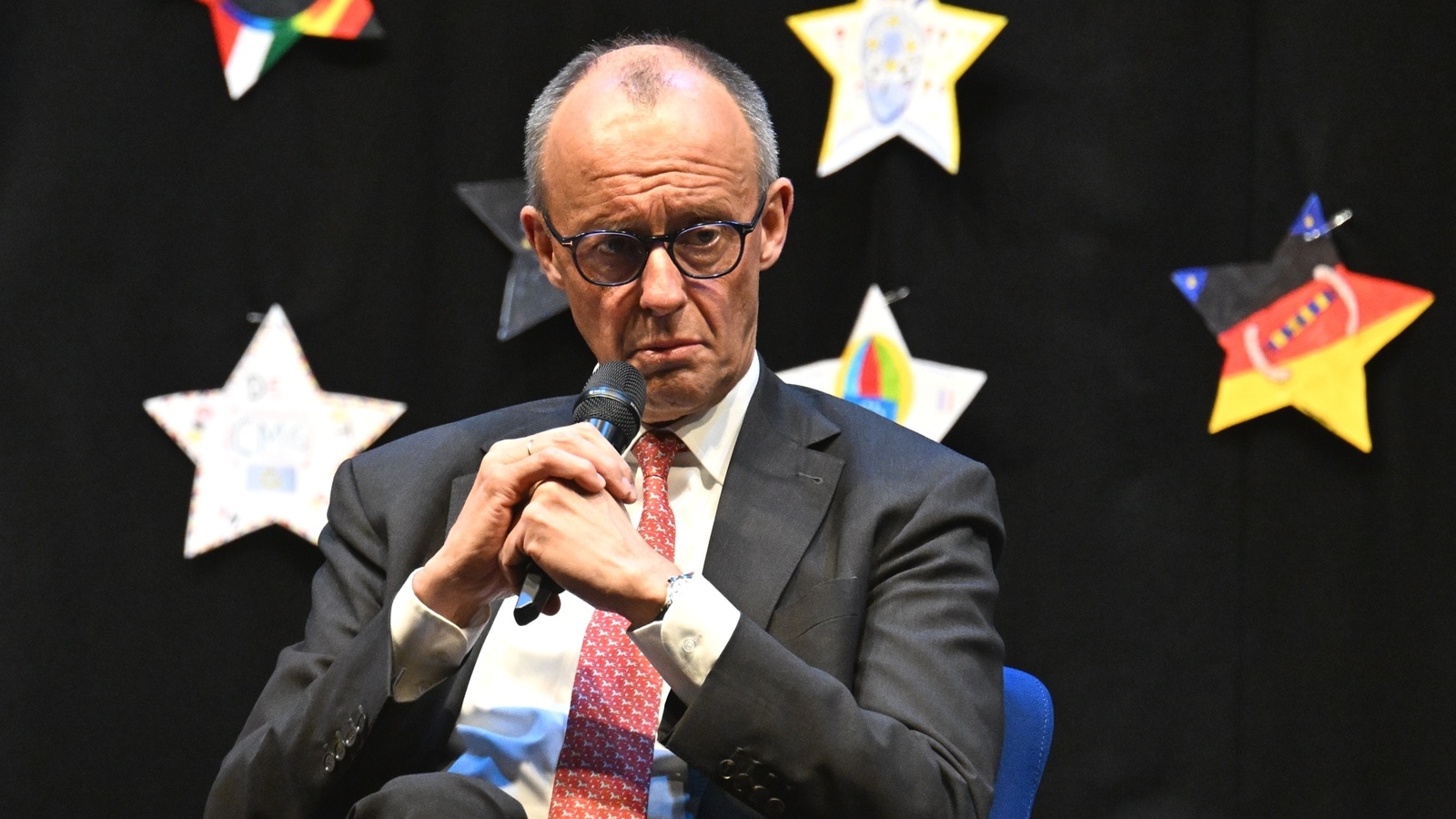
The air in the Chancellery in Berlin carries a different weight these days. It isn’t just the smell of old stone and polished wood; it is the friction of a continent trying to find its footing while the ground beneath it shifts. Friedrich Merz does not speak like a man who is interested in the polite fictions of traditional diplomacy. He speaks like a man who has watched a masterclass in deception and is tired of pretending he didn’t see the strings.
When Merz looks across the Atlantic toward Washington, and then toward the intricate, centuries-old labyrinth of Tehran, he sees a mismatch. It isn’t a mismatch of firepower or money. It is a mismatch of patience. To Merz, the United States has spent years playing a high-stakes game of checkers while the Iranians have been quietly perfecting a version of three-dimensional chess that the West struggles to even define.
He hasn't been shy about it. In his view, the Iranians are not just participating in negotiations; they are outplaying the Americans at every turn.
The Illusion of the Strongman
Consider the image of the boardroom table. We are taught to believe that the loudest voice, the one that bangs the fist and demands the "greatest deal in history," holds the power. Donald Trump operated on this frequency. His approach to Tehran was built on the architecture of the "maximum pressure" campaign—a blunt instrument designed to break the spirit of a nation through economic strangulation.
But pressure only works if the object you are squeezing has nowhere to go.
Merz’s critique of the failed Tehran talks isn't just a political jab; it is a fundamental observation of human psychology and geopolitical endurance. He watched as the previous American administration tore up the JCPOA, believing that a vacuum of diplomacy would lead to a surplus of submission. Instead, it led to a hardening.
The Chancellor sees the irony in the mockery. While the U.S. focused on the theater of the "deal," the Iranian negotiators focused on the clock. They know that American power is subject to the four-year cycle of the ballot box. They know that a policy written in ink today can be erased by a different pen tomorrow.
They waited. They pivoted. They outlasted.
A Hypothetical Walk Through the Bazaar
To understand what Merz is getting at, we have to look past the cold text of sanctions and enrichment percentages. Imagine a carpet merchant in a dusty corner of Isfahan. This is a hypothetical man, let’s call him Abbas, who has seen three different currencies lose their value in his lifetime.
When a Westerner enters Abbas’s shop, they usually want the best price immediately. They have a flight to catch. They have a schedule. Abbas, however, has all the time in the world. He offers tea. He talks about the weather, his ancestors, the intricate weave of the silk. He knows that the longer the Westerner stays, the more the Westerner’s internal clock begins to unravel. By the time they get to the price, the Westerner is exhausted, but Abbas is just getting started.
This is the "Velvet Trap." It is the art of using the opponent’s own restlessness against them.
Merz is signaling that the U.S. fell for the tea and the conversation. By walking away from the table and then trying to force a new one into existence, the U.S. gave the Iranians the most valuable commodity in the Middle East: a grievance that justifies expansion.
The Cost of the Mockery
The Chancellor’s recent remarks weren't just about the past; they were a warning for the future. When he mocks the "failed" talks, he isn't just laughing at a predecessor’s ego. He is mourning the loss of Western leverage.
Every time a deal is struck and then broken, the "Trust Deficit" grows. It is a mathematical reality. If we represent trust as a variable $T$, and the consistency of policy as $P$, the relationship can be viewed as:
$$T = \int_{t_0}^{t_1} P(t) dt$$
If $P$ drops to zero or goes negative, the integral of trust collapses. Merz understands that you cannot build a security architecture on a foundation of sand. The Iranians, he argues, realized long ago that the West’s internal divisions are their greatest asset. They don't need to defeat the U.S. military; they only need to wait for the U.S. to defeat its own foreign policy.
The "outplaying" isn't happening in secret bunkers. It’s happening in plain sight. It’s the way Tehran manages to maintain trade corridors with the East while the West debates which specific valve on a pipeline to shut off. It’s the way they’ve turned "maximum pressure" into "maximum self-reliance," however painful that has been for their own people.
The Human Stake in the High Offices
We often treat these stories as if they are about "nations," but nations don't make mistakes. People do.
Behind every failed summit is a group of weary aides in wrinkled suits, drinking lukewarm coffee at 3:00 AM, trying to find a word in a communiqué that satisfies a domestic base 5,000 miles away. Merz is pointing out that while the U.S. negotiators were looking at their Twitter feeds to see how the "deal" was landing with voters in Ohio or Florida, the Iranians were looking at the next thirty years.
There is a profound loneliness in the Chancellor’s position. He leads a Germany that is caught in the middle—a nation that needs energy, needs security, and needs a partner in Washington that doesn't change its mind every time the wind blows.
When he says the Iranians are outplaying the U.S., it’s a cry for a return to professional, boring, long-term statecraft. It’s an admission that the "art of the deal" is a poor substitute for the science of diplomacy.
The stakes aren't just numbers on a screen. They are the lives of sailors in the Strait of Hormuz. They are the families in Berlin wondering if their heating bills will spike because of a geopolitical tremor. They are the young people in Tehran who want a future that isn't defined by the cage of sanctions.
The Silent Room
In the end, the power of a leader isn't measured by the volume of their rhetoric, but by the silence they can command at the negotiating table. Merz is suggesting that the U.S. has become too loud to listen.
He sees a Washington that has forgotten how to be a "patient power." By mocking the failures of the past, he is attempting to shock the present into a state of awareness. He is tired of the theater. He is tired of the "failed" promises that leave Europe holding the bag.
The tragedy of the situation is that the trap is still open, and the tea is still warm. The question isn't whether the U.S. can win a fight, but whether it can survive a conversation that lasts longer than a news cycle.
As the sun sets over the Spree, casting long, jagged shadows across the Chancellery floor, the reality remains. The carpets are still being woven. The clock is still ticking. And the man in Berlin is no longer laughing.
The most dangerous thing about a velvet trap is that you don't realize you're caught until you try to leave.