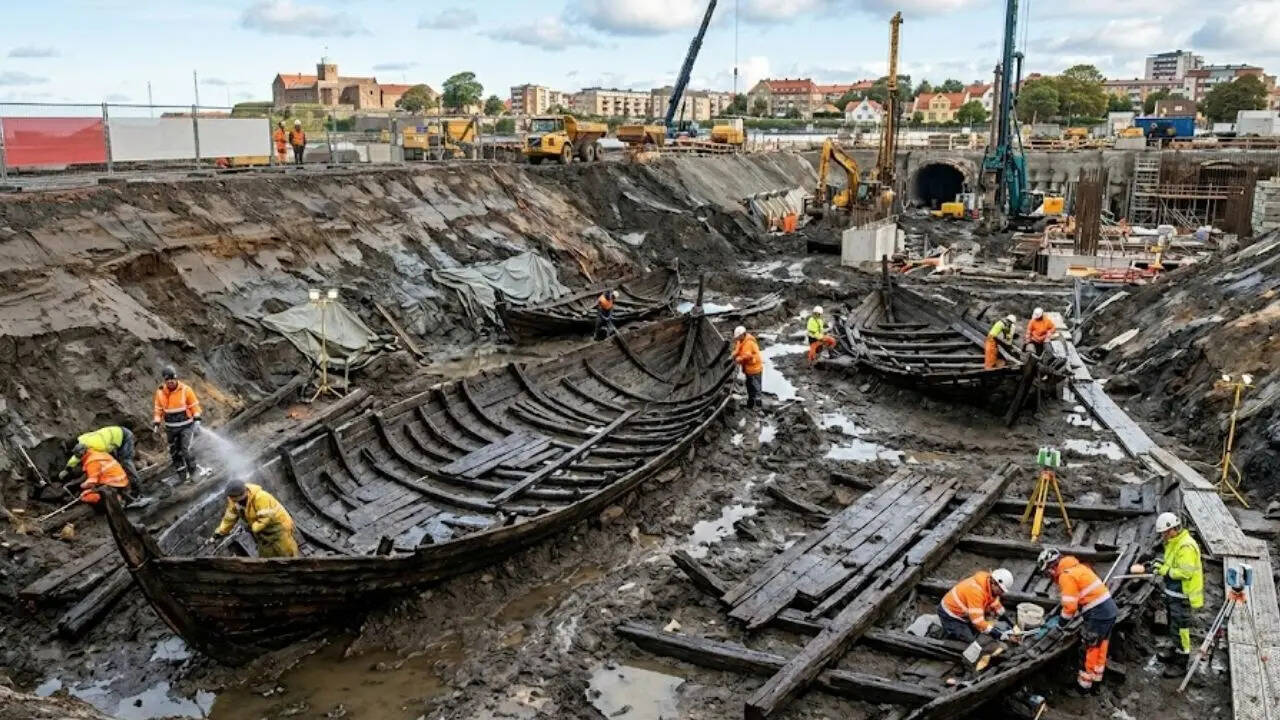
Construction crews working on the massive West Coast Line railway expansion in Varberg, Sweden, expected to move dirt and rock. Instead, they hit a graveyard of oak and iron. Over the past few years, the excavation of a new railway tunnel has unburied a staggering collection of six medieval ships, dating back as far as the 14th century. These vessels didn't sink in a dramatic ocean storm. They were found resting beneath what are now the city’s streets, trapped in the silt of a reclaimed shoreline that once served as a bustling commercial artery for Northern Europe.
The discovery presents a massive logistical headache for the Swedish Transport Administration (Trafikverket). While the archaeological world celebrates a find of this magnitude, the reality on the ground is a tense standoff between the preservation of national heritage and the relentless timeline of a multi-billion krona infrastructure project. This isn't just about old wood. It is a fundamental clash between where we are going and where we came from.
A Medieval Hub Frozen in Silt
Varberg has always been defined by its relationship with the Kattegat sea. During the 1300s and 1400s, this region was a critical node in the Hanseatic League’s trade network. The six ships found vary in size and purpose, but collectively they paint a picture of an era when Varberg was far more than a quiet coastal town. It was a chaotic, wealthy, and dangerous frontier of international commerce.
Archaeologists from Arkeologerna, part of the National Historical Museums in Sweden, have identified that these ships were likely abandoned or sank in the old harbor area, which was eventually filled in to expand the city. The preservation is eerie. Because the ships were encased in thick, oxygen-poor clay, the timber hasn't rotted away. We are seeing the tool marks of medieval shipwrights, the remains of cargo, and even the personal effects of the sailors who manned these decks.
The most significant find is a "cog"—a heavy, sturdy merchant vessel synonymous with medieval sea power. Cogs were the tractor-trailers of the Middle Ages. They were designed for volume, carrying everything from salt and cloth to timber and dried fish across the Baltic and North Seas. Finding one is rare. Finding several in one concentrated area suggests that the Varberg harbor was a high-traffic zone where ships were frequently repaired, scuttled, or lost to the shifting sands of the coast.
The Archaeology of Speed
The pressure on the archaeological team is immense. In Sweden, the law is clear: the developer pays for the archaeological excavation. In this case, the developer is the state, and the budget is public money. Every day the archaeologists spend brushing silt off a 600-year-old mast is a day the heavy machinery sits idle.
This creates an environment where "rescue archaeology" becomes a race against the clock. The team cannot afford the luxury of a decade-long study. They have to document, stabilize, and remove these massive structures in months, if not weeks. They use 3D photogrammetry to create digital twins of the wrecks before they are even lifted from the ground.
$D = \frac{M}{V}$
While the physics of displacement ($D$) determined how these ships floated centuries ago, the physics of modern logistics determines how they are handled now. If the wood dries out too quickly, it will warp and crumble into dust. The moisture held within the cellular structure of the oak must be replaced with a stabilizing agent, usually polyethylene glycol (PEG), a process that can take years in a laboratory setting. But when you have six ships and a railway schedule to meet, choices have to be made about which pieces are worth the multimillion-dollar conservation effort and which must be documented and then, unfortunately, destroyed or reburied.
Why the Soil Kept These Secrets
To understand why these ships are here, we have to look at the geomorphology of the Swedish coast. The land in this part of Scandinavia has been rising since the end of the last Ice Age—a process known as post-glacial rebound. As the land rose, the old medieval harbor became too shallow for newer, larger ships.
By the 16th and 17th centuries, the "old" Varberg was largely abandoned or built over as the city center shifted. The ships were left behind in the mud, which acted as a perfect seal. This clay prevented shipworms (Teredo navalis) from eating the wood. These mollusks are the primary reason why shipwrecks in the Caribbean or the Mediterranean are often nothing more than piles of ballast stones and pottery. In the cold, anaerobic mud of Varberg, the wood survived.
The excavation revealed that at least one of the ships had been intentionally weighed down with stones. This suggests it might have been used as a makeshift pier or a foundation for a wharf. This was common practice in medieval urban planning. If a ship was no longer seaworthy, it wasn't wasted. It became part of the city’s bones.
The Logistics of a 600 Year Old Problem
Moving a medieval shipwreck is not like moving a piece of modern wreckage. The timber is waterlogged and has the consistency of wet cardboard. If you lift it incorrectly, the entire structure will collapse under its own weight.
- Exposure: The site is carefully drained and the mud removed by hand and small tools.
- Scanning: High-resolution lasers and cameras map every centimeter of the vessel.
- Cradling: A custom steel or wood frame is built around the hull to provide support.
- Extraction: Large cranes lift the entire "package" out of the trench.
- Transportation: The wreck is moved to a climate-controlled facility where it is kept constantly wet.
The cost of this process is staggering. For the Swedish Transport Administration, these ships are "unforeseen geological obstacles," much like a pocket of unstable rock or an underground spring. But for the public, they are a non-renewable resource. You can always build another railway; you can never find another 14th-century cog once it has been crushed by a backhoe.
The Human Cost of Medieval Trade
Beyond the technical marvel of the ships themselves, the Varberg finds offer a grim look at the reality of medieval life. Preliminary analysis of the debris found within the hulls shows evidence of the harsh conditions these sailors endured. We find traces of pests, spoiled grain, and the meager possessions of men who lived their lives on the edge of a cold, unforgiving sea.
These ships were the engines of early globalization. The wealth they brought into Varberg allowed for the construction of the massive Varberg Fortress, which still dominates the skyline. The ships and the fortress are two sides of the same coin: one generated the wealth, and the other protected it.
A Comparison of Medieval Vessel Types Found
| Ship Type | Estimated Age | Primary Use | Notable Features |
|---|---|---|---|
| The Cog | 14th Century | Bulk Trade | Flat bottom, high sides, massive cargo capacity. |
| The Kraweel | 15th Century | Regional Trade | Carvel-built (flush) planks, more maneuverable. |
| Small Boat | 12th-16th Century | Fishing/Lightering | Used for moving goods from larger ships to the shore. |
The Conflict of Interest
There is a quiet tension between the archaeologists and the engineers. The engineers want to see the "Varberg Tunnel" completed by its 2025/2026 target. They see the ships as a fascinating delay, but a delay nonetheless. The archaeologists see the tunnel as a violent intrusion into a historical record that has remained undisturbed for six centuries.
The Swedish government has to balance these interests. The railway expansion is a key part of the "Go:West" initiative, aimed at improving the connection between Oslo and Copenhagen. It is a vital green infrastructure project intended to move freight off the roads and onto the tracks. To stop the project would be a massive blow to the region’s economic and environmental goals.
Yet, the discovery of six ships in one location is statistically improbable. It suggests that the entire "submerged" history of Sweden's west coast is far denser than previously thought. If six ships were found in this one stretch of track, how many hundreds more lie beneath the coastal cities of Halmstad, Falkenberg, or Gothenburg?
The Future of the Varberg Six
What happens to the ships now? Most will likely be documented and then "re-deposited." This is a polite term for burying them back in a controlled environment where they won't rot, but where they also won't be on display. The cost of preserving all six vessels for museum display would run into the hundreds of millions of dollars. Only the "Vasa" in Stockholm receives that kind of budget.
The most intact Cog might find a home in a museum, but the rest will exist only as digital files—millions of data points stored on a server, a ghostly recreation of a fleet that once commanded the waves.
This is the reality of modern archaeology. We are no longer in the age of "Indiana Jones" where every artifact is hauled off to a pedestal. We are in an age of data management. We extract the information, we save what is most critical, and we let the rest return to the earth so the trains can run on time.
The irony is thick. The medieval sailors of Varberg built these ships to move goods faster and more efficiently than their ancestors. They were the "high-speed rail" of the 1300s. Today, we are tearing through their remains to achieve that same goal for ourselves. We are not so different from the merchants who abandoned these hulls in the mud; we are both driven by the same demand for speed, regardless of what gets buried in the process.
The heavy machinery has already returned to the Varberg site. The oak ribs have been lifted, the clay has been cleared, and the concrete is being poured. The ghost fleet of Varberg has had its brief moment in the sun, a six-century hiatus from the dark, before being eclipsed once again by the shadows of a new city.