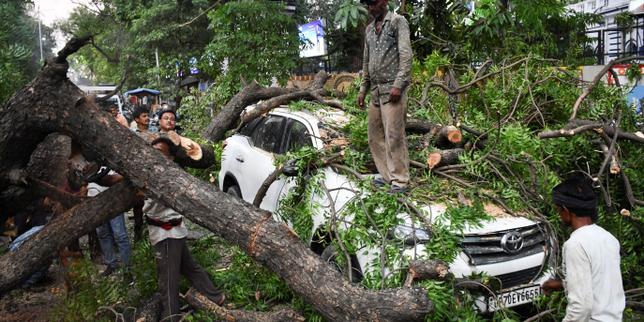
The death toll in Uttar Pradesh has reached a staggering 111 people following a series of brutal lightning strikes and intense rainstorms. This isn't just a "freak weather event" anymore. It's a recurring tragedy that exposes the fragile infrastructure and lack of early warning systems in India's most populous state. When the sky turns dark over the plains of Northern India, it isn't just rain that people fear. It’s the sudden, lethal discharge of electricity that kills dozens in a single afternoon.
Most of these victims weren't daredevils or thrill-seekers. They were farmers tending to their crops, laborers working in the open, and families living in mud-brick homes that offer zero protection against a direct strike. If you think lightning is a rare way to go, you haven't been paying attention to the data coming out of the Indo-Gangetic plain.
Why Uttar Pradesh keeps losing lives to lightning
It’s easy to blame nature, but that’s a cop-out. The high death toll in Uttar Pradesh is as much about socio-economics as it is about meteorology. Lightning is the leading cause of death by natural disasters in India, often outpacing floods and heatwaves. In this latest spell, districts like Jhansi, Ghazipur, and Varanasi bore the brunt of the atmospheric instability.
The physics is simple but the consequences are messy. As the pre-monsoon and monsoon fronts clash, high-moisture air rises rapidly, creating massive electrical potential. In a region where millions work outdoors and "shelter" often means standing under a tall tree—literally the worst place to be—the results are predictable. We aren't talking about one or two isolated incidents. We’re talking about 111 families shattered because they lacked the information or the physical infrastructure to stay safe.
State authorities have scrambled to announce compensation—usually around 400,000 rupees for the families of the deceased. It's a standard response. But cash after the fact doesn't fix the systemic failure of rural safety.
The deadly myth of the lone tree
One of the biggest killers in these storms is a lack of basic safety education. In rural UP, when the downpour starts, people run for cover. Often, the only cover available is a large, solitary tree in the middle of a field.
It’s a death trap.
Lightning follows the path of least resistance. A tall, wet tree is a perfect conductor. When it hits, the current doesn't just stay in the trunk. It spreads through the ground in what’s called "step potential." You don't even have to be touched by the bolt to die; just standing near the tree can stop your heart. This is a common mistake I see reported every single year, and it’s one that could be solved with better grassroots communication.
The failure of the early warning system
India actually has some pretty sophisticated weather tracking. The Damini app, developed by the Indian Institute of Tropical Meteorology, is designed to give users a 15-minute heads-up before lightning strikes their area.
But there’s a massive gap.
How many small-scale farmers in rural Ghazipur have a smartphone with a stable data connection and an app running in the background? Not enough. The "last mile" of communication is broken. If the warning stays on a server in Pune and never reaches the guy with a plow in a field, it’s useless. We need more than apps. We need physical sirens, radio broadcasts, and village-level alerts that don't rely on 5G signals.
Infrastructure that actually protects
Most modern buildings in cities have lightning rods. They’re cheap and they work. But in the villages of Uttar Pradesh, they’re almost non-existent. Public buildings like schools and panchayat bhawans (village council halls) should be the gold standard for storm safety. They aren't.
If we can build massive highway networks across the state, we can certainly afford to mandate lightning conductors on every government-funded structure. It's a low-tech solution that saves lives. Instead, we spend millions on disaster relief after the damage is done. It's backwards.
Climate change is upping the ante
It’s not your imagination; the storms are getting worse. Rising global temperatures mean the atmosphere can hold more moisture. More heat means more energy. More energy means more frequent and more violent electrical storms.
The India Meteorological Department (IMD) has been tracking a steady increase in lightning activity over the last decade. The "lightning season" is expanding. We’re seeing these events happen earlier in the year and with much higher intensity. This 111-death toll is a warning shot. If the state doesn't adapt its disaster management strategy to account for this increased volatility, these numbers will become the new normal.
What you should actually do when caught outside
If you're caught in an open field and you feel your hair stand on end or your skin tingle, you're in immediate danger. Don't run. Don't lie flat on the ground.
- Squat low: Keep your feet together and tuck your head.
- Minimize contact: The goal is to have as little of your body touching the ground as possible.
- Stay away from water: Do not stand in puddles or near irrigation channels.
- Avoid metal: Drop the tools, the umbrellas, and stay away from fences.
These are simple rules. They’re the difference between a close call and a fatality. But again, these rules need to be part of a massive, state-wide education campaign, not just a footnote in a news report.
Stop treating weather like a surprise
We know the storms are coming. We know which districts are most vulnerable. Treating 111 deaths as an "unavoidable tragedy" is an insult to the victims. The Uttar Pradesh government needs to move beyond the cycle of "storm, death, compensation."
Real progress looks like installing lightning arresters in every village. It looks like integrating weather alerts into local mosque and temple loudspeakers. It looks like teaching every schoolchild exactly what to do when the sky starts to rumble.
Don't wait for the next "red alert" from the IMD to think about storm safety. If you live in an area prone to these strikes, take the initiative now. Retrofit your home with a grounding system. Educate your neighbors. The state might be slow to act, but your safety shouldn't be dependent on a government check. Protect your property, secure your roof, and for heaven's sake, stay away from the trees when the clouds roll in.