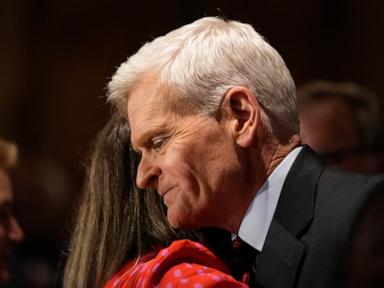
The political media establishment loves a neat, tragic narrative. The current darling of the pundit class is the fable of Louisiana Senator Bill Cassidy: the principled conservative who dared to vote to convict Donald Trump, tried to play nice afterward, and was promptly crushed by the gears of partisan retribution.
It is a beautiful, clean story. It is also entirely wrong.
Mainstream commentary looks at Cassidy’s censures by his local party, his plummeting poll numbers among base voters, and Trump’s public venom, and concludes that Cassidy is a cautionary tale about the futility of moderation. They see a man stranded in no-man's-land, rejected by the MAGA faithful and ignored by the left.
They are misreading the entire board.
What the consensus views as a failed attempt at reconciliation is actually something far more calculating. Cassidy did not stumble into a trap; he executed a textbook maneuver in long-term political diversification. In a system obsessed with the next twenty-four hours, Cassidy is playing an entirely different game. The narrative of his "retribution" ignores the brutal, transactional reality of modern senate mechanics.
The Myth of the Omnipotent Primary
Let’s dismantle the foundational premise of the Cassidy tragedy: the idea that a gubernatorial or senatorial career ends the moment the populist wing of a party turns on you.
Pundits look at poll numbers from local Republican parish committees and see a political death warrant. Having advised campaigns navigating these exact waters, I can tell you that local party committees do not equal the electorate. A censure from a state GOP committee is a press release; it is not a ballot.
The conventional wisdom dictates that Cassidy’s post-impeachment behavior—voting for the Biden administration's infrastructure bill, working across the aisle—was a desperate, failed olive branch to appease a furious base. This is a fundamental misunderstanding of political leverage. Cassidy knew the base was gone the second he cast that impeachment vote. He wasn't trying to win them back. He was building an alternative coalition.
Look at the mechanics of the 2021 Infrastructure Investment and Jobs Act. The lazy critique is that Cassidy gave Joe Biden a win while gaining nothing but a target on his back. The reality? Cassidy secured billions for Louisiana infrastructure, specifically targeting coastal restoration and flood mitigation—existential issues for his state's business elite.
By doing this, Cassidy secured the one thing that actually keeps a non-populist Republican alive: the donor class.
Politicians do not just run on grassroots enthusiasm. They run on capital. While the loudest voices in the party were screaming for his head, the people who write the checks—the energy executives, the shipping magnates, the real estate developers who actually drive Louisiana's economy—were locking arms behind him. He traded cheap rally applause for hard, institutional financial backing.
Why 'People Also Ask' Questions Are Fundamentally Flawed
If you look at what voters are searching regarding this dynamic, the questions themselves expose the delusion of the public consciousness.
- Can a Republican survive a Trump endorsement of their opponent?
- Why did Bill Cassidy vote to convict?
- Is the moderate Republican dead?
The premise of these questions is flawed because they treat "survival" as a purely ideological metric.
Can a Republican survive without Trump? Ask Brian Kemp in Georgia. Ask Lisa Murkowski in Alaska. Survival is not about ideological purity; it is about local structural insulation. Kemp survived because he built a formidable ground game and delivered on core economic policies that mattered to Georgians, making Trump's grievance look provincial. Murkowski survived because Alaska’s ranked-choice voting system insulated her from a hyper-partisan primary.
Cassidy’s vote to convict was not a moral spasm. It was a calculated risk based on the assumption that institutional memory lasts longer than a populist news cycle. He bet that by the time he faced voters again, the immediate emotional high of January 2021 would be superseded by concrete, material outcomes.
To answer the final question bluntly: The moderate Republican is not dead, but the naive moderate Republican is. The ones who survive are the ones who understand that moderation is not a philosophy—it is a weapon. You do not compromise out of the goodness of your heart; you compromise when it buys you structural immunity from your own party's extremes.
The High Cost of the Contrarian Strategy
It would be dishonest to suggest this strategy comes without a cost. It is a grueling, high-wire act that most politicians do not have the stomach for.
When you break from the tribal consensus, you lose the safety net of the party apparatus. You will not get the soft-ball interviews on cable news primetime. You will not have the national fundraising emails blasting out on your behalf to millions of small-dollar donors. You are entirely on your own, forced to build a bespoke political machine from scratch.
Imagine a scenario where the national political winds shift even slightly more toward the extremes during a primary year. The corporate donors who patted you on the back in an off-year suddenly get terrified of a boycott. They quiet down. Their checks get smaller. Suddenly, your calculation fails because the capital market proved just as cowardly as the political electorate.
That is the downside. If you miscalculate the timing, you do not just lose an election; you become a political pariah, mocked by the side you left and distrusted by the side you tried to court.
The Institutionalist’s True Target
But Cassidy’s real target isn't the governor's mansion in Baton Rouge or even a permanent seat in the Senate. The real prize for a figure like Cassidy is institutional staying power within a fractured legislative body.
In a Senate split down the middle, power does not belong to the loudest ideologues on the wings. It belongs to the microscopic group of senators in the center who are willing to cross the aisle. When the margin of error is a single vote, a single senator becomes a shadow kingmaker.
By establishing himself as someone who can break from his party on constitutional questions but still negotiate hard-nosed economic policy, Cassidy elevated his utility. He made himself indispensable to any legislative agenda that requires a filibuster-proof majority. Every major piece of bipartisan legislation now has to run through his office.
The media calls that retribution. Inside the halls of power, we call that leverage.
Stop looking at political survival through the lens of viral tweets, primary censures, and Mar-a-Lago press releases. Those are metrics for influencers, not lawmakers. Bill Cassidy didn't get played by the system. He looked at the structural incentives of the modern Senate, realized that a permanent minority of ideologues cannot govern, and staked his entire career on the reality that eventually, the shouting stops and the bills have to be paid.
The establishment thinks he's a martyr. The joke is on them; he's the one holding the ledger.