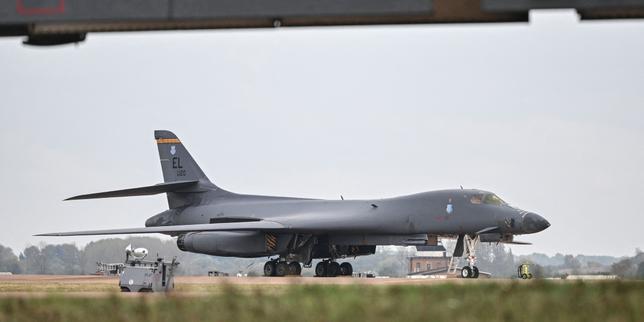
The mainstream media spent the last month hyperventilating over the Pentagon yanking its B-1 bombers out of RAF Fairford and stripping tankers from Mildenhall. Headlines screamed about a compromised perimeter, an alarming breakdown in British counter-terrorism, and an intelligence failure of catastrophic proportions.
It is a comforting narrative for armchair defense analysts who love a juicy spy thriller. It assumes that a few arrests outside the fence line panicked Washington into tucking tail and flying back across the Atlantic.
They have got it completely backwards.
I have watched defense procurement and strategic redeployments for decades, and panic rarely looks this clean, this fast, or this orderly. What we witnessed was not a frantic retreat from an exposed outpost. It was a calculated operational deception that exposed the utter obsolescence of fixed European air bases while setting up a much larger chess move.
Stop viewing this through the lens of local perimeter security. Start viewing it through the brutal math of modern long-range strike capabilities.
The Fixed Base Fallacy
For eighty years, military planners treated British installations like Fairford and Mildenhall as permanent unsinkable aircraft carriers. During the Cold War, that made sense. You packed squadrons close to the European theater to shorten response times against Warsaw Pact armor.
That logic died quietly years ago, yet military officialdom clung to it like a security blanket. Fixed infrastructure is a liability in an era of hypersonic proliferation, precision telemetry, and asymmetric domestic infiltration. If you park a dozen multi-billion-dollar supersonic bombers on a tarmac three hours outside London, you have built a high-value bullseye.
The security incident involving suspected operatives linked to the Islamic Revolutionary Guard Corps was treated by the press as the primary catalyst for the withdrawal. But let us be honest about statecraft: perimeter breaches happen at military installations globally every single week. They rarely trigger an immediate, trans-oceanic redeployment of an entire heavy bomber squadron unless the Pentagon wanted an excuse to move those assets anyway.
Washington did not pull out because it was terrified of a local cell with a barrel of petrol. Washington pulled out because maintaining a static, high-profile footprint in the UK provides diminishing returns while anchoring strategic flexibility to a vulnerable geographic anchor.
The Real Cost of Hosting US Power Projection
Let us talk about the political friction nobody wants to acknowledge. London wants the prestige of being America’s primary unsinkable platform without bearing the diplomatic and physical blowback of active Middle Eastern interventions. When British Prime Minister Andy Burnham insists that domestic bases remain totally safe while quietly fielding threats from foreign intelligence services, the theater of alliance management becomes exhausting.
The UK government finds itself trapped between an American ally running aggressive long-range operations and a domestic populace increasingly unwilling to absorb the security externalities of those wars.
By abruptly clearing out Fairford and Mildenhall, the Pentagon effectively called Whitehall’s bluff. The message sent behind closed doors was unambiguous: if the host nation cannot guarantee an ironclad, foolproof defensive shield against localized sabotage, the assets simply evaporate. And when American air power evaporates from British soil, the UK loses its seat at the table where real targeting decisions are made.
The Pivot to Distributed Lethality
The future of global power projection does not rely on parking twelve B-1s in Gloucestershire waiting for a localized threat vector to materialize. It relies on dynamic force employment—dispersing aircraft across austere locations, moving targets constantly, and making enemy intelligence synchronization an impossibility.
When you scatter tankers to Germany, Spain, and Scotland, and send strategic bombers back to continental US bases from which they can still reach any theater via rapid global refuelers, you throw sand into the gears of adversary targeting loops. An adversary cannot map a static vulnerability if the asset footprint morphs every forty-eight hours.
The real story here is not that a British air base was compromised by an amateur plot. The real story is that the era of fixed European forward operating bases for heavy strategic strike is drawing to a close, replaced by a hyper-mobile doctrine that treats traditional host nations as temporary landlords rather than permanent partners.
The next time Washington pulls out of an allied base under the guise of an immediate security threat, look past the local police blotter. Look at the global chessboard. They aren't running away. They're just clearing the board for something faster.