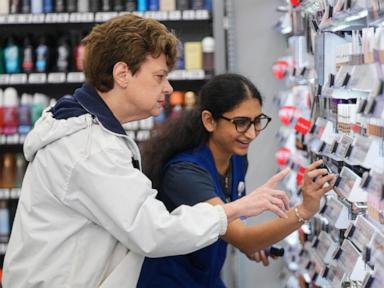
Walmart’s deployment of in-store beauty experts represents a fundamental shift from a high-volume, low-friction retail model toward a high-engagement, service-oriented ecosystem. This is not a branding exercise; it is a calculated attempt to capture the "Value-Added Basket" by neutralizing the primary competitive advantage held by specialty retailers like Sephora and Ulta. By introducing human expertise into the aisle, Walmart aims to solve the Discovery Gap—the psychological barrier that prevents mass-market shoppers from purchasing premium, high-margin skincare and cosmetic products due to perceived technical complexity or risk of incorrect selection.
The Margin Expansion Thesis
Walmart’s traditional dominance rests on the efficient distribution of commodities. However, beauty and personal care operate on a different economic logic. While grocery margins are famously razor-thin, prestige beauty products can command gross margins exceeding 60%. The bottleneck for Walmart has never been supply or pricing; it has been the Trust Deficit.
Standard retail logic dictates that as price increases, the need for tactile verification and expert validation increases linearly. A consumer will buy a $5 shampoo based on brand recognition alone. A $45 anti-aging serum, however, requires a different conversion mechanism. By placing trained experts on the floor, Walmart is attempting to internalize the following value drivers:
- Reduction of Return Rates: High-end cosmetics suffer from high return rates when purchased without consultation, as shade matching and skin-type compatibility are high-variance factors. Expert intervention lowers the cost of "bad fit" returns.
- Basket Composition Shifts: Experts are trained in "regimen building"—the practice of moving a customer from a single SKU purchase (a cleanser) to a multi-SKU routine (cleanser, toner, serum, SPF). This increases the Average Order Value (AOV) without requiring additional foot traffic.
- Cross-Category Conversion: A shopper entering for household staples who engages with a beauty expert is effectively being "upsold" into a different margin bracket, maximizing the lifetime value of a single store visit.
The Labor-Utility Tradeoff
The introduction of specialized labor into a "no-frills" environment creates a complex cost-benefit equation. In a standard Walmart model, labor is an operational expense focused on replenishment and checkout speed. In the beauty expert model, labor becomes a Capital Investment in conversion.
The success of this initiative depends on the Conversion Delta—the difference between the sales generated by an unassisted aisle versus one staffed by an expert. For the model to be sustainable, the beauty expert must generate enough incremental margin to cover their higher-than-average hourly wage plus the opportunity cost of the shelf space dedicated to more complex products.
The Three Pillars of In-Store Conversion
- Diagnostic Authority: The expert must possess the technical knowledge to diagnose a customer’s specific needs (e.g., hyperpigmentation vs. dehydration). Without this, they are merely "greeters" who add cost without adding value.
- Brand Agnosticism: To maintain trust in a mass-market environment, the expert must appear to prioritize the customer’s outcome over a specific brand's sales quota. This is a delicate balance in a retail space often subsidized by "slotting fees" from major manufacturers.
- Operational Integration: The expert cannot operate in a vacuum. They must be supported by "smart" shelving, testers, and inventory depth. A successful consultation that ends in an "out of stock" notification is a net negative ROI event due to the sunk labor cost.
Defending Against the Digital Migration
The "Amazon Effect" has historically hit the beauty sector less hard than electronics or books because of the "Trial Barrier." Consumers want to smell, touch, and see pigments before they commit. However, as Augmented Reality (AR) try-on tools improve, the physical store’s advantage shrinks.
Walmart’s deployment of humans is a counter-move against digital parity. While an algorithm can suggest a lipstick shade based on a photo, it cannot provide the Affective Labor—the emotional reassurance and physical demonstration—that drives high-ticket sales.
This strategy also addresses the "Showrooming" threat. By providing immediate expert gratification and the ability to walk out with the product, Walmart short-circuits the customer’s tendency to research in-store and purchase online later. The expert acts as a "Closing Agent" for the transaction.
Structural Risks and the Scale Paradox
Implementing a service-heavy model across a footprint of thousands of stores introduces significant execution risk. Walmart’s greatest strength—scale—becomes its primary obstacle in maintaining quality control.
- The Talent Scarcity Problem: There is a finite pool of skilled beauty consultants. Competing with specialty boutiques for this talent requires Walmart to either pay a premium or invest heavily in internal training. If the quality of advice drops, the "Expert" label becomes a liability, damaging the brand's credibility in the premium space.
- The Friction of the "Fast-Trip" Shopper: Walmart’s core demographic often values speed. An expert intervention that slows down the shopping trip might be perceived as a nuisance rather than a service. The physical layout must allow for "Passive Discovery" (looking at products) and "Active Consultation" (talking to an expert) to coexist without impeding traffic flow.
- Incentive Misalignment: If beauty experts are measured on traditional retail KPIs like "units per hour," they will fail. Their value is qualitative and long-term. Measuring the ROI of this program requires sophisticated data attribution—linking an in-store consultation today to a repeat purchase three months from now.
The Competitive Response and Market Re-segmentation
As Walmart moves "up-market" with service, specialty retailers are forced to respond. This creates a squeeze on mid-tier department stores. Walmart has the advantage of High-Frequency Foot Traffic; people go to Walmart for milk, not just mascara. By intercepting the beauty consumer during their routine errands, Walmart creates a "Convenience Moat" that Sephora or Ulta cannot easily replicate.
However, the "No-Frills" legacy is a heavy weight. The physical environment of a Walmart—bright fluorescent lighting, industrial flooring, and loud intercoms—is the antithesis of the "Spa-like" luxury environment where premium beauty thrives. The success of the beauty expert depends on their ability to create a "Micro-Climate" of luxury within a warehouse-style box.
Strategic Requirement: Data-Driven Personalization
To outclass competitors, Walmart must leverage its vast transaction data to empower these experts. An expert equipped with a tablet that shows a customer’s purchase history across all categories could provide a level of personalization that a beauty-only retailer cannot.
For instance, knowing a customer buys organic groceries could lead an expert to recommend "clean" beauty brands. This Full-Spectrum Customer View is the "unfair advantage" Walmart holds. If they fail to integrate their data with their human experts, they are simply running a 1990s-style department store counter in a 2020s retail environment.
The Final Strategic Play
The transition to in-store beauty experts is the first phase of a broader "Service-as-a-Product" strategy. For this to yield a permanent competitive advantage, Walmart must move beyond the "Consultant" role and into "Clinical Validation." This involves partnering with dermatological brands to offer basic skin analysis services that go beyond mere sales.
The objective is to transform the beauty aisle from a shelf into a destination. If Walmart can successfully bridge the gap between "Discount Giant" and "Trusted Advisor," they will not only capture the beauty market but create a blueprint for expanding into other high-margin, high-complexity categories like pharmacy-adjacent wellness, consumer electronics, and home optimization. The metric of success is not the number of experts hired, but the shift in the Margin-per-Square-Foot of the beauty department relative to the rest of the store. Failure to achieve a 15-20% lift in this metric within 24 months would indicate that the labor cost is outstripping the conversion value, necessitating a return to a tech-first, human-light model.