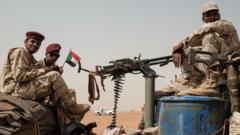
The brutal proxy war in Sudan is running on foreign fuel, and everyone in the diplomatic community knows exactly where the pipeline originates. For years, the United Arab Emirates managed to keep its fingerprints relatively smudge-free while pouring support into Africa’s most devastating modern conflict. It relied on shell companies, vague humanitarian missions, and plausible deniability. That cover story just completely shattered.
A damning investigation by Human Rights Watch lays bare an elaborate pipeline channeling private military contractors directly from South America to the frontlines of Darfur. The UAE isn't just an interested bystander or a source of back-channel funding. The Gulf monarchy has operated as a foundational logistics hub and training ground for foreign mercenaries bound for Sudan's Rapid Support Forces. If you enjoyed this article, you should check out: this related article.
If you want to understand why Sudan’s civil war keeps grinding forward despite international condemnation, you have to look at the covert network operating out of Abu Dhabi.
The Colombian Pipeline Operating Under Abu Dhabi's Nose
The mechanics of this mercenary network read like a geopolitical thriller, but the consequences on the ground are horrific. According to investigative data, hundreds of seasoned Colombian military veterans were funneled through a highly coordinated international recruitment web. They didn't just stumble into Sudan. They were actively recruited, processed, and trained by a network deeply intertwined with Emirati infrastructure. For another look on this event, refer to the recent update from Al Jazeera.
Human Rights Watch tracked these fighters from Colombia directly to military installations inside the UAE. Contractors spent time training at a major military base in the Al Dhafra region, located about 250 kilometers west of Abu Dhabi, as well as another facility inside the capital city itself. They weren't hiding in the shadows; they were utilizing state-adjacent facilities to hone skills before entering a war zone.
From these Gulf bases, the pipeline splits into specialized logistical routes. One heavily utilized transit point is the port city of Bossaso in Somalia's Puntland state. It’s a region where the UAE holds immense sway, having funded and managed the Puntland Maritime Police Force for well over a decade. Mercenaries arrived in Bossaso on commercial flights, holed up in fortified underground bunkers, and were then shuttled via private, unstamped flights back through Emirati military facilities like Ghiyathi before deployment to Sudan.
Weapons Training and Child Soldiers in Darfur
The Colombians weren’t brought in as low-level infantry. The RSF hired them for specialized, high-tech combat roles. The Sentry and UN expert panels have identified these foreign fighters operating heavy artillery, driving armored vehicles, and piloting the advanced drone fleets that have terrorized Sudanese cities.
Worse yet, their responsibilities extended to training the next generation of cannon fodder. A Colombian contractor detailed his time training fresh RSF recruits in camps surrounding Nyala, the provincial capital of South Darfur. He noted that a staggering number of those recruits were young children.
The entity pulling the strings on the ground is the Abu Dhabi-based Global Security Services Group. This private security firm has been linked directly to Mohamed Hamdan Alzaabi, a prominent Emirati national who maintains close business ties with high-ranking UAE government officials. The corporate trail moves from Abu Dhabi through recruitment agencies like the International Services Agency in Colombia, with salaries paid out via offshore accounts managed by a Panama-registered entity called Global Staffing. It’s an engineered system designed specifically to obscure financial liability.
The Fallout of the Fall of El Fasher
The true horror of what this mercenary network unlocked became undeniable during the siege of El Fasher, the capital of North Darfur. The city fell to the RSF after an 18-month campaign defined by starvation tactics, relentless drone strikes, and indiscriminate shelling.
UN-commissioned experts stated that the assault bore the distinct hallmarks of genocide. When the RSF finally breached the city, the aftermath was a slaughterhouse. At least 6,000 people were massacred in a span of just three days. Human Rights Watch verified video footage from the ground showing Spanish-speaking, Colombian mercenaries actively fighting alongside RSF units during the height of the atrocities.
The combat assistance provided by these foreign contractors directly accelerated the collapse of local defenses. They gave a brutal paramilitary group the technical edge required to execute a systematic campaign of ethnic cleansing, mass executions, and widespread sexual violence.
Blanket Denials Meet Smoking Guns
The official response from the UAE’s Foreign Ministry follows a predictable, well-worn script. They categorically reject the allegations. They claim the UAE doesn't permit its territory to be used for recruiting, financing, or transiting foreign fighters. They argue that any rogue individual doing so is acting without state authorization and violating domestic law.
Honestly, nobody is buying it anymore. The scale of the operation makes the "rogue actor" theory entirely unbelievable. You don't move hundreds of foreign military contractors through highly secure military bases like Al Dhafra, orchestrate unstamped private flights through state-monitored ports, and process millions of dollars in international corporate payments without the highest levels of state awareness.
This isn't the first time the UAE's denials have fallen apart under scrutiny. Battlefields across Sudan have yielded physical evidence that shatters Abu Dhabi's claims of neutrality:
- Captured Emirati-manufactured armored vehicles outfitted with European defense systems.
- Authenticated flight logs showing dozens of cargo flights landing in Amdjarass, Chad, ostensibly delivering humanitarian aid but actually offloading crates of Kalashnikovs and ammunition for the RSF.
- Actual Emirati passports recovered from RSF-controlled battlefields, pointing to direct, on-the-ground coordination.
The evidence is overwhelming. Western nations, particularly the US, the UK, and the European Union, have spent years treating the UAE as an indispensable security and economic partner in the Middle East. Because of that relationship, they've largely looked the other way while Abu Dhabi fuels a humanitarian catastrophe that has displaced over 12 million people and pushed millions more to the brink of famine.
International rights groups are completely done with the diplomatic soft-footing. The immediate next step requires a massive shift in foreign policy from global powers. If you want to stop the bloodshed in Darfur, you have to cut off the supply lines running through the Gulf. This means enforcing immediate, targeted sanctions against entities like Global Security Services Group, freezing the assets of facilitators like Mohamed Hamdan Alzaabi, and conditioning future Western arms sales to the UAE on a total, verifiable cessation of all support to the RSF. The era of accepting blanket denials in the face of absolute proof must end.