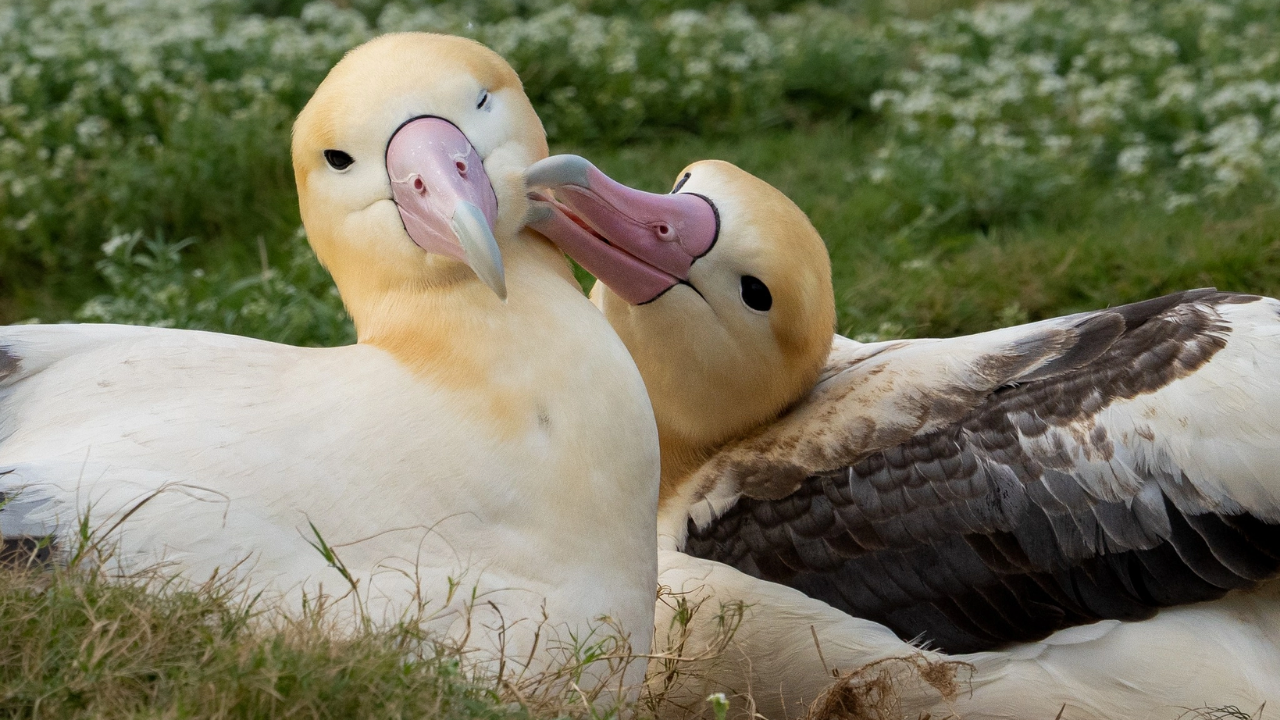
Two vulnerable short-tailed albatrosses have successfully raised five chicks on Midway Atoll, and their earlier offspring are now returning to the same remote Pacific island to establish a new breeding colony. This multi-year biological milestone proves that social attraction techniques can pull a seabird species back from the brink of localized extinction when its primary ancestral nesting ground sits atop an active volcano.
Wildlife biologists spent decades watching the world's remaining short-tailed albatrosses cluster dangerously on Torishima, a Japanese volcanic island prone to catastrophic eruptions and landslides. Relying on a single unstable rock in the Pacific was an ecological gamble with terrible odds. By luring a single pair to Midway Atoll National Wildlife Refuge and watching them rear five consecutive chicks—with older siblings now returning to prospect for mates—conservationists have finally cracked the code on assisted colonization for long-lived pelagic birds.
The Torishima Trap and the Logic of Backup Colonies
To understand why five chicks on a tiny coral atoll matter so much, you have to look at the brutal math of seabird survival. Short-tailed albatrosses (Phoebastria albatrus) were slaughtered by the millions in the late nineteenth and early twentieth centuries by feather hunters supplying the global millinery trade. By the late 1940s, the species was declared extinct. A handful of birds survived only because they were out at sea during the final hunts, returning years later to the barren volcanic slopes of Torishima.
Conservation efforts on Torishima worked remarkably well at boosting raw numbers, yet they created a severe geographic bottleneck. Having the overwhelming majority of a species breed on one active volcano violates every principle of risk management. A single major eruption during the winter breeding season could wipe out a massive percentage of the adult breeding population in a matter of hours.
Midway Atoll, located roughly 1,300 miles northwest of Honolulu, offered an obvious geographic hedge. The atoll sits far outside the volcanic blast zone of the Izu Islands, features flat coral sand safe from volcanic mudslides, and already supports the largest Laysan albatross colony on Earth. Biologists knew from historical bone middens that short-tailed albatrosses once visited the Hawaiian archipelago. Getting them to stay and breed was another problem entirely.
How Biologists Tricked Pelagic Instincts With Resin and Speakers
Albatrosses are creatures of extreme philopatry, a biological drive that compels them to return to the exact patch of dirt where they hatched. You cannot simply catch adult albatrosses, drop them on a new island, and expect them to build a nest. They will immediately take flight and cross thousands of miles of open ocean back to their natal colony.
To overcome this hardwired loyalty, the U.S. Fish and Wildlife Service deployed a classic ornithological deception known as social attraction. Biologists placed life-sized, hand-painted resin decoys of short-tailed albatrosses along the northern edge of Eastern Island at Midway Atoll. They paired the decoys with solar-powered sound systems broadcasting recorded courtship calls—the distinct groans, clacks, and whinnies that signal a thriving, safe breeding ground to passing birds.
The strategy relied on a simple behavioral quirk. Young, pre-breeding albatrosses spend years wandering the North Pacific before choosing a nest site. While they strongly favor their birthplace, they are also drawn to the visual and acoustic cues of an active colony, which subconsciously signals protection from predators and reliable access to marine food webs.
It took years of patience. Transient birds landed, inspected the silent plastic statues, and flew away. Then, a specific male and female—identified by their unique leg bands—found each other among the decoys. They bypassed the biological urge to return to Japan, built a scrape in the coral sand, and laid a single egg.
Five Chicks and the Slow Mathematics of Albatross Generations
Unlike songbirds that pump out multiple clutches every spring, short-tailed albatrosses operate on a glacial reproductive timeline. A breeding pair lays just one egg per year. If that egg fails, they do not lay another until the following autumn. Both parents must share incubation duties for roughly two months, followed by five months of grueling foraging flights to feed a single, rapidly growing chick.
Raising five chicks across consecutive seasons means this lone Midway pair achieved near-flawless reproductive execution in an environment fraught with hazards. Consider what those two birds had to navigate every single year:
- Thermal stress on exposed, low-lying coral sand where shade is scarce compared to their ancestral Japanese slopes.
- Marine plastic ingestion, a pervasive threat across the North Pacific garbage patch where foraging adults accidentally scoop up bottle caps and lighter fragments while skimming for squid.
- Longline fishing fleets, whose baited hooks still pose a lethal drowning risk to diving seabirds despite the widespread adoption of streamer lines.
- Storm surges, which increasingly wash over the low elevations of the Northwestern Hawaiian Islands during winter swells.
Each chick that fledged from Midway carried a crucial biological imprint. Because they hatched on Eastern Island, Midway—not Torishima—became their natal home.
Why Returning Offspring Change the Conservation Equation
A single breeding pair is a curiosity; returning offspring represent the birth of a self-sustaining population. Short-tailed albatrosses spend their first four to six years entirely at sea, never touching land while their flight feathers mature and they master the art of dynamic soaring across ocean winds. When those five Midway-born chicks finally felt the pull to return to land, their internal compasses pointed straight back to the Northwestern Hawaiian Islands.
Biologists monitoring the colony have documented these banded offspring landing back on Midway, strutting through the grass, and engaging in practice courtship dances. In seabird biology, this phase is called prospecting. Young birds return to their natal island for several seasons before they actually pair up and breed, learning the local geography, testing potential mates, and establishing territory.
This generational loop solves the biggest weakness of human-led wildlife management. Decoys and speakers require constant maintenance, battery replacements, and funding cycles. Live, returning birds do the recruitment work for free. Every Midway-hatched bird that lands on Eastern Island acts as a living beacon to other wandering sub-adults passing over the Pacific, dramatically increasing the odds that unrelated short-tailed albatrosses will drop in, pair with the Midway natives, and expand the genetic pool.
The Unspoken Risks of Low-Lying Atolls
Celebratory press releases often gloss over the long-term vulnerabilities of moving a species from a volcano to a coral atoll. While Midway protects the birds from magma and ash, it exposes them to a slower, equally relentless threat: sea-level rise and intensifying Pacific storms.
Eastern Island sits only a few feet above the high-tide line. During severe winter storms, ocean waves already overtop the beaches and flood low-lying nesting areas, drowning eggs and newly hatched chicks of Laysan and black-footed albatrosses. Moving short-tailed albatrosses to Midway is a brilliant medium-term insurance policy, buying the species decades of demographic stability, yet it is not a permanent sanctuary if ocean levels continue to climb at current projections.
Genetic diversity presents another quiet hurdle. Because the Midway outpost started with a single founding pair, researchers must carefully track who pairs with whom as the five offspring reach sexual maturity. If the first generation of returning chicks breeds exclusively with each other, the fledgling colony risks a localized inbreeding bottleneck. Conservationists are actively watching for unbanded or Japanese-banded visitors to join the Midway flock to ensure healthy gene flow between the western and central Pacific populations.
What Wildlife Agencies Must Do Next to Lock In the Gains
The success on Midway provides a clear operational blueprint, yet replicating it requires discipline rather than complacency. Translocation and social attraction projects frequently fail when agencies declare victory early and pull funding the moment the first chicks fledge.
To turn five chicks into five hundred breeding pairs, conservation managers must maintain three strict priorities on Midway Atoll:
- Predator eradication vigilance: Midway recently fought a brutal, multi-year campaign to eliminate invasive house mice that had begun attacking and scalping nesting adult albatrosses. Even a single reintroduced rodent could wipe out a nascent short-tailed albatross colony overnight.
- High-ground nest site preparation: Biologists must continue placing decoys and acoustic lures on the highest, most storm-resistant elevations of the atoll rather than letting birds settle near vulnerable shorelines.
- International bycatch enforcement: Protecting birds on the breeding grounds means nothing if they are killed at sea. Regulatory pressure on North Pacific pelagic longline fisheries to maintain strict bird-scaring protocols remains the single most decisive factor in adult survival rates.
Two birds proved that an ancient migratory instinct can be redirected with patience, fiberglass models, and recorded bird calls. The return of their offspring proves the birds have accepted the new address, leaving the survival of this fledgling dynasty entirely dependent on whether humans can keep the island safe and the surrounding ocean clear of hooks and plastic.


