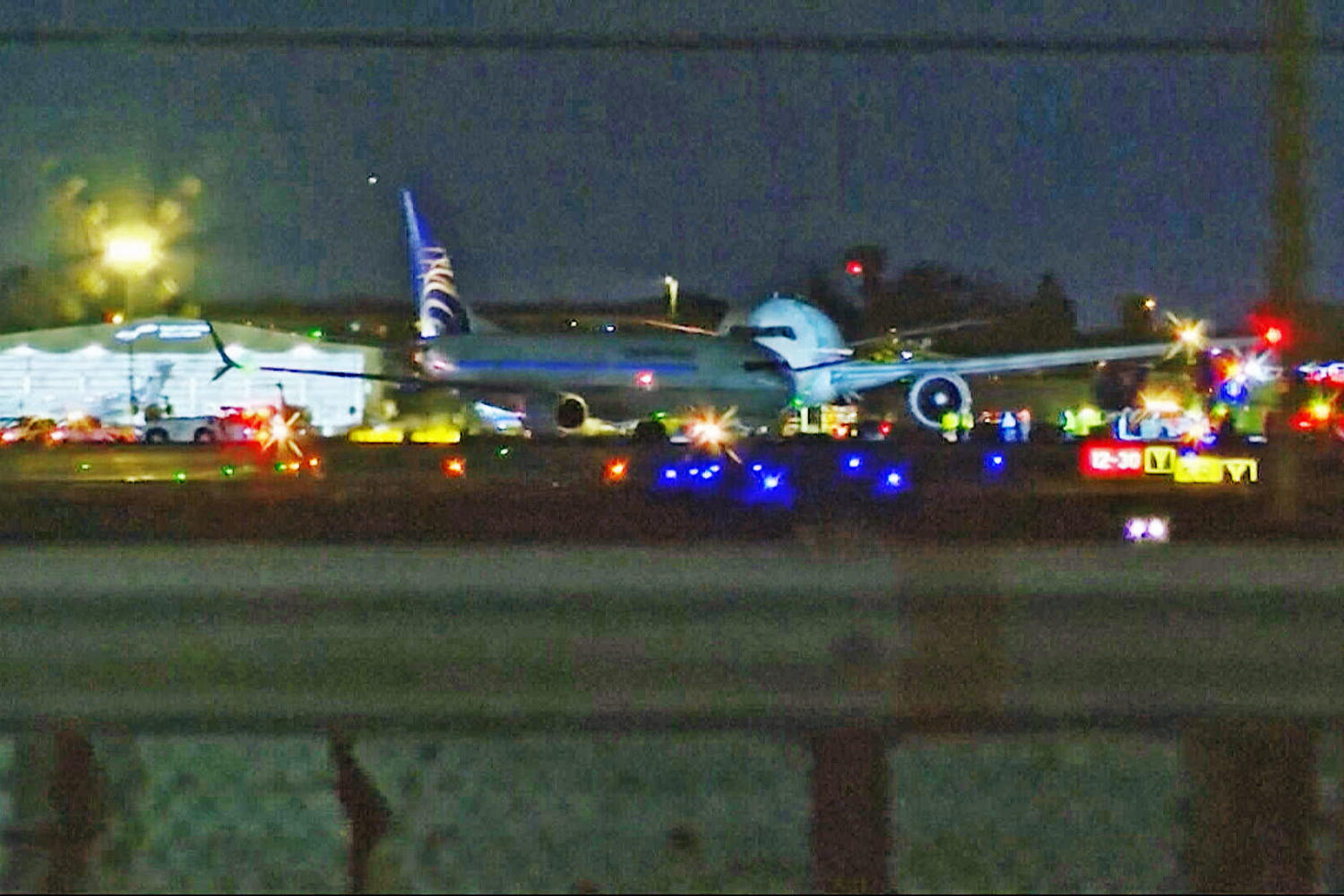
Two people sustained injuries when two commercial aircraft collided on a taxiway at Miami International Airport, exposing the mounting strain on ground control operations at one of America's busiest aviation hubs. While minor wingtip scrapes occur periodically across major global terminals, an incident resulting in passenger or crew injuries signals a more severe breakdown in surface separation protocols, spatial awareness, or air traffic coordination during peak pushback windows.
Local emergency responders transported the two injured individuals to area medical facilities following the low-speed impact on the tarmac. Neither aircraft was airborne at the time, as both were maneuvering between terminal gates and active departure runways. Federal aviation investigators immediately secured the scene to examine cockpit voice recorders, surface movement radar logs, and ground controller communications to establish which crew or controller deviated from cleared taxiway routing.
The Anatomy of a Tarmac Collision
People assume the most dangerous phase of flight happens at thirty-five thousand feet. They are wrong.
The modern airport ramp is a chaotic, tightly choreographed ballet of multi-ton aluminum tubes, fuel trucks, baggage carts, and pushback tugs operating within feet of one another. At Miami International Airport, this choreography faces relentless pressure from a physical footprint hemmed in by surrounding urban infrastructure and a schedule dominated by synchronized international connecting waves. When dozens of widebody and narrowbody jets push back simultaneously to meet strict departure slots, the margins for error shrink to inches.
Ground collisions rarely stem from a single catastrophic mistake. Instead, they emerge from a chain of minor compromises. A pilot glances down to verify a revised weight-and-balance sheet while rolling past an intersection. A ground controller, managing fifteen active frequencies at once, issues a rapid-fire hold-short instruction that sounds identical to a clearance given seconds earlier. Painted yellow centerlines become obscured by tire rubber deposits, tropical rain glare, or aging asphalt markings.
Consider a hypothetical example of how an intersection incursion unfolds on a busy south terminal ramp. Aircraft A receives clearance to taxi straight ahead on a primary parallel taxiway toward the departure threshold. Simultaneously, Aircraft B finishes pushback from an adjacent alley and receives instructions to hold short of that exact intersection. If Aircraft B's flight crew misinterprets the hold point—perhaps mistaking an intermediate service road marking for the taxiway hold line—their nose or wingtip encroaches into the active lane. Because modern jet cockpits sit high above the tarmac and offer zero rear or extreme peripheral visibility, neither crew sees the impending contact until the structural impact jolts the cabin.
Why Injuries Happen at Low Speeds
A collision at fifteen knots does not sound violent until you account for mass and sudden deceleration. A fully fueled commercial airliner weighs anywhere from eighty to over three hundred tons. When a wingtip shears into a vertical stabilizer or a fuselage section, the kinetic energy transfers instantaneously through the airframe.
Inside the cabin, passengers and flight attendants are frequently unbuckled during early taxi phases. Flight attendants are standing in the aisles conducting safety demonstrations, securing galley carts, or checking overhead bins. Passengers are shifting in their seats or reaching for personal items. A sudden lateral jolt throws standing crew members violently against bulkheads or armrests, turning a minor structural fender-bender into a medical emergency.
Miami International Airport and the Infrastructure Bottleneck
Miami is not merely another domestic hub. It serves as the primary aviation gateway between North America, Latin America, and the Caribbean, handling massive volumes of both passenger traffic and heavy international freight.
Over the past decade, passenger numbers and cargo movements at Miami International Airport have surged far faster than concrete could be poured. While terminal concourses have undergone periodic renovations, the underlying airfield geometry—the network of taxiways, aprons, and ramp alleys—remains constrained by decades-old design parameters. Newer generations of aircraft feature wider wingspans designed to maximize fuel efficiency, yet they are routinely routed through taxi lanes originally engineered for smaller, older jets.
This mismatch creates persistent wingspan clearance bottlenecks. When an aircraft with a wider wingspan navigates a legacy taxiway, ground controllers must dynamically restrict adjacent lanes, effectively reducing the airport's surface capacity every time a heavy jet moves. During afternoon thunderstorms—a daily reality in South Florida for much of the year—ground stops trap dozens of inbound and outbound flights on the tarmac simultaneously. Once the lightning clears and the ramp reopens, the resulting rush to clear the backlog pushes human controllers and flight crews to their cognitive limits.
The Technology Gap on the Tarmac
Airborne commercial aviation operates under layers of automated collision avoidance. If two planes converge in the sky, Traffic Alert and Collision Avoidance System (TCAS) computers inside both cockpits communicate directly and issue urgent, unmistakable climb or descend commands.
On the ground, that safety net largely disappears.
While major airports utilize surface surveillance radar systems—such as Airport Surface Detection Equipment, Model X (ASDE-X)—to track transponders and ground vehicles, these systems primarily alert tower controllers rather than the pilots sitting behind the controls. A warning chime in the control tower still requires a human controller to spot the conflict on a screen, key a microphone, call out the correct callsign, and wait for the pilot to comprehend the instruction and apply the brakes. Those four or five seconds of latency are often the exact window in which a collision occurs.
Aviation safety advocates have spent years pushing for widespread deployment of cockpit moving-map displays equipped with real-time traffic overlays and automated runway/taxiway incursion alerts. Yet equipping legacy fleets with upgraded avionics requires massive capital expenditure and lengthy regulatory certification cycles. Until direct-to-cockpit surface alerting becomes standard across every commercial airliner, pilots remain reliant on out-the-window visual scanning, paper or tablet charts, and voice radio readbacks—tools fundamentally unchanged since the mid-twentieth century.
The Human Factor and Controller Fatigue
You cannot examine surface incidents without confronting the staffing crisis inside air traffic control facilities. Across the United States, certified professional controllers have faced chronic understaffing, mandatory six-day workweeks, and rotating shift schedules that disrupt circadian rhythms.
Tower and ground controllers at high-density facilities operate in an environment of sustained high-stakes vigilance. Unlike en-route controllers who monitor aircraft separated by miles of empty sky, ground controllers manage dozens of moving objects separated by wingspans. Fatigue degrades short-term memory and narrows auditory attention, increasing the likelihood that a controller misses a subtle readback error—where a pilot repeats back the wrong taxiway identifier without catching their own mistake.
Pilots face parallel pressures. Tight turnaround schedules leave minimal buffer time between gate arrival and departure pushback. Flight crews work rapidly through pre-departure checklists, programming flight management computers, reviewing weather updates, and coordinating with ground handlers while the aircraft is already moving. Dividing attention between head-down avionics programming and head-up visual taxiing remains one of the single highest risk factors in modern airline operations.
Regulatory Accountability and What Investigators Look For
Following a tarmac collision involving injuries, the National Transportation Safety Board (NTSB) and the Federal Aviation Administration (FAA) launch parallel inquiries. Their investigation avoids speculation and zeroes in on hard physical and digital evidence.
- Surface Movement Radar Replay: Investigators reconstruct the exact second-by-second trajectory, ground speed, and heading of both aircraft using tower radar logs to determine if either crew strayed off the painted centerline.
- Air Traffic Control Audio Transcripts: Every transmission on ground and ramp frequencies is analyzed to verify whether clearances were unambiguous, properly acknowledged via standard phraseology, and issued with sufficient reaction time.
- Cockpit Voice and Flight Data Recorders: The Cockpit Voice Recorder (CVR) reveals whether the flight crews were distracted by non-essential conversation—violating Sterile Cockpit Rules—or overwhelmed by late load-sheet revisions during taxi.
- Ramp Markings and Lighting Inspections: Engineers inspect the specific intersection for faded paint, burned-out taxiway centerline lights, or confusing signage that could induce visual illusions, particularly at night or on wet pavement.
- Ramp Control Jurisdictional Boundaries: At many major airports, the airline manages the immediate gate apron while FAA tower controllers manage the main taxiways. Investigators examine the exact handoff point between airline ramp operators and federal controllers, a notorious gray zone where overlapping authority frequently breeds confusion.
The Structural Fix Airlines and Airports Resist
Preventing the next tarmac collision requires changes that disrupt schedules and cost money, which is precisely why the industry hesitates to adopt them.
First, airlines must enforce strict head-up taxi policies. No crew member should be programming flight computers, calculating takeoff performance numbers, or reviewing company messages while the aircraft is in motion. If last-minute paperwork arrives during taxi, the captain must bring the aircraft to a complete stop, set the parking brake, and resolve the administrative task before resuming movement.
Second, airport authorities must eliminate split-jurisdiction ramp operations where airline employees and federal controllers share overlapping patches of concrete without unified surface radar integration. A single, integrated command structure with shared real-time positional data removes the dangerous handoff gaps between gate pushback and active taxiways.
Finally, regulators must mandate direct-to-cockpit surface conflict alerting across commercial fleets, bringing ground collision prevention up to the same technological standard that has virtually eliminated mid-air collisions over the past three decades. Without structural reform to tarmac infrastructure, controller staffing, and cockpit alerting technology, two injured travelers in Miami will remain a predictable symptom of an overcrowded system pushed past its design limits.