Salt does not just dry your skin; after sixty days in an open ocean, it turns your memory into chalk.
If you have ever stood on the bow of a small craft three hundred miles past the sight of the nearest lighthouse, you know the specific, hollow silence that settles into your ribs when the engine coughs once and dies. It is not the cinematic panic of a Hollywood shipwreck. It is quieter. Worse. It is the sudden realization that the horizon—that flat, unbroken razor line separating water from sky—is no longer a destination you are steering toward, but the walls of a room you cannot leave.
When news broke of an eighty-six-year-old sailor and his dog plucked alive from the Pacific after drifting for months, most wire services treated it like a quirk of meteorology and grit. A man. A boat. A pet. A rescue. Check the boxes, file the copy, move on to the next election cycle.
They missed the real story entirely.
Because surviving the Pacific at eighty-six is not an athletic feat, and it isn't a miracle dropped from a clear sky. It is a slow, brutal negotiation between human biology, maritime physics, and the fierce, irrational stubbornness of two creatures who refused to let the other die alone.
The Myth of the Romantic Horizon
We like our ocean stories tidy. We want Ernest Hemingway’s noble struggle or the tidy arithmetic of survival manuals—catch rainwater, eat raw mahi-mahi, keep your head covered, wait for the shipping lane.
Out there, the Pacific laughs at manuals.
Covering more than sixty million square miles, the Pacific is larger than all of Earth’s dry land combined. To drift across its central or eastern currents without propulsion is like dropping a single toothpick into a swimming pool the size of Texas and hoping a lifeguard trips over it. When a storm snaps your mast or salt corrosion chews through your fuel lines, you do not "sail" anywhere. You become cargo. You belong to the North Equatorial Current, the windage of your own hull, and the slow, grinding mathematics of drift.
Consider what happens next to a body that has already seen eight decades of gravity.
At eighty-six, human skin is thin as onion paper. Thermoregulation—the body's internal furnace—no longer fires on command. Nighttime temperatures on the open water can plunge twenty degrees below the blistering afternoon glare, pulling core heat out of an older man’s bones while spray soaks his clothes. Every muscle twitch burns calories you cannot replace. Every blister from a salt-stiffened rope threatens a systemic infection miles away from a single tube of antibiotic ointment.
And yet, he didn't fold.
Why?
What Kept the Pulse Going
If you talk to search-and-rescue coordinators from Honolulu to San Diego, they will tell you about the "will-to-live curve." Statistically, solo castaways face a silent killer long before dehydration stops their kidneys: cognitive surrender. Around week three, when the horizon refuses to change and the sound of slapping hull water becomes an endless, mocking metronome, the human brain begins to turn inward. People stop collecting dew. They stop checking the tarp. They lie down in the cockpit and simply wait for the dark.
Now add twenty pounds of warm fur, four wet paws, and a pair of brown eyes watching your every move.
To understand how an octogenarian outlasted the Pacific, look at the dog. Not as a cute footnote for the evening broadcast, but as an anchor.
In behavioral psychology, there is a well-documented phenomenon among isolated survivors—whether prisoners of war, polar explorers, or lost mariners—where responsibility for a dependent shifts the brain out of panic and into duty. When you are alone, skipping a ration of warm, plastic-tasting rainwater feels like a mercy to yourself. When a small dog is licking salt off its paws and looking at you because you are the entire universe of its survival, skipping that ration is betrayal.
Every morning became a ritual. Check the canvas catchments for condensation. Divide the water—not in half, because an eighty-six-year-old body requires roughly two liters a day just to keep blood from thickening like syrup, while a small dog needs ounces—but with the precision of a pharmacist. Rig a scrap of sailcloth for shade before the ten-o'clock sun turns the fiberglass deck into a griddle. Catch whatever curiosity swam close enough to the hull: small flying fish stranded on deck at dawn, barnacles scraped from the rudder, maybe a stray dorado lured by the shadow of the drifting hull.
That shadow, by the way, is a well-known ecological trick on the open ocean. Any floating object—a log, a buoy, a crippled thirty-foot sloop—becomes an instant artificial reef. Algae grows first. Baitfish gather to nibble the algae. Larger predators circle the baitfish. A drifting boat doesn't just float through a desert; if you know how to read the water beneath your keel, it carries a tiny, moving pantry with it.
Still, knowing the theory and executing it with arthritic fingers while the deck pitches thirty degrees in a cross-swell are two different worlds.
The Invisible Arithmetic of Drifting
Let’s strip away the romance for a second and look at the brutal mechanics of what this pair actually endured.
Imagine, as a grounded thought experiment, trying to sleep on a hardwood floor while someone tilts it violently every four seconds, splashing cold saltwater in your face every twenty minutes, for ninety consecutive nights. That is life aboard a disabled monohull in open ocean swells. Without a functioning rudder or steady sail trim, a boat turns beam-on to the waves—broadside—rolling sickeningly from gunwale to gunwale.
Sleep never comes in eight-hour blocks. It comes in twenty-minute fragments snatched between lurches.
Your kidneys begin to bargain with you. Mild chronic dehydration thickens the blood, forcing an eighty-six-year-old heart to pump harder against rising vascular resistance. Salt crusts in your ears, behind your knees, inside the creases of your elbows, chafing skin raw until seawater feels like battery acid. Your tongue swells slightly. Words lose their edges because you haven't spoken to another human being since the last garbled transmission died on your VHF radio weeks ago.
Except he did speak.
Any mariner who has sailed single-handed knows you talk to your boat, your coffee mug, and the gulls. With a dog aboard, you have a congregation. You narrate the clouds. You argue with the wind. You apologize when the rainwater cup comes up short, and you celebrate like you’ve won the lottery when a tropical squall finally breaks over the masthead, filling buckets with sweet, sky-fallen fresh water that tastes like heaven itself.
Why Nobody Found Them Sooner
People always ask the same question when a rescue like this hits the headlines: With satellites, GPS, and modern coast guards, how does a boat vanish for months?
It is a fair question, and the answer exposes a quiet truth about how fragile our modern safety net really is.
We live under an illusion of total surveillance. Because our phones track our steps to the nearest coffee shop, we assume the oceans are watched with the same hawk-eyed precision. They aren't.
Commercial shipping lanes are narrow highways cut across an immense wilderness. Step fifty miles off the great-circle route between California and Hawaii, or drift south into the doldrums near the Intertropical Convergence Zone, and you enter an empty quarter where weeks pass without a single mast or smokestack breaking the line of the sea. Satellites do not scan the ocean in real time looking for white thirty-foot fiberglass hulls; white hulls look identical to whitecaps from four hundred miles up.
Unless an Emergency Position Indicating Radio Beacon—an EPIRB—is registered, charged, and actively pinging a 406-megahertz distress signal to orbiting satellites, searchers are hunting a needle in a haystack that moves twenty miles a day. Batteries corrode in marine air. Antennas snap when booms swing wild in a gale. And at eighty-six, a sailor who grew up navigating by sextant, paper charts, and dead reckoning often trusts his own seamanship far more than a plastic box with a lithium battery.
Pride is a heavy anchor. Sometimes it keeps you steady; sometimes it holds you underwater.
The Sighting
Rescue, when it finally comes out there, rarely looks like a triumphant parade.
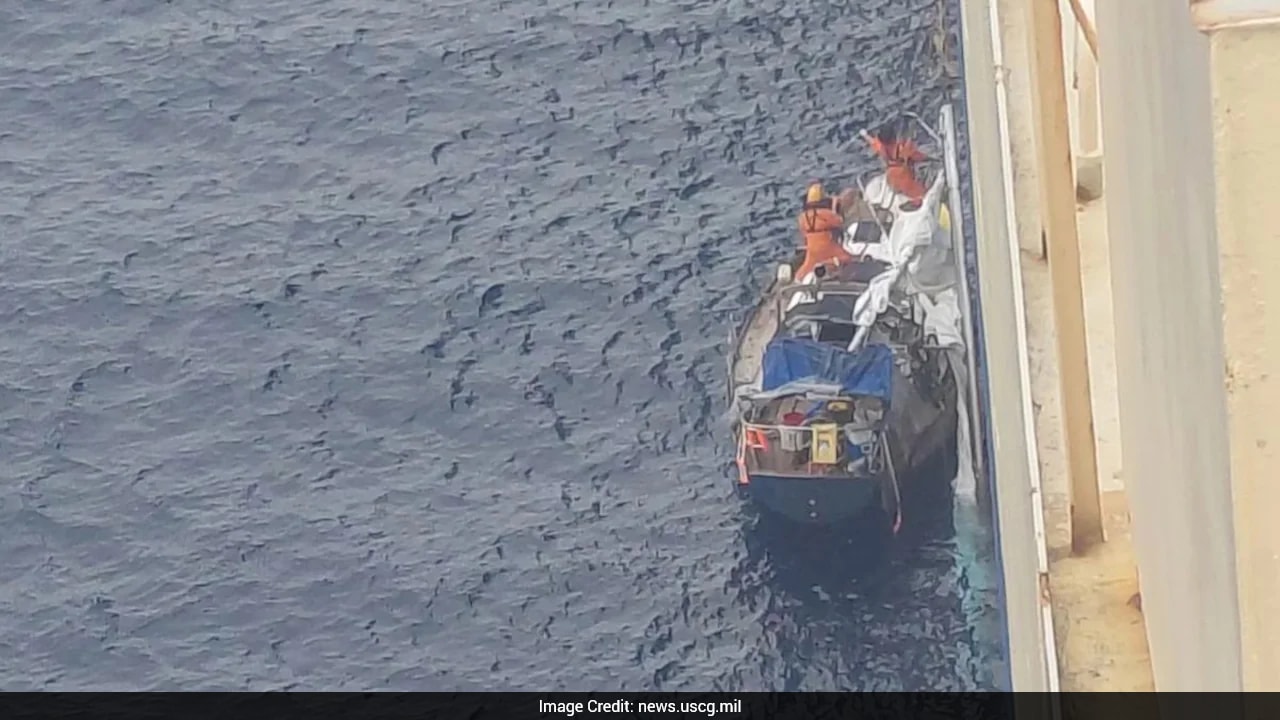
A lookout on a commercial vessel—or a spotter plane running a grid—catches a flash of unnatural geometry against the endless chaos of blue waves. A straight line where nature only draws curves. A faded patch of canvas. A frail figure waving a shirt or flashing a mirror, flanked by a small dark silhouette barking furiously at a wall of steel rising six stories out of the water.
When rescuers pull a man like that onto a deck, they have to move with agonizing care. You cannot hand a severely dehydrated octogenarian a gallon of ice water or a plate of hot food. Rapid rehydration can trigger fatal electrolyte shifts; sudden standing after months of lying low in a pitching cockpit can drop blood pressure so fast the brain blacks out. Medics wrap them in foil blankets, run slow intravenous lines into veins flattened by months of fluid loss, and check the dog’s gums for capillary refill.
And almost universally, the survivor asks about the animal before he asks where he is.
What the Wire Stories Left Out
We live in an era obsessed with optimization. We track our sleep scores, argue over longevity supplements, and treat aging like a technical glitch to be engineered away in Silicon Valley labs.
Then an eighty-six-year-old man drifts across the Pacific on nothing but stubbornness, rainwater, and devotion to a dog, and reminds us what actual durability looks like.
Durability isn't pristine youth. It isn't having the newest satellite messenger or the strongest back in the marina. True durability is psychological ballast—the deep, quiet weight in the bottom of your hull that keeps you upright when every wave tries to roll you upside down. For this sailor, that ballast had four paws and a wet nose pressed against his ribs through the coldest hours before dawn.
Somewhere in a coastal hospital ward, the IV lines eventually came out. The salt washed out of his hair. The dog ate real kibble from a steel bowl that didn't slide across the floor with every swell.
Yet if you ask anyone who has ever survived the open sea what stays with them afterward, they won't talk about the storms, the hunger, or the headlines. They will tell you about the quiet nights when the wind dropped, the stars came down close enough to touch, and the only sound in ten thousand square miles of darkness was a steady, rhythmic breathing curled warm against their side.